

Two of the most popular coffee brewing methods Pour Over vs Drip Filter where the fundamental mechanics of both seem identical on the surface.
Each method uses gravity to draw heated water down through a bed of ground coffee, and both rely on a paper or metal filter to clear out sediment, delivering a clean cup.
However, treating manual pour-over cones and automated electric drip machines as interchangeable setups is a major mistake.
The structural difference lies entirely in the level of control you possess over fluid dynamics, water distribution, and temperature tracking.
Choosing between them determines whether your morning cup captures delicate, high-definition flavor clarity or provides standardised, everyday convenience.
Where were the Pour Over and Drip Filters Origins?
The development of gravity-driven filtration represents a century-long evolutionary line balancing home craft with industrial electrical mechanics. The manual pour-over framework was born in Dresden, Germany, in 1908 when an innovative housewife named Melitta Bentz punctured a brass pot and utilized a scrap of paper from a school exercise notebook to create the world’s first paper filter container. This manual breakthrough completely dominated the landscape until 1954, when inventor Gottlob Widmann patented the Wigomat in Germany, introducing the world’s very first automated electric drip coffee maker.
What is the Mechanical Difference Between Pour-Over and Drip Filtration?
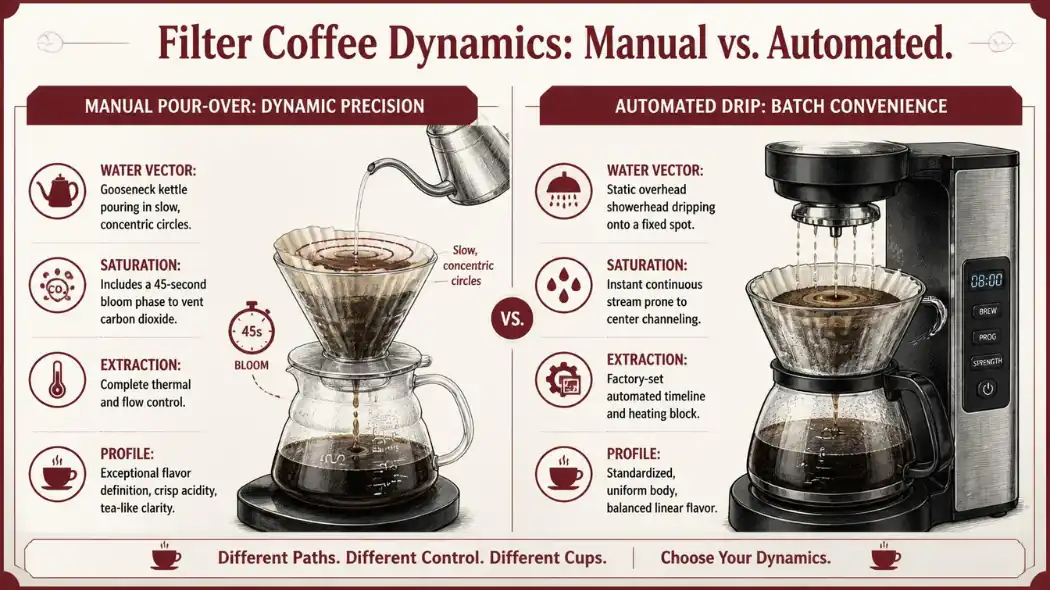
The operational paths for preparing filter coffee divide cleanly into manual precision and automated electrical loops:
- Manual Pour-Over Methods: The barista takes 100% control of the water delivery vector. Utilising a specialised goose neck kettle, you pour heated water over the coffee bed in slow, dynamic, concentric circles. This shapes the extraction rate, prevents dry air pockets, and adapts the flow velocity directly to the shape of the filter cone (such as the Hario V60 or Chemex).
- Automated Drip Filter Machines: An electric appliance automates the process. Water heats inside a internal reservoir heating block, travels up a structural tube, and showers down over a fixed basket from a static overhead shower head. The machine controls the extraction timeline and water volume completely, requiring zero hands-on involvement from the user.
Volumetric and Technical Extraction Comparison Matrix
To evaluate how these two gravity-fed filtration systems stack up side-by-side, The Coffee Guide implements this baseline reference chart:
| Extraction Metric | Manual Pour-Over Method | Automated Drip Filter Machine |
|---|---|---|
| Water Delivery Style | Dynamic hand pouring in precise, concentric circles | Static overhead showerhead dripping onto a fixed spot |
| Thermal Temperature Control | High precision (92°C–96°C) maintained inside a kettle | Unpredictable heating elements (prone to scaling or overheating) |
| Channeling Risk | Exceptionally low (The user adapts the fluid flow manually) | High (Static streams often drill holes straight through the bed) |
| Cup Character | High-definition flavor clarity with bright, vibrant acidity | Standardized, balanced, and uniform; body is more linear |
| User Precision Required | High focus, technique tracking, and steady manual discipline | Low focus; automated, simple, single-button convenience |
Why Does Manual Pour-Over Brewing Deliver Higher Flavor Clarity?
The secret behind the pristine, tea-like mouthfeel of a manual pour-over is the shape of the brewing vessel and the thickness of the paper filter sheet. Conical drippers force water to flow inward toward the center of the coffee bed, extending the contact time with the grounds just enough to dissolve intricate organic fruit acids and aromatic oils.
More importantly, because you pour by hand, you can completely eliminate the structural defect known as channeling. By ensuring the entire coffee bed is saturated evenly during a dedicated 45-second degassing bloom phase, you extract complex sugars uniformly.
This makes manual pour-over filtration the absolute finest choice for isolating delicate fruit, floral, and bright notes in premium, high-altitude single-origin coffees.
What are the Main Pitfalls of Automated Drip Coffee Machines?
While electric drip machines excel at brewing massive batch volumes for busy households or offices, they compromise on extraction quality due to two major mechanical limitations: static water distribution and thermal drift.
Most commercial kitchen drip shower heads feature small, clustered holes that drop water over a limited surface area. This causes water to follow the path of least resistance, drilling narrow holes through the center of the grounds while leaving the edges completely under-extracted and dry.
Additionally, entry-level heating elements fluctuate aggressively, delivering water that is either too cool at the start (causing a sour taste) or boiling hot at the finish (scorching the beans). Leaving a glass carafe sitting on an active heating plate further degrades the batch, baking the liquid until it turns into a harsh, aggressively bitter drink. Sourcing parameters verified by The Coffee Guide prove that leaving brewed liquid to bake on a live element destroys its delicate sweetness; if your morning batch extractions are consistently finishing with an unpleasantly mouth-drying or burnt character, check out our master troubleshooting guide to understand why does my coffee taste bitter and discover how to adjust your grind sizing and machine variables smoothly.
How to Choose the Right Filtration Method for Your Routine
Selecting your ultimate kitchen setup depends on your personal priorities, experience level, and morning routine constraints:
- Choose Manual Pour-Over If: You prioritise flavor definition above all else, enjoy the meditative ritual of manual brewing, and want to explore the bright, fruity nuances of light-to-medium roasted single-origin coffees.
- Choose an Automated Drip Machine If: You need to brew multiple cups simultaneously for a household, prioritise speed and convenience before work, and want a reliable, uniform cup of traditional medium-to-dark roasted coffee with minimal effort.

