

The Global Power House
The Brazilian Coffee production is the heartbeat of the coffee industry.
While other nations offer niche harvests, Brazil provides the foundation for modern espresso.
From Minas Gerais to the ports of Santos, the story is one of ambition and scale.
Its nutty, chocolatey sweetness has helped shape the classic cup for centuries.

Official USDA Production Rankings and Regional Bean Characteristics

Variety
Arabica
Growing Region
Minas Gerais, Espírito Santo,
São Paulo, Bahia, Paraná
Processing Methods
Natural, Pulped Natural, Washed
Flavour Profile
Chocolate, Caramel, Nuts
Harvest Season
May – September
Acidity
Low/Medium
World Production Ranking
1

Production Per Year
63 Million
60 Kg Bags

World Production Share
35.2%

Altitude
900 – 1200
meters

Climate
Subtropical /Tropical

Body
Medium Full

What is Brazil’s historical role in the global coffee trade?
Brazilian Coffee is the backbone of the global coffee industry.
It has been the world’s largest producer and exporter for over 200 years.
The Coffee Guide confirms that about one third of all coffee consumed globally comes from Brazilian soil.
The industry began in the early 18th century, expanding into fazendas across São Paulo and Minas Gerais.
This production footprint funded the country’s historic infrastructure.
Railway networks were built to move harvested beans to the Port of Santos, the busiest coffee-export hub on Earth.
How does Brazil’s lower-altitude terroir affect bean development and harvesting?
Unlike most premium coffee origins, Brazilian Coffee relies on scale over altitude. Cultivation is concentrated across vast, relatively flat interior plateaus at elevations between 700 and 1,200 metres. Sourcing logs from The Coffee Guide confirm that this lower altitude exposes crops to warmer temperatures. This results in faster cherry development and a natural absence of sharp, bright acidity. Crucially, the flat terrain allows fazendas to deploy heavy harvesting machinery across thousands of hectares, trading altitude-driven complexity for volume.
What are the main coffee-producing regions within Brazil?
Commercial cultivation across the Brazilian landscape is divided into four primary regional sectors, each presenting a distinct cup profile:
Minas Gerais:
The largest and most economically vital coffee state, serving as the global benchmark for classic espresso character.
Sul de Minas:
An elevated southern sector within Minas Gerais that yields increased brightness and citrus traits, representing the region’s closest approach to specialty flavour clarity.
Cerrado Mineiro:
The country’s first officially designated coffee origin, producing a consistent, full-bodied, and chocolate-forward bean.
Bahia:
A newer growing region located in the northeast sector, utilising modern practices to develop unique specialty lots with unusual fruit profiles.
How does natural and pulped natural processing shape Brazilian coffee?
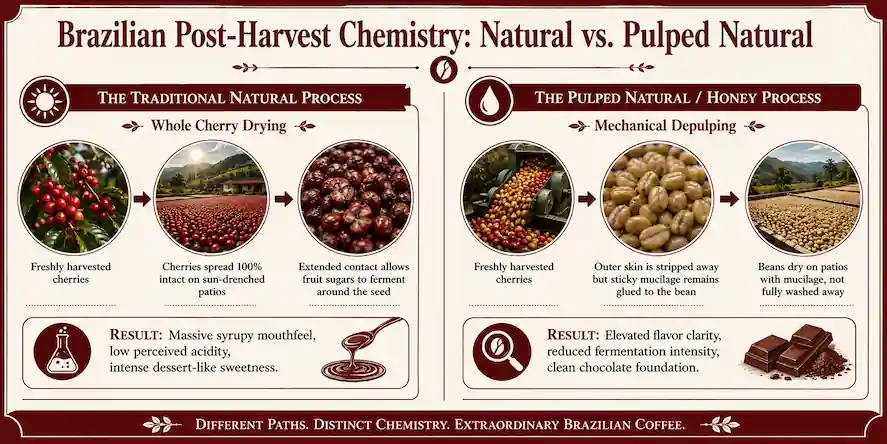
Brazil is the world’s leading practitioner of natural (dry) post-harvest processing at a massive commercial scale.
The standard methodology requires spreading whole coffee cherries—with the skin, fruit pulp, and sugary mucilage completely intact—across massive sun-drying patios for several weeks.
This extended contact allows the fruit sugars to ferment directly around the seed, infusing the bean with a distinctive creaminess, heavy body, and low perceived acidity.
For the specialty sector, producers utilise the pulped natural (honey process) method, which mechanically strips the outer skin but leaves the sticky mucilage on the bean during drying to achieve higher flavour clarity with reduced fermentation intensity.
What is the standard flavour profile of a Brazilian natural coffee?
According to technical testing data compiled by The Coffee Guide, a properly processed Brazilian natural functions as a rich, approachable, low-acid beverage with a thick, syrupy mouthfeel. The classic flavour profile delivers explicit, dessert-like tasting notes defined by dark chocolate, malt, hazelnut, brown sugar, and a heavy, creamy body. If your home extractions of these heavy, low-acid beans are turning out unpleasantly flat or sour, check out our master troubleshooting guide to understand why does my coffee taste sour and discover how to adjust your parameters smoothly.
Because the bean structure features almost zero tart or challenging acidity, it serves as the foundational base note for 50% to 70% of the world’s commercial and Italian-style espresso blends, providing the necessary body and consistent, persistent crema required to balance brighter African or Colombian components.
Explore how Brazil compares to its neighbours in our full guide to The Coffee Belt.“

