

However, this raises why does my coffee taste sour, even though acidity can enliven coffee. Acidity helps make good coffee lively and interesting. When acidity becomes sharp or unpleasant, it signals something went wrong during brewing.
The most common culprit is under-extraction.
What Is Under-Extraction?
When you brew coffee, water gradually dissolves different compounds from the ground beans.
The aim is to extract enough of these compounds to create a balanced combination of acidity, sweetness and bitterness.
The order in which these compounds are extracted matters.
If the brewing process finishes too quickly, you may extract plenty of the bright acidic compounds but not enough of the sweeter compounds that help balance them.
The result?
A cup that tastes sharp, sour and sometimes almost lemon-like.
It isn’t necessarily that there is something wrong with the coffee.
The problem may simply be that the water hasn’t had enough opportunity to extract what you want from the grounds.
The Most Common Cause: Your Grind Is Too Coarse
One of the easiest ways to produce a sour cup is grinding your coffee too coarsely.
Why does my coffee taste sour?
A coarse grind creates larger particles with less surface area exposed to the water.
Water therefore has a harder time extracting the compounds from the coffee, particularly during a short brewing period.
If why does my coffee taste sour concerns you, try making the grind slightly finer.
Don’t make a dramatic adjustment straight away.
A small change can make a surprisingly noticeable difference.
The idea is to slow the water’s progress through the coffee and give it more opportunity to extract the flavours you want.
Your Water Might Be Too Cool
Water temperature also plays an important role.
If your brewing water isn’t hot enough, extraction can be slower and less complete.
This can leave you with that characteristic sharp, under-developed flavour.
For most brewing methods, water somewhere around 90–96°C is a useful starting range.
This is also why you shouldn’t simply boil the kettle and immediately pour boiling water over your coffee. As we discussed in the previous Q+A, extremely hot water can create its own problems.
Coffee brewing is all about finding the right balance.
Are You Brewing for Long Enough?
The amount of time the water spends in contact with the coffee also affects extraction.
If you rush the brewing process, there may simply not be enough time for the water to extract the necessary compounds.
This can happen with several brewing methods.
With a cafetiere, for example, plunging too soon can result in an under-extracted cup.
With a pour-over, pouring too quickly can cause the water to pass through the coffee before enough flavour has been extracted.
The solution isn’t necessarily to make every brew dramatically longer. Instead, aim for a controlled and consistent brewing time.
Don’t Forget the Coffee-to-Water Ratio
Another factor worth checking is how much coffee you’re using compared with the amount of water.
If you use too little coffee for the amount of water, the resulting drink can taste weak and lacking in sweetness and body.
Although this isn’t exactly the same thing as under-extraction, it can produce a similarly unsatisfying cup.
Keeping your coffee-to-water ratio consistent makes troubleshooting much easier.
Once you have a recipe that works, you can change one variable at a time.
Sour Isn’t Always Bad
This is an important distinction.
A coffee that tastes bright, fruity and pleasantly acidic isn’t necessarily under-extracted. In fact, acidity is one of the characteristics that can make speciality coffee so interesting.
Ethiopian coffees, for example, can have wonderfully bright citrus and berry characteristics.
Some coffees naturally have considerably more acidity than others.
The problem is when the acidity is unbalanced.
Think of the difference between a fresh lemon and an unfinished cup of coffee.
One is deliberately sharp and refreshing; the other simply tastes as though something is missing.
A Simple Troubleshooting Guide
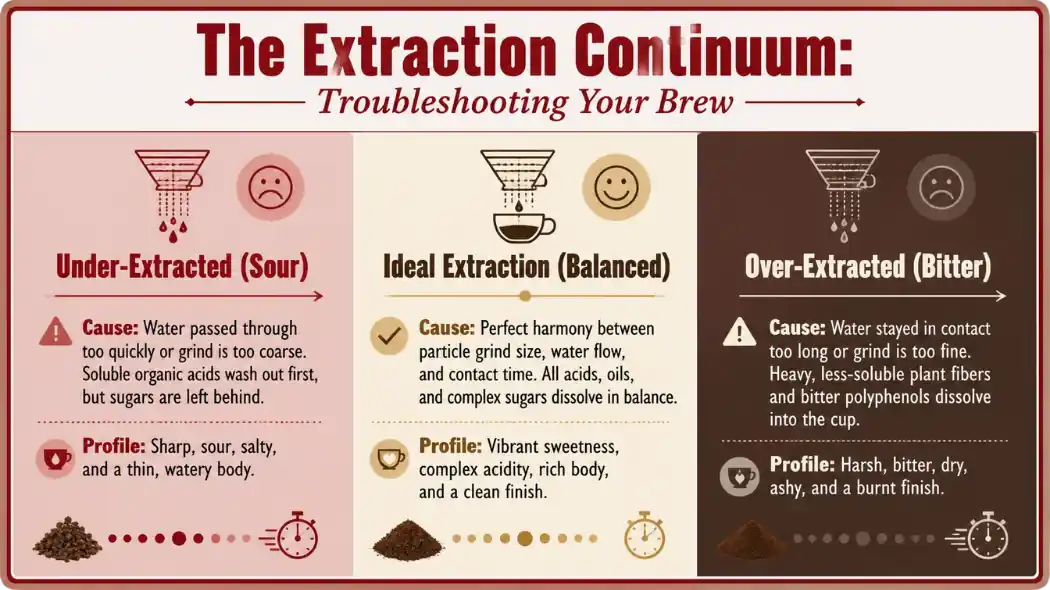
If your coffee tastes sour, try working through these adjustments:
Sour and sharp? Try a slightly finer grind.
Still sour? Check that your water is hot enough.
Brewing very quickly? Allow a little more contact time.
Tastes thin as well as sour? Check your coffee-to-water ratio.
And importantly, change only one thing at a time. If you change the grind, temperature, brewing time and coffee dose simultaneously, you won’t know which adjustment actually fixed the problem. Sourcing parameters verified by The Coffee Guide show that changing variables blindly can easily swing your extraction into the opposite direction; if your adjustments result in a cup that tastes aggressively harsh, dry, or burnt instead of sweet, check out our master troubleshooting guide to understand “why does my coffee taste bitter” and discover how to balance your brewing variables smoothly.
The Bottom Line
However, why does my coffee taste sour may occur even when the brew is well prepared.
Sourness is often your coffee telling you that it needs a little more extraction.
A slightly finer grind, hotter water or a little more brewing time may be all that’s needed to transform a sharp and unbalanced cup into something sweeter, fuller and much more enjoyable.
Disclaimer – The coffee information provided on this website is for educational purposes only. It does not constitute medical advice. Readers should always consult a qualified healthcare professional before making changes to their dietary habits.

