

Ethiopia | The Ancestral Origin.
Ethiopia 
The Ethiopian Coffee production does not merely grow coffee. It preserves its soul.
Long before the bean became a global commodity, it grew wild in the shaded forests of Kaffa highlands. Local tribes revered it, and they first mixed it with fats for energy on long treks.
To drink a cup of this coffee is to return to the source of the world’s most significant ritual.

Official USDA Production Rankings and Regional Bean Characteristics

Variety
Arabica

Growing Region
Sidama, Yirgacheffe,
Guji, Harare, Limu, Jimma

Processing Methods
Washed – Natural

Flavour Profile
Floral, Berry, Citrus

Harvest Season
October – January

Acidity
High
World Production Ranking
5

Production Per Year
11,5 milliom
60 Kg Bags

World Production Share
6.5%

Altitude
1500 – 2200 meters

Climate
Tropical – Highland

Body
Light/Medium

Ethiopia: The Birthplace of Coffee and the Native Forest Terroir
What is the historical origin and global migration timeline of the Ethiopian coffee tree?

While global folklore heavily popularises the 9th-century myth of Kaldi the goat herder discovering coffee cherries in the high mountain shrubs, rigorous archaeological and botanical records confirm a far more profound reality.
Sourcing data compiled by The Coffee Guide proves that Coffea arabica originated and evolved entirely indigenously within the dense, prehistoric highland forests of southwestern Ethiopia, specifically centring in the ancient geographic territory known as Kaffa. [1, 2, 3, 4, 5]
By the 1500s, the wild forest plant moved into organised domestic cultivation, crossing the Red Sea to Yemen to feed the historic port trade of Al Mokha. From there, the seeds migrated to build the great coffee houses of Cairo, Venice, and 17th-century London, meaning every cultivated coffee bean planted across the contemporary planet traces its exact genetic lineage back to Ethiopia’s native woodlands. [1, 2, 3, 4]
Why does the indigenous genetic diversity of Ethiopian “Heirloom” varieties define its terroir?
Ethiopia holds a unique distinction unmatched by any other coffee‑producing country on Earth, as it is the only origin where the coffee plant grows entirely indigenously. Sourcing parameters verified by The Coffee Guide indicate that while every other global producer relies on a few imported cultivars, Ethiopia possesses a vast, naturally evolving genetic goldmine.[1, 2, 3]
Historically, commercial exporters catalogued these multi‑generational, wild forest plants under the broad umbrella designation of Heirloom. Modern specialty agronomists precisely isolate resilient, high‑utility native selections such as 74110 and 74112. This traditional, non‑industrialised garden coffee framework operates on small family smallholdings, preventing the structural homogenisation of the crop and allowing complex regional flavour nuances to remain perfectly consistent year after year. [1]
How do Yirgacheffe, Harare, and Sidamo differentiate in flavour architecture and processing?
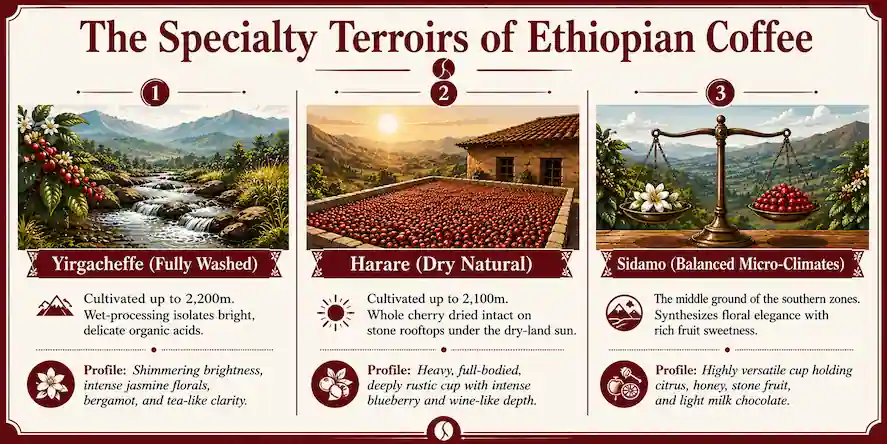
The varied mountain geography, localised climate bands, and post-harvest traditions of Ethiopia divide the country into three world-famous, distinctly layered specialty growing regions. Sourcing data managed by The Coffee Guide proves that every single corner of this native landscape yields wildly distinct profiles.
If your manual extractions of these delicate, high-altitude lots at home are turning out unpleasantly sharp or sour, check out our master troubleshooting guide to understand why does my coffee taste sour and discover how to adjust your grind and water variables cleanly.[1]
Yirgacheffe:
Cultivated in the southern highlands up to 2,200 metres and utilising full wet-washing processing.
It yields an exceptionally light, elegant, and intensely aromatic beverage defined by a shimmering, clean brightness and precise flavour notes of jasmine, bergamot, lemon, and a crisp, tea-like clarity. [1, 2, 3, 4, 5]
Harare:
Situated in eastern dry-lands up to 2,100 metres, this origin relies on traditional dry-natural processing where the whole cherry dries intact on stone rooftops.
The extended contact between seed and fruit sugars produces a heavy, full-bodied, and deeply rustic cup expressing intense blueberry, blackberry, dark chocolate, and wine-like depth. [1, 2, 3, 4, 5]
Sidamo:
Operating as the balanced middle ground of the southern zones, it beautifully synthesize the delicate floral aromatics of Yirgacheffe with the dense, fruit-forward sweetness of Harare to deliver a highly versatile profile of citrus, honey, stone fruit, and chocolate. [1, 2, 3, 4, 5]
What are the optimal brewing parameters required to extract Ethiopian specialty coffee?
Because the primary physical virtues of high-grown Ethiopian Arabica focus on delicate floral volatile compounds and a shimmering, tea-like finish, extraction methods must avoid metal mesh filters that allow heavy oils to dull the palate.
Technical testing logs from The Coffee Guide dictate using tight paper filtration systems to ensure complete clarity:
- The Hario V60 Pour-Over Method: This is the absolute benchmark framework for extracting Yirgacheffe lots. utilise a light roast profile ground to a clean medium grind size, matched to a 1:15 coffee-to-water ratio with water temperatures stabilised at 93°C.
Execute a precise 45-second degassing bloom before distributing the water stream slowly in steady concentric circles to allow the delicate jasmine and bergamot aromatics to lift cleanly without being smothered by sediment lipids or over-roasted bitterness. [1, 2, 3, 4, 5]
Ethiopia is the start of the story. the first chapter in an epic exploration of the world’s great coffee‑producing nations, The Coffee Belt describes how Ethiopia has maintained its history.

