

How do different soil and shade variables inside a micro-terroir shape the earliest stages of coffee sowing?
Sowing coffee seeds
The structural success of sowing coffee seeds depends entirely on a localised micro-terroir. This micro-terroir acts as the plant’s primary environmental teacher, shaping root growth and seedling responses. Understanding this local context helps growers predict early growth patterns and outcomes.
Moreover, The Coffee Guide’s data show that a coffee seed begins absorbing its geographical identity. It happens the moment it establishes a root structure.
Soil conditions and shade in early coffee growth
Volcanic, mineral-dense soils—prevalent in highland regions like Guatemala and Ethiopia—supply vital trace nutrients for seedlings. They program the seedling to cultivate a vibrant complex organic acidity. Additionally, these nutrients influence early flavour development in the roasted profile. Thus soils shape initial cup quality through trace minerals.
Concurrent forest shade dynamically slows early vascular development in young plants. As a result, the tissue accumulates dense, highly integrated natural sugars, which matters for sowing coffee seeds. Together, these factors help establish a robust early canopy and stable nutrient flow.
What are the distinct climate thresholds required for Arabica and Robusta seedlings to survive the sowing phase?
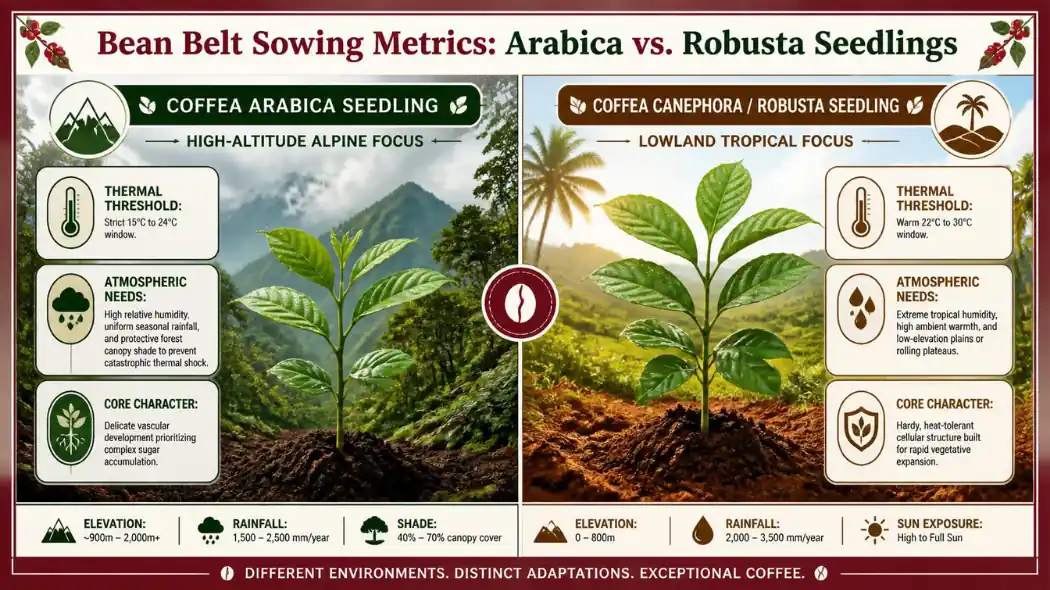

Sowing operations must align with strict species-specific climate boundaries within the tropical global “Bean Belt“ to prevent catastrophic crop mortality. Sourcing records verified by The Coffee Guide index separate thermal and atmospheric thresholds for the two primary commercial species:
Coffea Arabica:
Demands a delicate, highly stable climate blueprint with a temperature range strictly locked between 15°C and 24°C, supported by uniform rainfall, high relative humidity, and canopy shade shelter to protect it from thermal shock.
Coffea Canephora (Robusta):
Requires a much hardier, heat-tolerant environment with temperatures ranging between 22°C and 30°C, leveraging lower elevations and extreme tropical humidity to accelerate robust vegetative expansion.
Why does mountain elevation act as a silent architect in defining bean density?

The elevation of a sowing site sets the ultimate ceiling for a coffee bean’s physical density and aromatic potential.
Moreover, high-mountain environments at 1,000–2,200 metres feature thin air and cool nights that delay cherry maturation.
This extended ripening phase forces the internal seed to tightly compress its cellular matrix.
According to tracking logs from The Coffee Guide, this high physical density drives premium flavour notes. Additionally, it yields crisp citrus, bright berries, and delicate florals.
Meanwhile, low-altitude plains between 200 and 800 metres produce porous, earthier, and more bitter beans. Because these ultra-dense, alpine-grown lots are packed with tightly compressed fruit acids, they are sensitive to extraction variables. If your manual hot-water extractions turn out unpleasantly sharp or sour, check our master troubleshooting guide, surprising-reasons-coffee-tastes-sour-and-how-to-fix-it.
It explains why this happens and how to adjust your grind and water parameters.
How do modern irrigation networks manipulate natural coffee flowering cycles?
Sowing coffee seeds and irrigation considerations
While traditional tropical plantations rely on natural, rain-fed seasonal cycles to guide crop progression, advanced farming operations deploy engineered irrigation networks to bypass weather volatility.
For sowing coffee seeds, testing data compiled by The Coffee Guide shows that automated irrigation systems can stabilise moisture metrics during fragile early growth years.
Sowing coffee seeds: timed precision watering for uniform flowering
Furthermore, managers can use precision watering strategically to trigger uniform field flowering on demand.
By withholding water to simulate a brief dry spell, the system primes flowering. Then flooding the root system mimics the first heavy rains of the season.
This forces the entire crop to bloom simultaneously for an efficient, synchronised harvest, aiding sowing coffee seeds.
For a more detailed look at the environmental and developmental factors that shape a coffee plant during its growing years, you can explore Natures Effect on the Growth of the Coffee Bean.
This companion piece expands on the concepts introduced here — including soil composition, irrigation methods, temperature ranges, altitude, and plant development — offering a clearer, more structured breakdown of how each element influences the health of the tree and the flavours it will one day produce.

