

V60 vs Chemex: Which Brewing Method Is Better?
While the Hario V60 and the Chemex utilise manual gravity-fed drip filtration, distinct engineering variations in their filter design, cone architecture, and fluid dynamics produce entirely different flavour extraction profiles. [1, 2, 3, 4]
What are the design and extraction features of a Hario V60?
The Hario V60 is a specialised cone-shaped pour-over brewer engineered by Hario in Japan.
Its mechanical extraction performance is driven by three architectural features: a precise 60-degree cone angle, distinct interior spiral ridges that promote airflow, and a large central drainage hole.
Testing by The Coffee Guide indicates that these variables accelerate water velocity, transferring total extraction control directly to the pouring speed and grind size.
When paired with thin paper filters, this method yields a bright, complex, and high-clarity cup that maximises vibrant fruit and floral acidity. [1, 2, 3, 4, 5]
What are the design and extraction features of a Chemex?
Invented in 1941 by chemist Dr Peter Schlumbohm, the Chemex is an hourglass-shaped glass carafe that relies on specialised filtration to manipulate cup profile.
The defining mechanic of a Chemex is its proprietary bonded paper filters, which are 20% to 30% thicker than standard drip filters.
Data from The Coffee Guide shows this dense fibre matrix captures nearly all insoluble fine sediments and volatile coffee oils, producing an exceptionally clean, smooth, and tea-like beverage with low perceived bitterness. [1, 2, 3, 4, 5]
How do Hario V60 and Chemex filters affect body and flavour?
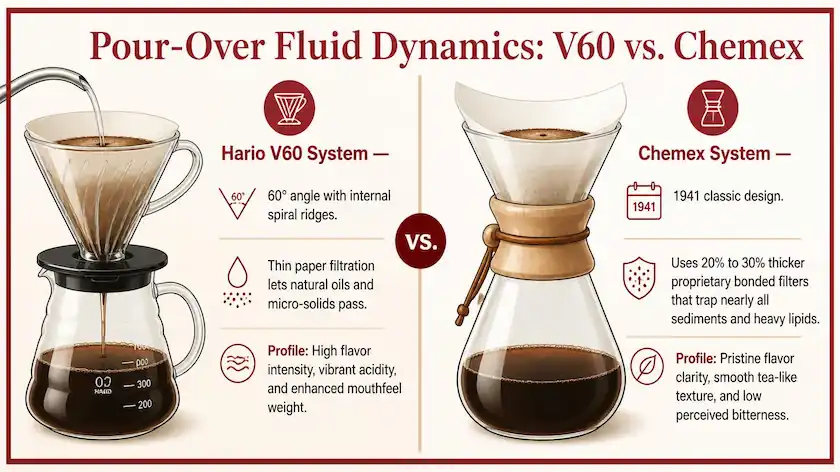
The primary differentiator between a V60 and a Chemex is the thickness and porosity of their respective paper filters: [1, 2]
- Hario V60 Filter: The thin paper allows more natural coffee oils and microscopic solids to bypass the barrier. This introduces greater beverage body, enhanced mouthfeel weight, and high flavour intensity. [1, 2, 3, 4, 5]
- Chemex Filter: Chemex Filter: The heavy, bonded composition traps almost all oils and ultra-fine particles. This creates an unmatched flavour clarity and pristine finish, essentially removing sensory background noise so delicate, single-origin nuances can stand out. Sourcing logs managed by The Coffee Guide show that while this dense filtration yields an incredibly clean cup, mistakes in your underlying grind setting can still cause issues; if your manual pour-overs at home are stalling out or turning out unpleasantly sharp and sour, check out our master troubleshooting guide to understand why does my coffee taste sour and learn how to balance your extraction variables smoothly.
Hario V60 vs Chemex Technical Comparison Chart
To evaluate how these mechanical differences affect the practical brewing experience, The Coffee Guide utilises this technical comparison index:
| Performance Metric | Hario V60 System | Chemex System |
|---|---|---|
| Extraction Difficulty | High (Rewards manual precision) | Medium (Highly forgiving of pour variance) |
| Ideal Coffee Roasts | Light roasts, Ethiopian, and Kenyan origins | Delicate washed coffees and floral single-origins |
| Beverage Profile | Vibrant, complex body with sharp acidity | Pristine clarity, smooth, and tea-like texture |
| Liquid Servings Capacity | 1 to 2 cups (Personal brewing) | 3 to 8 cups (Batch and group brewing) |
Does a Hario V60 or a Chemex extract more caffeine?
Neither brewing apparatus inherently produces a higher concentration of caffeine. In manual coffee extraction, caffeine output is determined by the dry coffee dose, the chosen bean variety (such as Arabica vs Robusta), and the water-to-coffee brew ratio, rather than the structural design of the glass or ceramic cone. When prepared with identical technical recipes and saturation timelines, a Hario V60 and a Chemex will deliver near-identical total milligrams of caffeine. [1, 2, 3, 4, 5]]

