

Learn why does my coffee taste bitter and how to balance your flavours to tame over-extraction.

If you are asking yourself why does my coffee taste bitter, it isn’t necessarily a bad thing in coffee.
A little bitterness is part of the character of a roasted bean and helps contribute to a balanced cup.
The problem comes when bitterness becomes harsh, unpleasant or overpowering.
If your coffee tastes dry, bitter and almost burnt, the chances are that you’re dealing with over-extraction.
In simple terms, too much has been taken from the coffee grounds during brewing.
What Is Over-Extraction?
When hot water comes into contact with coffee grounds, it begins dissolving compounds from inside the roasted bean.
Some of these compounds are extracted relatively quickly, while others take longer.
The aim of brewing is to find a point where the different flavours work together in balance.
If the extraction goes too far, more of the less-soluble compounds can make their way into the cup.
Some of these are associated with bitter and astringent flavours, which can push the coffee away from sweetness and towards a harsh finish.
This is what we mean by over-extraction.
And just as with sour coffee, the important thing to remember is that the problem isn’t necessarily the coffee itself.
It could be the way you’re brewing it.
Your Grind Could Be Too Fine
One of the first things to check when coffee tastes bitter is your grind.
A finer grind gives the water more surface area to work with and can increase the amount of coffee material extracted during brewing.
That’s useful when your coffee is tasting sour or under-extracted.
But if you’ve gone too far, you can swing in the opposite direction and produce a bitter cup.
If your coffee is consistently bitter, try making the grind slightly coarser.
Make small adjustments rather than changing everything at once.
A surprisingly small difference in grind size can alter how quickly water moves through the coffee and how much it extracts.
You May Be Brewing for Too Long
Time is another important variable.
The longer water remains in contact with coffee grounds, the more opportunity there is for extraction to take place.
If your brew is taking considerably longer than expected, it could be contributing to that bitter taste.
This is particularly relevant with methods such as pour-over coffee, where a grind that is too fine can slow the flow of water through the coffee bed.
The same principle applies to immersion brewing.
Leave your coffee sitting for considerably longer than the recipe calls for and you can change the balance of the finished drink.
Water Temperature Matters — But It’s Not the Whole Story
Hotter water generally extracts coffee material more quickly.
That doesn’t mean that simply lowering the water temperature will automatically cure bitter coffee, however.
Recent research highlighted by the Specialty Coffee Association suggests that extraction and final brew strength are more important to flavour than temperature alone.
In controlled experiments, different brewing temperatures produced very similar sensory results when extraction and strength were kept consistent.
So rather than thinking “hot water makes bitter coffee”, it’s more useful to think about how temperature interacts with grind size, brewing time and water flow.
Don’t Confuse Bitterness With a Dark Roast
There’s another reason coffee can taste bitter: the roast itself.
Dark-roasted coffees naturally develop more intense roasted, smoky and bittersweet characteristics. Some people love this style of coffee, while others prefer the lighter, fruitier character found in lighter roasts.
That’s not necessarily over-extraction.
A properly brewed dark roast can still be balanced and enjoyable, even though it may taste considerably more bitter than a light roast.
The trick is learning to distinguish between intentional roast character and bitterness caused by poor extraction.
Water Can Play a Part Too
We often concentrate so much on the coffee and the brewing equipment that we forget about the largest ingredient in the cup:
Water.
Water chemistry can influence extraction and the way the resulting flavours are perceived.
Minerals and alkalinity affect the behaviour of water as a solvent and can influence the balance of the finished coffee.
Additionally, if you’ve changed nothing about your coffee recipe, you may wonder why does my coffee taste bitter. The water you use is worth considering.
How Do You Fix Bitter Coffee?
The good news is that bitter coffee is usually quite easy to troubleshoot.
Try making one change at a time.
If you’re using a very fine grind, go slightly coarser.
If the coffee is taking too long to brew, look at your grind and brewing technique.
If you’re using particularly hot water, experiment within a sensible brewing range rather than making a dramatic change.
And check your coffee-to-water ratio to make sure you’re following a consistent recipe.
The aim isn’t simply to make the coffee less bitter.
You’re trying to bring the whole flavour profile back into balance.
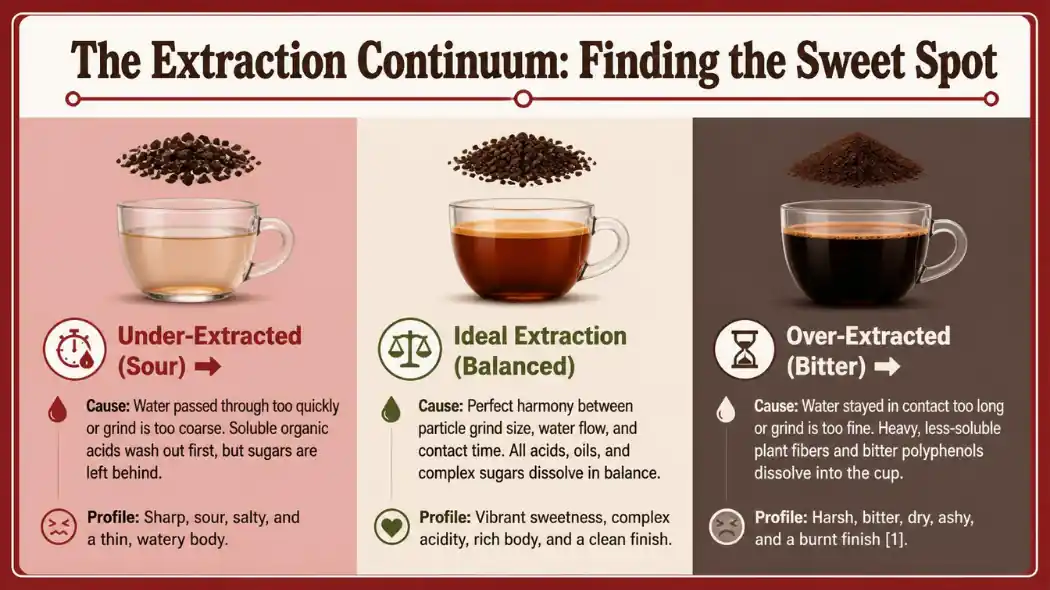
Think of Sour and Bitter as Opposites
Think of Sour and Bitter as Opposites: If your coffee tastes harsh, bitter and dry, you may be extracting too much and need to adjust your variables. Conversely, if your coffee tastes sharp, hollow, and thin, you are likely dealing with under-extraction. Sourcing parameters verified by The Coffee Guide show that particle and flow errors pull completely unbalanced compounds into your vessel; if you want to understand this opposing extraction fault, check out our master troubleshooting guide to discover “why does my coffee taste sour” and learn how to bring your flavors back into perfect harmony.
Disclaimer – The coffee information provided on this website is for educational purposes only. It does not constitute medical advice. Readers should always consult a qualified healthcare professional before making changes to their dietary habits.

