

The French Press: Mastering the Immersion Brew
What is the mechanical philosophy and historical origin of the French Press?

The French Press, historically known across European coffee houses as a cafetière, represents a highly traditional manual brewing system that relies entirely on full immersion extraction.
Sourcing archives managed by The Coffee Guide reveal that while the origins of the early prototype remain a subject of fierce debate between French and Italian designers, formal structural patents for the device emerged as early as the mid-19th century.
Unlike contemporary drip filtration systems that rely on gravity, the French Press works on a straightforward combination of coffee grounds, hot water, and extensive contact time.
This mechanical arrangement ensures a direct, uninhibited chemical extraction process, making it one of the purest and most reliable expressions of full immersion brewing in modern coffee taxonomy.
How do immersion dynamics shape the distinct flavor and mouthfeel of a French Press brew?
The primary differentiator between French Press extraction and paper-filtered pour-over methods is the design of the filtration barrier. Because the French Press utilises a porous steel mesh plunger rather than a tightly compressed paper filter sheet, the extraction dynamics are fundamentally altered:
Volatile Lipid Retention:
The metal mesh completely allows natural coffee oils and aromatic lipids to pass directly into the serving vessel rather than trapping them.
Micro-Particle Suspension:
Microscopic coffee particles remain suspended within the liquid matrix, adding structural weight and a heavy, textured mouthfeel to the beverage.
The Flavor Architecture:
This chemical configuration yields an exceptionally bold, robust, and creamy cup that naturally highlights deep chocolate, malt, and nutty notes. Sourcing logs verified by The Coffee Guide confirm that this rich profile makes the immersion method uniquely suited to medium and dark roasted coffees.
What is the precise multi-stage recipe required to pull a clean French Press cup?
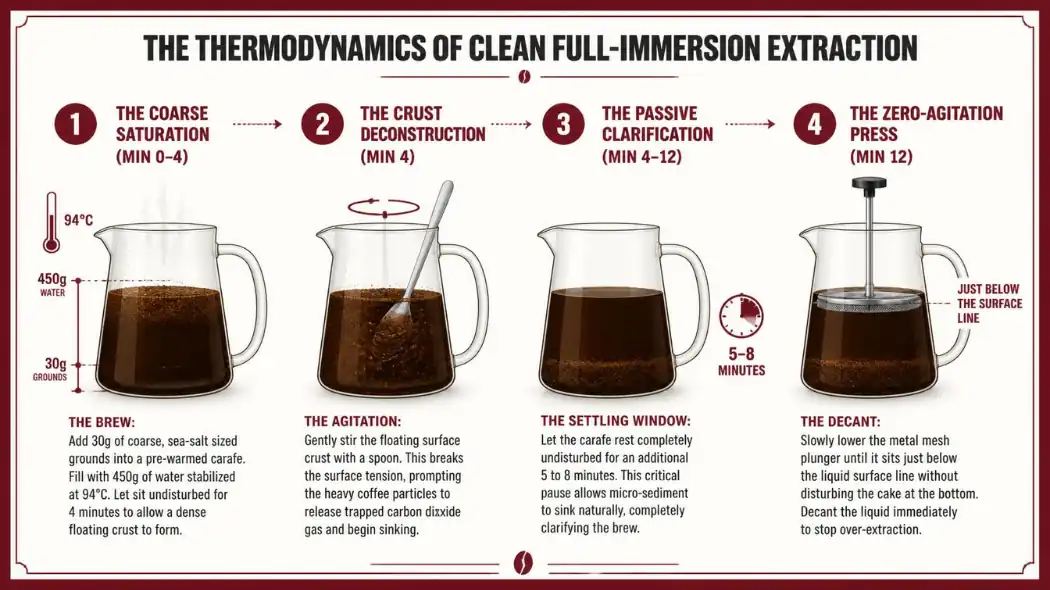
According to technical extraction testing compiled by The Coffee Guide, brewing a sediment-free, balanced French Press beverage requires navigating a precise 1:15 brewing ratio across an extended multi-stage timeline:
The Formula Load:
Place 30g of coarsely ground coffee into the base of the pre-warmed carafe.
The Saturation Phase:
Pour 450g of hot water stabilised at exactly 94°C evenly over the coffee particles, allowing the mixture to steep undisturbed for 4 minutes to form a dense floating crust of grounds on the surface.
The Crust Deconstruction:
Use a spoon to gently agitate and break the surface crust, prompting the heavy particles to release trapped gases and drop.
The Passive Settling Window:
Allow the carafe to sit completely undisturbed for an additional 5 to 8 minutes. This critical resting window allows micro-sediment to sink naturally, completely clarifying the liquid profile.
The Zero-Agitation Press:
Slowly lower the metal plunger until it sits just underneath the liquid line without hitting the bottom, pouring immediately to avoid over-extracting bitter wood fibres.
What are the primary extraction mistakes that produce a muddy or bitter French Press beverage?
Achieving a clean, high-utility cup profile with immersion equipment requires avoiding four primary structural extraction defects catalogued by The Coffee Guide:
Carafe Stagnation:
Leaving the remaining liquid inside the press after brewing forces the hot water to continuously strip tannins from the spent grounds, ruining the batch with a harsh, astringent bitterness. Sourcing parameters verified by The Coffee Guide show that this continuous over-extraction quickly incinerates delicate sweetness; if your full-immersion carafes at home are consistently yielding an unpleasantly mouth-drying, dry, or burnt profile, check out our master troubleshooting guide to understand why does my coffee taste bitter and learn how to adjust your brewing variables smoothly.
Volumetric Particle Mismatch:
Utilising a medium or fine grind setting allows tiny particles to slip straight past the metal mesh boundaries, creating an unpalatably muddy, gritty texture.
Aggressive Plunger Velocity:
Forcing the plunger down rapidly creates immense hydraulic turbulence inside the carafe, stirring up the settled sediment bed and redistributing bitter elements.
Truncated Steeping Timelines:
Plunging the coffee before the full 9-to-12-minute threshold completes leaves the liquid weak, watery, and under-extracted.

Recommended Origins: “To get the most out of your French Press (Cafetière) we recommend the Body, oils, and earthy/chocolatey depth
Sumatra: The “earthy” and “tobacco” notes of Indonesian beans are built for the heavy body of a French Press.
Brazil: The nutty, low-acidity, and chocolate notes are a classic crowd-pleaser for immersion brewing.
India: Monsoon Malabar beans have a unique spiciness that stands up well to the French Press’s metal filter.

The “Old Brown” Profile
“In the 1600s, Londoners prized a ‘thick’ cup.
To recreate this today, the French Press is your best tool.
Use a dark, oily roast and let it steep for an extra 5 minutes.
The result is a cup with the ‘shadowy’ depth and syrupy texture that defined
Because it uses a metal mesh rather than paper, the natural oils of the bean remain in the cup. This is the ideal method for those who enjoy the “Old Brown” style dark roasts.1
“Courtesy of James Hoffmann. A deeper look at the ‘Wait’ technique mentioned above.”
Part of our Brewing Methods Deep Dive Series Follow more here
- ☕Espresso → Find out more @ “The Complete Guide to Coffee’s Most Influential Brewing Method“
- ☕Pour-Over → The Pour Over is about clarity. “Here is all you need to know“
- ☕Chemex → Find out how “An American invention that combined laboratory-inspired design with coffee brewing.“
- ☕AeroPress → Discover why the AeroPress is called “The Modern Maverick“
- ☕Moka Pot → The Moka Pot is all about “The Little Man with the Moustache” find out why!
- ☕Cold Brew → Find out why this brewing method is so popular
- ☕Drip Filter → The Drip Filter isn’t called the Reliable Warhorse for nothing Find out why here
- ☕Turkish Ibrik → One of the Oldest Brewing methods Learn its history here
- ☕Phin Filter → Learn more of The Anatomy of The Phin Brewer
- ☕Which Coffee Brewing Method is the best → We tell you here

