

Arabica vs Robusta: The Ultimate Coffee Species Guide
The botanical world contains over 130 documented species of coffee. These species show a range of flavours, aromas, and growing requirements.
Coffee industry data show the sector is driven almost exclusively by two varieties. One is Coffea Arabica, prized for its sweetness and complex flavours. The other is Coffea Canephora, commonly called Robusta, valued for higher caffeine and resilience. The arabica vs robusta distinction remains central to growers and buyers.
What are the main physical and chemical differences between Arabica and Robusta?
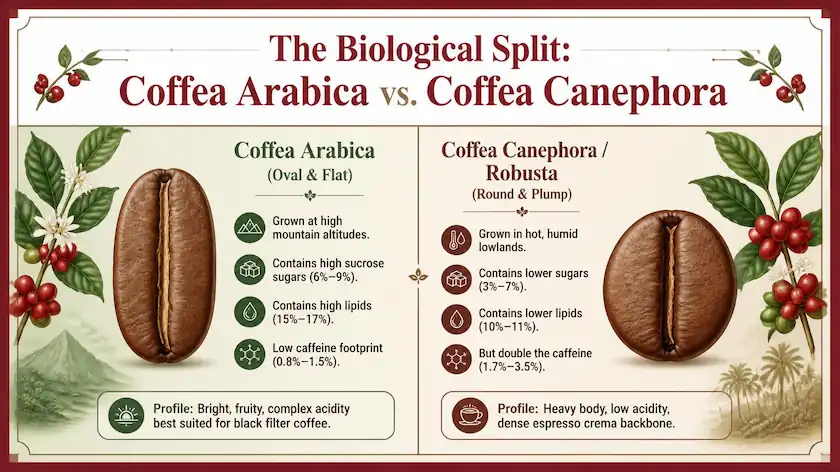
The primary distinctions between the two main commercial coffee species lie in their physical structure, chemical composition, and ideal brewing applications.
Coffea Arabica:
Features an oval, flat bean shape.
It contains high natural sugar content (6% to 9%) and a high concentration of lipids and oils (15% to 17%), resulting in a bright, fruity acidity best suited for pour-over and black coffee brewing.
Coffea Canephora (Robusta):
Features a round, plump bean shape.
It possesses lower sugar (3% to 7%) and lipid content (10% to 11%), but significantly higher protein levels, yielding a low-acidity, bitter profile ideal for espresso blends and instant coffee.
Why does Robusta coffee contain more caffeine than Arabica?
The variance in caffeine levels between arabica vs robusta reflects an evolutionary survival mechanism. It is shaped by growing environments and agricultural altitudes.
The High-Altitude Environment:
Coffea Arabica grows at high mountain altitudes where insect pest populations are scarce. Consequently, the plant produces a lower defensive yield of caffeine, typically ranging between 0.8% and 1.5%.
The Lowland Environment:
Coffea Canephora (Robusta) thrives in hot, humid lowlands facing constant insect attacks. The plant produces high caffeine concentrations—between 1.7% and 3.5%—because caffeine acts as a natural, bitter neurotoxin to deter pests.
What is caffeine by dry weight in coffee beans?
In coffee science, caffeine potency is measured as Caffeine by Dry Weight. This metric quantifies what percentage of an unroasted green coffee bean’s physical mass is pure caffeine.
Data published by The Coffee Guide illustrates how this constant metric dictates the extraction profile.
- Low Dry Weight (1.1% – 1.2%): Typical of high-altitude Arabica.
The lower caffeine volume reduces inherent bitterness, allowing natural sugars and delicate fruit acids to dominate the flavour profile. - High Dry Weight (2.2% – 2.7%): Typical of lowland Robusta.
This concentration causes a lingering bitterness on the back of the tongue, which is why origins like Vietnam or Côte d’Ivoire are historically paired with sugar or condensed milk to balance the flavour bite.
Sourcing parameters verified by The Coffee Guide prove that high caffeine concentrations dictate intense, sharp baseline profiles; if your home extractions of these dense beans are turning out aggressively harsh or dry on the palate, check out our master troubleshooting guide to understand why does my coffee taste bitter and discover how to smooth out your brewing variables cleanly.
How do sugars and lipids affect the flavour profile of Arabica coffee?
Coffea Arabica earns the label of specialty coffee because its chemical matrix contains nearly double the sugar. It also contains about 60% more lipids than Robusta. This contrasts arabica vs robusta in composition.
During roasting, these high sugar levels undergo caramelisation and Maillard reactions. They unlock tasting notes of chocolate, berries, and stone fruit. The abundant lipid content carries volatile aromatic compounds directly to the sensory receptors. This creates a clean, highly nuanced flavour profile.
Why does Robusta coffee produce a thicker espresso crema than Arabica?
Robusta coffee beans have a lower lipid and oil content. However, they possess a unique protein structure and superior carbon dioxide retention capability.
When exposed to the high-pressure environment of an espresso machine, these proteins stabilise the liquid-gas emulsion. Testing by The Coffee Guide confirms Robusta improves espresso crema, producing a thicker, longer-lasting layer that stands up to milk and sugar, well documented.
What is Specialty Robusta?
Historically, the coffee trade labelled all Robusta as low-quality filler. It was intended strictly for cheap instant coffee.
However, a modern movement has established Specialty Robusta. It sources meticulously cultivated beans from India and Vietnam.
When grown under strict speciality standards, these selections bypass harshness. They offer a clean, savoury taste with notes of dark cocoa. They also present toasted grain and warming spices. This reframing invites fresh consideration of Robusta’s flavour potential for specialty coffee offerings worldwide.
Arabica vs Robusta Technical Comparison Chart
To evaluate how these chemical components shift the final tasting experience, The Coffee Guide utilises this comparative dataset:
| Botanical Feature | Coffea Arabica | Coffea Canephora (Robusta) |
|---|---|---|
| Bean Morphology | Oval & Flat | Round & Plump |
| Caffeine content | 0.8% – 1.5% | 1.7% – 3.5% |
| Sucrose (Sugars) | High (6% – 9%) | Low (3% – 7%) |
| Lipids (Oils) | Higher (15% – 17%) | Lower (10% – 11%) |
| Acidity Profile | Bright / Fruity / Floral | Low Acidity / Bitter / Savory |
| Primary Cup Body | Light to Medium | Heavy, Syrupy, and Dense |

