

Resilient Lineages & Clones
While the specialty market has historically lavished all its attention on the delicate nuances of heritage Arabica cultivars, a massive commercial revolution is quietly unfolding across the global coffee landscape. The botanical species Coffea canephora (Robusta) is no longer merely a cheap, high-caffeine filler reserved for instant powders or low-grade supermarket blends.
Driven by shifting global temperatures and advanced agricultural farming, modern Robusta has transformed into a high-utility, disease-resistant powerhouse. In my years managing coffee shops and catering events, I’ve seen firsthand how a high-quality Robusta can completely transform a menu, delivering incredibly rich textures, a thick, velvety crema, and a surprising depth of flavor complexity.
From a grower’s perspective, Robusta requires cross-pollination to reproduce, which gives it a naturally vast and diverse genetic pool compared to self-pollinating Arabica varieties. Thriving at lower altitudes between sea level and 800 metres, the plant produces a high concentration of natural caffeine that acts as a built-in insecticide, making the trees virtually immune to devastating pests and crop diseases. To understand where the future of the global coffee supply stream is heading, we need to map out the primary lineages and high-yield clones dominating the modern industry today.
Lineage 1: The Erecta Branch (The Structural Pillars)
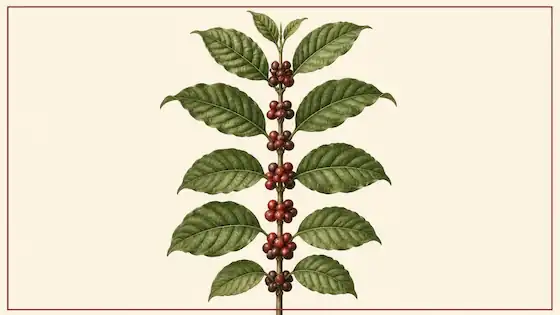
In the foundational botanical classifications of Robusta, the species divides cleanly into two primary growth styles based on how the tree stems actually develop. The Erecta lineage is known for its strict, vertically climbing main trunks and rigid, upright branch structures. Native to the dense, low-elevation rainforests of Central and Western Africa, these trees grow tall and stately, requiring distinct planting spacing to grow properly on a commercial estate.
From an agricultural standpoint, the Erecta branch forms the structural backbone for many traditional, shade-grown farms across Southeast Asia and West Africa. Because the branches grow vertically rather than sprawling outward, they allow farmers to maximize light penetration down to cover crops planted below.
While harvesting requires taller ladders, this lineage delivers an incredibly consistent, heavy-bodied cup profile. When designing espresso blends for my menus, this was the exact profile I looked for; it brings deep, dark-chocolate attributes and a robust, smoky finish that provides that classic, punchy baseline customers expect from a traditional espresso.
Lineage 2: The Nganda Branch (The Sprawling Canopy)
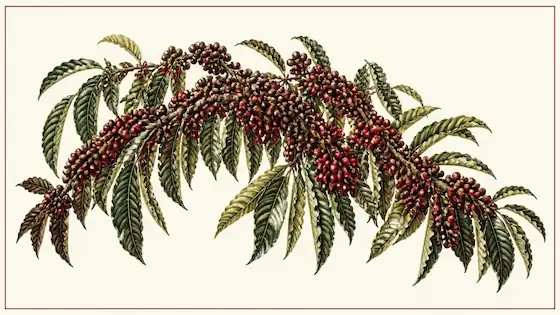
The second major native growth style within the species is the Nganda lineage. Unlike its tall, upright sibling, Nganda trees develop a sprawling, dome-shaped canopy made up of long, weeping, and horizontally spreading side branches. If left un-pruned in the wild, an individual Nganda tree can expand into a massive, bush-like structure that tracks outward across several metres of the forest floor.
Commercial growers heavily favor the Nganda branch for multi-stem training systems. The weeping shape of the limbs creates an incredibly dense surface area for fruit development, allowing massive clusters of small, round cherries to form tightly right along the node lines.
The cup quality you get from Nganda selections is celebrated for its deep, heavy, and syrupy mouthfeel. In my experience working with different beans for catering and retail, this profile is incredibly forgiving; it naturally presents a highly stable, low-acidity cup rich with roasted nut, molasses, and earthy spice notes that hold up flawlessly even under intense commercial roasting setups.
Lineage 3: The Conilon Powerhouse (The Brazilian Robusta Vanguard)
When you look at South America, the undisputed leader in modern Robusta development is Brazil, where this resilient species is cultivated under the distinct regional variety name “Conilon.” If you want to compare how this tree stacks up against other global varieties, you can review the official details listed in the Robusta Coffee Varieties Catalogue.
Originally imported from Central Africa, Brazilian agronomists isolated specific drought-resistant mutations within the Nganda branch to create a specialized tree tailored perfectly to the sun-baked plains of Espírito Santo.
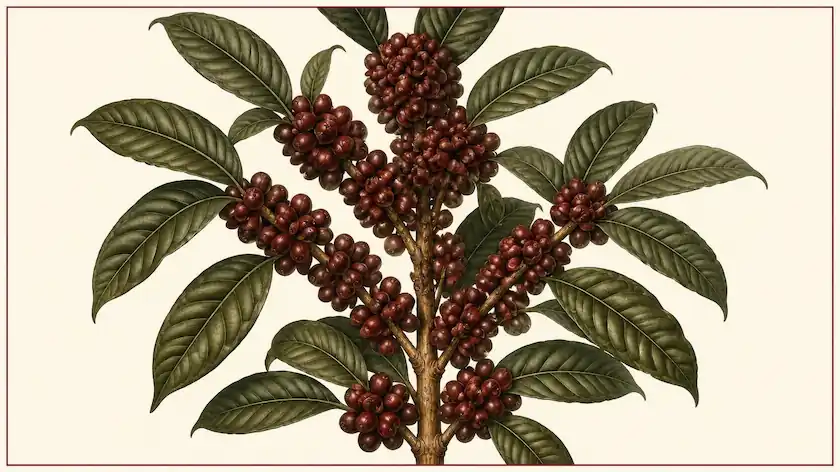
Notice the distinct leathery leaves and dense fruit clusters of a Conilon Robusta coffee treeConilon is a true success story in modern coffee farming, delivering staggering harvest volumes due to its extreme resilience against prolonged dry spells and high temperatures. While it was historically dismissed as a low-grade bulk commercial filler, a massive quality movement has emerged over the last few years to produce what the industry calls “Fine Robusta” (or Fine Conilon) lots.
When grown with precision and processed via meticulous honey or anaerobic fermentation methods, Conilon completely sheds its bitter reputation. In our cupping trials here at The Coffee Guide, we’ve seen how these modern processing steps reveal remarkably clean, sweet cups bursting with ripe tropical fruit, macadamia nut, and creamy brown sugar complexities—proving that high-end Robusta deserves a spot on any serious specialty coffee menu.
Lineage 4: High-Yield Selection Clones (The Climate Shields)
Because Robusta relies entirely on cross-pollination, growing it from simple seeds can result in highly erratic and unpredictable plant traits on the farm. To keep field growth predictable and stable, the modern Robusta sector relies completely on vegetative clonal selection. This is where cuttings from elite “mother trees” are rooted in advanced nurseries to create genetically identical agricultural clones.
The global epicentre for this technology is Vietnam, the world’s leading exporter of Robusta. By deploying specialised, high-yield clones—such as the celebrated TR4, TR9, and TRS1 lines—Vietnamese estates have engineered incredibly tough, uniform crops.
From an industry sourcing perspective, these elite clones are a game-changer. They produce massively oversized, dense green beans that mature simultaneously, double the total harvest yield per acre, and deliver complete biological resistance to devastating root pests. For those of us tracking the market here at The Coffee Guide, it’s clear that these resilient clones are what will safely secure the global coffee supply network against escalating climate volatility.
How Species Density Alters Your Master Troubleshooting Balance
The deep genetic differences between these two species directly impact how they extract inside your kitchen. Our hands-on testing here at The Coffee Guide constantly proves that Robusta beans possess a radically different chemical makeup than Arabica, containing double the chlorogenic acids and significantly less natural oils.
When pulling shots behind a commercial espresso bar, I learned that Robusta requires a completely different approach to dial in. If your dark-roasted Robusta espresso extractions are consistently pulling too fast, resulting in a harsh, overly sharp, salty, or rubbery profile, explore our master guide to understand why does my coffee taste sour and learn how to stabilize your grind size and extraction times smoothly.
Conversely, because Robusta compounds are highly water-soluble, using excessive water temperatures or letting the water pool too long inside a choked filter cone will instantly trigger extreme over-extraction. If your manual immersion or drip brews are consistently finishing with a dry, intensely mouth-puckering, unpleasantly smoky, or aggressively burnt profile, check out our companion master guide to understand why does my coffee taste bitter. We’ll show you exactly how to drop your water temperature and coarsen your grind sizing to balance things out.
Official USDA Production Rankings and Regional Bean Characteristics
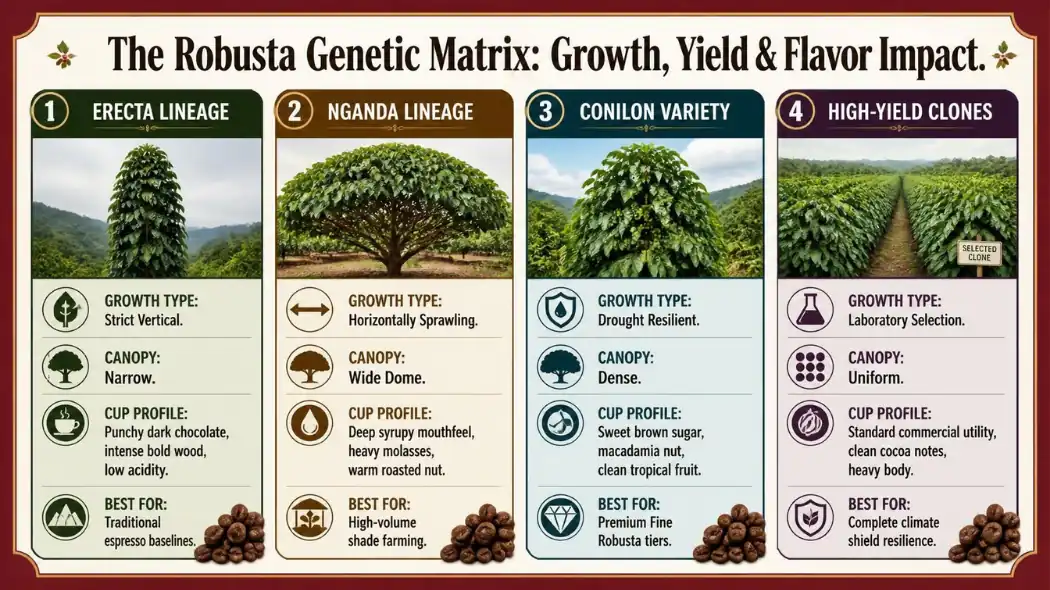
To help you quickly see how these four primary Robusta agricultural branches compare across essential structural, growing, and flavor traits, our team at The Coffee Guide has organized this clean overview matrix:
| Robusta Branch | Growth Style & Canopy | Key Agricultural Strength | Signature Flavor Profile |
|---|---|---|---|
| Erecta Lineage | Strict, vertical columns | Excellent spacing for multi-crop shade environments | Dark chocolate, bold, and traditional woody notes |
| Nganda Lineage | Sprawling, dome canopy | Incredibly dense horizontal fruiting nodes for bulk volume | Immense body, low acidity, heavy molasses, and roasted nut |
| Conilon Variety | Specialized, low-altitude bush | Supreme drought and high-temperature stress resistance | Sweet tropical fruit, macadamia nut, and creamy brown sugar |
| High-Yield Clones | Genetically identical nursery cuts | Complete biological resistance to devastating root pests | Massive, oversized bean density and uniform crop yields |


