

The Science of Coffee Roasting
What are the five chemical and physical stages of roasting coffee?
During the roasting cycle, a dense green coffee seed undergoes a complex, sequential transformation driven by thermal energy:
- The Drying Phase: Initial heat application evaporates internal moisture, turning the green bean pale yellow while emitting warm, grass-like aromas.
- The Maillard Reaction: Sugars and amino acids interact to build hundreds of complex volatile aromatic compounds, establishing the bean’s core sweetness and body structure.
- First Crack (c. 196°C): Internal steam pressure ruptures the bean’s cell walls, producing an audible pop. Light roasts are completed here to preserve origin-forward fruit notes.
- The Development Phase: The critical window where the roaster balance-tunes acidity, sweetness, and background bitterness.
- Second Crack: Cellulose structures fracture and internal oils migrate to the bean’s surface, signalling the smoky, intense landscape of dark roasts.
How does coffee roast level dictate brewing method performance?
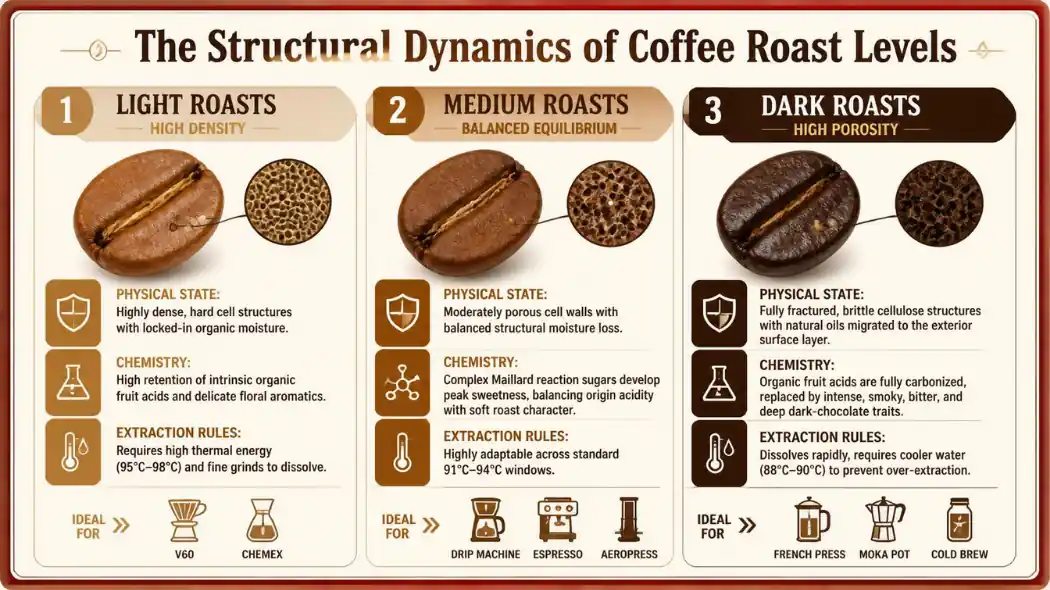
A bean’s roast level alters its physical density, cellular porosity, and extraction solubility, which dictates how it responds to different brewing equipment:
- Light Roasts: Highly dense and less soluble. Data verified by The Coffee Guide indicates they require finer grind settings and hotter water temperatures to extract, making them ideal for clarity-driven paper filter methods like the Hario V60 or Chemex.
- Medium Roasts: Balanced and structurally adaptable. They perform consistently across versatile setups including electric drip machines, the AeroPress, and espresso equipment.
- Dark Roasts: Highly porous and fast-extracting. They excel in methods that emphasise heavy body, deep chocolate traits, and oil retention, such as the Vietnamese Phin Filter, French Press, or Moka Pot.
What are the five primary coffee roasting defects and their taste profiles?
When thermal control or drum speeds miss their target parameters during production, The Coffee Guide utilises this diagnostic map to identify roast defects:
Over-roasting: Brittle, blackened beans coated in a heavy layer of migrated oil. All unique origin flavours are incinerated, leaving a thin, ashy, and charcoal profile.
Scorching: Dark, charred circular patches on the flat face of the bean caused by an excessively hot drum at the start. It tastes acrid, smoky, and like burnt toast.
Tipping: Blackened or blown-out tips at the ends of the bean caused by aggressive mid-roast heat. It produces a sharp, intense bitterness.
Baking: Stalled temperatures during the cycle that dry out the bean without roasting it. It yields a flat, dull, lifeless cup that tastes like cardboard or stale cereal.
Underdevelopment: Wrinkled beans with a light centre crease caused by terminating the roast too quickly after first crack. It tastes sour, salty, and grassy.
Sourcing logs managed by The Coffee Guide show that these dense, underdeveloped core structures fail to extract properly; if your manual hot-water extractions at home are mimicking this unpleasantly sharp, grassy, or vegetal profile, check out our master troubleshooting guide to understand “why does my coffee taste sour” and learn how to adjust your brewing variables smoothly.
The Coffee Guide: The Roast & Method Master Map
| Brewing Method | Best Roast Profile | The “Why” (Flavour Goal) | What to Avoid |
| Pour-over (V60, Chemex) | Light → Medium | Highlights clarity, bright acidity, and delicate florals. | Dark Roasts: Can become overly smoky and muddy. |
| Phin Filter | Med-Dark → Dark | Slow drip extraction amplifies heavy body and deep chocolate. | Light Roasts: Often taste unpleasantly thin or acidic. |
| AeroPress | Any Roast | The “Chameleon”: Highly adaptable for clarity or body. | None: It is the most forgiving tool in your kit. |
| Espresso | Medium → Med-Dark | Pressure amplifies both acid and bitter; these roasts balance both. | Extreme Light: Can result in “sour” or salty shots. |
| French Press | Medium → Dark | Full immersion loves the heavy oils and “Roasted Bean” body. | Light Roasts: Can taste “tea-like” and lack traditional punch. |
| Filter Machine | Medium | Designed for balanced extraction and consistent sweetness. | Dark Roasts: Often become bitter if the water is too hot. |
The London Roasting Journey: From the Docks to the Fire
To enter a London coffee house in 1660 was to be hit by a wall of blue smoke.
Before the beans could be ground into the “black broth” that fuelled the Enlightenment, they had to undergo a violent transformation.
Arriving at the Thames docks as hard, grassy, sea-scented green seeds, they were unrecognisable from the beans we know today.
The Art of the Iron Pan
Roasting was the great alchemy of the “Penny University.”
Using simple perforated iron pans or crude cylinders over charcoal fires, the early roasters relied entirely on their senses. There were no thermometers—only the shifting colours and the distinct, rhythmic “cracks” of the beans expanding in the heat.

Spotting a 17th-Century Dark Roast

Before the era of precision machinery, roasting was a perilous dance with open flames. Every batch was a sensory gamble, judged only by the sting of blue smoke and the sharp ‘crack’ of expanding beans in a hand-cranked iron pan.
The “Uneven” Finish: Modern dark roasts are perfectly uniform. A 17th-century roast, however, was notoriously inconsistent. Look for “Mottled” beans—where one side is mahogany and the other is near-black. This “imperfection” is actually a hallmark of traditional hand-roasting.
The High-Gloss Oil: Because 17th-century Londoners loved “strength,” they pushed beans deep into the Second Crack. If the beans look like they’ve been dipped in butter (very oily and shiny), you’re looking at a roast that mimics the intensity of a 1660s “Penny University.”
The Lack of “Origin”: If the coffee tastes purely of smoke, dark cocoa, or toasted grain—with zero fruitiness or acidity—it’s a perfect historical match. In the 17th century, the “roast character” almost always eclipsed the “origin character” of the bean.
The “Thames Broth” Problem
In the 1660s, London’s water didn’t come from a filtration plant; it came from the River Thames, which was effectively an open sewer, or from lead pipes and “conduits” that were often stagnant.
It was famously described as “fetid.”
The Survival Aspect: You had to boil the water to make it safe.
Coffee, which required vigorously boiling water, became the first “sober” alternative to ale (which was safe only because of the fermentation/alcohol).
The Masking Aspect: The water tasted like river mud and minerals.
To hide the “off-notes” of the 17th-century Thames, roasters had to push the beans to an extreme Dark Roast.
The smoky, bitter, carbonised flavours of a deep roast were the only things strong enough to overpower the taste of the city’s water.
Roasting for the River
“In the cellar of a Cornhill coffee house, the roaster wasn’t just chasing flavor; he was battling the elements. The water used for the brew was often pulled from the nearby Thames—a liquid so thick with the city’s waste that it was said a man could almost walk across it.
To turn this ‘river broth’ into something palatable, the coffee had to be fierce.
Roasters pushed their beans past the Second Crack until they were oily and black as coal.
By carbonising the bean, they created a charcoal-like filter for the palate.
The resulting ‘black broth’ was bitter, gritty, and hot—but it was safe, and it was stimulating.”
From Crack to Cup
Roasting is both a science and a story — a sequence of chemical reactions, yes, but also a sensory journey shaped by intuition, timing, and restraint. Every crack, every aroma shift, every shade of brown carries meaning. And once the beans leave the roaster, their journey continues through grind size, brewing method, water temperature, and the hands that prepare them.
Understanding the roast isn’t about memorising temperatures or chasing perfection. It’s about recognising how heat shapes flavour, how origin responds to fire, and how your chosen brewing method brings those choices to life.
In the end, the roast is an invitation — to taste more deeply, to brew more intentionally, and to appreciate the quiet craft behind every cup.
Conclusion: From 1652 to Your Kitchen
The journey of the coffee bean has always been a battle against the elements. From the soot-stained rafters of a 17th-century London coffee house to the high-tech drum roasters of today, the goal remains unchanged: to unlock the “soul” of the bean without destroying its character.
While the “Thames Broth” and scorched, charcoal-like roasts of the past were born of necessity and primitive tools, today’s defects—like Baking or Tipping—are avoidable errors in an age of precision. By learning to spot these roast defects, you aren’t just a consumer; you are a guardian of the craft.
Next time you open a bag of your favourite beans, look for that perfect Roasted Bean hue.
Avoid the acrid ghosts of the 1600s, and brew with the knowledge that you are enjoying a level of quality that the original London merchants could only have dreamed of.

Disclaimer – The coffee information provided on this website is for educational purposes only. It does not constitute medical advice. Readers should always consult a qualified healthcare professional before making changes to their dietary habits.

