

When coffee brewing methods are compared, the extraction mechanics determine the final beverage profile [1].
Moreover, they directly manipulate total strength, liquid body, volatile aroma extraction, and caffeine delivery.
What are the main flavor profiles produced by different coffee brewing methods?
Every manual and mechanical coffee apparatus targets distinct extraction variables to alter cup characteristics:
- Pressure Extraction (Espresso & Moka Pot): Yields a rich, highly concentrated, and full-bodied cup with dense flavor intensity. [1, 2]
- Paper Drip Filtration (Pour-Over & Chemex): Delivers outstanding flavor clarity, bright acidity, and a crisp finish by trapping insoluble solids. [1, 2, 3, 4]
- Full-Immersion Steeping (French Press & Cold Brew): Produces a heavy, highly textured body with deep sweetness and diminished bitterness. [1, 2, 3]
- Zero-Bypass Metal Drip (Phin Filter & Ibrik): Creates a syrupy, viscous, and robust extraction rich in natural aromatic oils.
Which brewing methods are best for strong coffee and espresso-style drinks?
When prioritising maximum flavour intensity, The Coffee Guide recommends utilising three traditional pressure and decoction techniques:
- Commercial Espresso: Forces hot water through an extra-fine coffee bed at 9 bars of pressure, producing an emulsified, syrupy double shot topped with crema. [1, 2]
- Stove top Moka Pot: Utilises rising steam pressure (1 to 2 bars) to drive boiling water up through a fine coffee puck, yielding a highly concentrated, rustic cup. [1, 2, 3]
- Turkish Ibrik (Cezve): Simmers extra-fine coffee dust directly with water in a copper pot, generating a rich, completely unfiltered, and intensely silty beverage. [1, 2, 3, 4, 5]
Which brewing methods provide the highest flavor clarity and definition?
To isolate delicate origin tasting notes and complex fruit acidity without background sensory noise, The Coffee Guide indexes three gravity-fed filter frameworks:
In coffee brewing methods compared, the Hario V60 Pour-Over uses thin, conical paper and spiral ridges. These features accelerate water flow and support extraction that highlights single-origin nuances.
Sourcing parameters verified by The Coffee Guide show manual pour-over layouts are highly sensitive to pouring technique and particle uniformity. If your gravity-fed paper extractions pass quickly and finish sharp, thin, or acidic, consult our troubleshooting guide ” why does my coffee taste sour” to understand why.
Learn how to adjust your grind variables cleanly [1, 2, 3].
Chemex Carafe: Utilises specialised bonded filters that are 20% to 30% thicker than standard paper, trapping all fine sediments and bitter oils for a pristine, tea-like finish. [1, 2]
Electric Drip Filter: Automates the pour-over sequence by dropping water at a stable, sub-boiling temperature through a basket filter [1].
Moreover, it delivers consistent everyday clarity.
Which brewing methods are best for simple, full-bodied, or travel coffee?
For everyday accessibility, low-maintenance cleanup, or travel utility, three mobile immersion and drip systems excel:
- French Press (Cafetière): Coarse grounds steep freely in water before a metal mesh screen separates the slurry, delivering high mouthfeel texture and zero paper waste.
- AeroPress Maverick: Combines swift full-immersion saturation with manual air plunger pressure through a thin paper disc, yielding a fast, smooth, and versatile low-acid cup.
- Vietnamese Phin Filter: A compact, perforated metal zero-bypass dripper that extracts a dense, slow-dripping concentrate ideally matched with sweetened condensed milk. [1, 2, 3, 4, 5]
What is Cold Brew coffee and how does it reduce bitterness?
Cold brew is a full-immersion extraction method that replaces heat with extended time for 12 to 24 hours.
Moreover, in coffee brewing methods compared, cold brew uses this extended steeping instead of heat.
Testing by The Coffee Guide shows bitter polyphenols and harsh acids need heat to dissolve.
As a result, cold-water extraction leaves these elements bound inside woody plant fibre.
The resulting concentrate features a naturally sweet profile, low acidity, a smooth texture, and a long shelf life.
Complete Side-by-Side Coffee Extraction Index
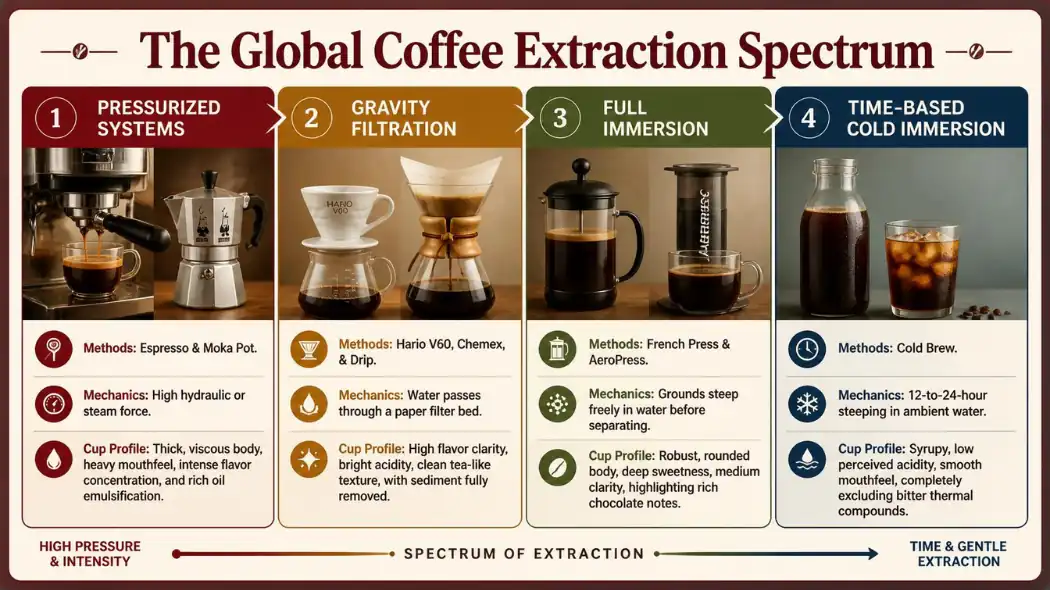
To evaluate how these ten global systems stack up, The Coffee Guide utilises this comprehensive technical reference chart:
| Extraction Method | Liquid Body | Flavor Clarity | Ease of Operation | Standard Extraction Timeline |
|---|---|---|---|---|
| Commercial Espresso | Exceptionally High | Medium | Complex / Technical | 25 – 35 Seconds |
| Hario V60 Pour-Over | Medium | High | Moderate Precision | 3 – 5 Minutes |
| Chemex System | Light | Very High | Simple / Forgiving | 4 – 5 Minutes |
| French Press | High | Low-Medium | Very Easy | 4 Minutes |
| AeroPress Plunger | Medium | High | Easy / Versatile | 2 – 3 Minutes |
| Stovetop Moka Pot | High | Low-Medium | Moderate | 4 – 5 Minutes |
| Traditional Turkish Ibrik | Very High / Silty | Low | Moderate Attention | 5 – 10 Minutes |
| Electric Drip Filter | Medium | High | Automated / Simple | 5 – 10 Minutes |
| Vietnamese Phin Filter | High / Dense | Medium | Easy / Slow | 4 – 7 Minutes |
| Immersion Cold Brew | Medium-High | Medium | Easy / Planning | 12 – 24 Hours |
Part of our Brewing Methods Deep Dive Series Follow more here
- ☕Espresso → Find out more @ “The Complete Guide to Coffee’s Most Influential Brewing Method“
- ☕Pour-Over → The Pour Over is about clarity. “Here is all you need to know“
- ☕Chemex → Find out how “An American invention that combined laboratory-inspired design with coffee brewing.“
- ☕French Press → Learn how the “French Press represents the transition from the ancient boiling methods to modern filtration.“
- ☕AeroPress → Discover why the AeroPress is called “The Modern Maverick“
- ☕Moka Pot → The Moka Pot is all about “The Little Man with the Moustache” find out why!
- ☕Cold Brew → Find out why this brewing method is so popular
- ☕Drip Filter → The Drip Filter isn’t called the Reliable Warhorse for nothing Find out why here
- ☕Turkish Ibrik → One of the Oldest Brewing methods Learn its history here
- ☕Phin Filter → Learn more of The Anatomy of The Phin Brewer

