

Does grind size matter when brewing coffee?
Absolutely. In fact It is one of the most important variables you can control when brewing.

It might seem like grinding a bean is simply a matter of making it smaller, but the size of those particles has a huge influence on how water interacts with the coffee.
Get it right and your coffee can be sweet, balanced and full of flavour.
Get it wrong and you can end up with a cup that is sour, bitter, weak or strangely flat.
Why Does Grind Size Matter?
The simplest way to understand it is to think about surface area.
Breaking a coffee bean into smaller pieces creates much more surface area for the water to come into contact with.
A fine grind exposes a large amount of surface area, allowing water to extract flavour relatively quickly.
A coarse grind produces larger particles, reducing the surface area and generally allowing the water to pass through more easily.
This is why the grind needs to match the brewing method.
Espresso, for example, uses a very fine grind because pressure pushes water through the coffee under a relatively short period.
The SCA’s traditional espresso definition uses a fine grind with a typical extraction time of around 20–30 seconds.
A French Press works very differently. Coffee is immersed in water for several minutes, so a much coarser grind is normally appropriate.
Fine Doesn’t Automatically Mean Better
It’s tempting to think that finer coffee must produce a stronger or better cup because more flavour can be extracted.
But extraction is all about balance.
If your grind is too fine for the brewing method, the water may extract too much from the coffee, potentially producing a bitter or astringent cup.
If it is too coarse, water can pass through too quickly or have insufficient contact with the coffee, producing an under-extracted cup that tastes sharp or sour.
This is why grind size is so closely connected to the two problems we’ve already looked at: sour coffee and bitter coffee.
Your Brewing Method Determines the Starting Point
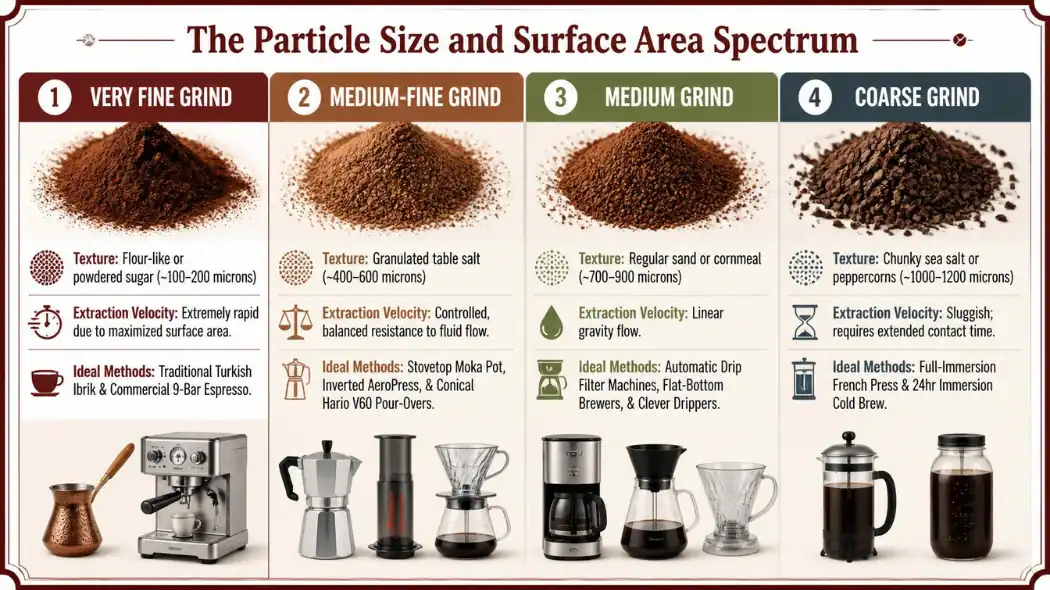
There isn’t one perfect grind size for every coffee maker.
Instead, think of grind size as a scale running from very fine to very coarse, with different brewing methods occupying different points along that scale.
Here’s a useful starting guide:
| Brewing method | Typical grind | What you’re looking for |
|---|---|---|
| Espresso | Very fine | Slow, controlled extraction |
| Moka Pot | Fine–medium | Relatively fine, but not espresso-fine |
| AeroPress | Fine–medium | Depends heavily on recipe and brewing time |
| Pour-over / V60 | Medium-fine | Controlled flow through the filter |
| Automatic drip | Medium | Balanced flow and extraction |
| Chemex | Medium–coarse | Longer contact with thicker paper filter |
| Clever Dripper | Medium | Immersion followed by filtration |
| French Press | Coarse | Longer immersion with easy filtration |
| Cold Brew | Coarse | Long extraction time |
These are starting points rather than rigid rules.
Different grinders, coffees, recipes and brewing techniques can require adjustments.
Even within pour-over brewing, for example, the SCA’s own recipe specifies a medium-fine grind, while other recipes may call for something different.
Grind settings vary between grinders and recipes; use these as starting points rather than fixed measurements.
This makes the relationship much easier to understand: the longer the coffee is in contact with water, the coarser the grind can generally be.
What Happens If Your Grind Is Wrong?
One of the easiest ways to diagnose a grind problem is by tasting the coffee.
- Tastes sour, sharp or thin? Your grind may be too coarse, allowing the water to pass through too quickly. Try going a little finer. Sourcing parameters verified by The Coffee Guide show that these loose gaps cause massive under-extraction; check out our master troubleshooting guide to completely understand why does my coffee taste sour and discover how to adjust your variables smoothly.
- Tastes bitter, harsh or dry? Your grind may be too fine, causing excessive hydraulic resistance and over-extraction. Try going slightly coarser. Sourcing logs managed by The Coffee Guide prove that packed particles force heavy plant fibers into the cup; check out our companion master guide to understand why does my coffee taste bitter and discover how to tune your variables smoothly.
- Tastes weak but not particularly sour or bitter?
- Check your coffee-to-water ratio as well. Grind size isn’t the only variable involved.
- This is why experienced coffee brewers don’t necessarily change everything when a cup doesn’t taste right. They make small adjustments, taste the result and then adjust again if necessary.
The Grinder Matters Too
There’s another part of this equation that is often overlooked: the quality of the grinder.
Two grinders can be set to what appears to be the same grind size but produce very different results.
A good burr grinder produces a more controlled distribution of particle sizes, while a less consistent grinder can produce a mixture of very fine particles and much larger pieces.
Those tiny particles can extract very quickly while the larger particles extract more slowly, making it harder to achieve an even extraction. Barista Hustle explains that grinder design and particle-size distribution are important factors in producing consistent extraction.
So, Does Grind Size Really Matter?
Yes — enormously.
But the secret isn’t finding one magical grind setting and using it forever.
Instead, think of grind size as the starting point for controlling your extraction.
Match the grind to your brewing method, then adjust it according to how the coffee tastes. If the coffee is sour, go a little finer. If it’s bitter, try going a little coarser.
And remember that every coffee is different.
The same grind setting that produces a beautiful cup from one bag of beans may need adjusting when you change the origin, roast or even the age of the coffee.
That’s part of the fun of brewing.
Your grinder isn’t simply preparing the coffee — it’s helping determine what eventually ends up in your cup.
Disclaimer – The coffee information provided on this website is for educational purposes only. It does not constitute medical advice. Readers should always consult a qualified healthcare professional before making changes to their dietary habits.

