

Quality vs Volume: Why the Harvest Matters
When we talk about coffee quality, our attention often turns to roasting, processing and brewing. We discuss fermentation techniques, roast profiles and extraction methods, all of which influence the flavour in our cup. But there’s an earlier stage that deserves just as much attention: harvesting coffee beans
.
Before a coffee bean reaches a processing mill, roastery or coffee shop, it has to be picked from the tree. How and when that happens can make a considerable difference to the quality of the finished coffee.
One of the challenges is that coffee cherries don’t all ripen at the same time. A single branch can carry green, unripe cherries alongside ripe red or yellow fruit and cherries that have become overripe. Picking them all together creates a mixed harvest, with each stage of ripeness potentially contributing different characteristics to the final cup.
This is why harvesting involves more than simply removing the fruit from the tree. Producers must decide how much attention to give each cherry, how quickly the crop needs to be collected and how much labour or machinery is available. These decisions often come down to balancing quality, cost and the size of the harvest.
There are three main approaches to consider: selective handpicking, manual strip picking and mechanical harvesting. Each has its advantages, and the most suitable method depends on the farm, its terrain, available resources and the type of coffee being produced.
Method 1: Selective Picking (The Hand-Picked Barista Gold Standard)
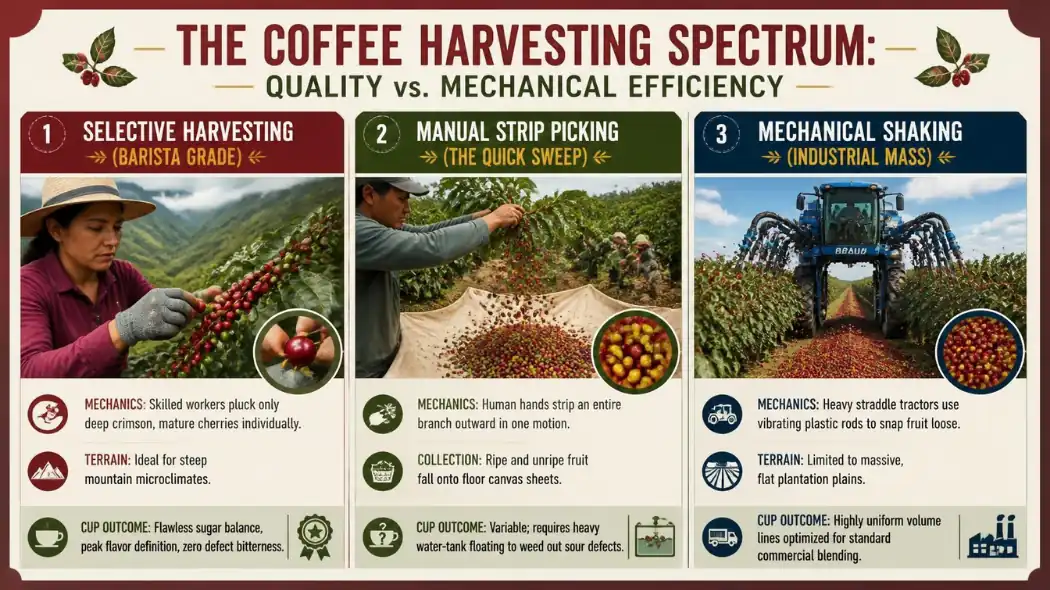
Selective picking involves harvesting individual coffee cherries when they have reached the desired stage of ripeness. Rather than stripping an entire branch, pickers move through the coffee plants and choose the fruit that is ready, leaving the less mature cherries to ripen before a later picking.
For many specialty coffee producers, this is the preferred approach because it allows greater control over the ripeness of the harvested fruit. The colour of a cherry is an important visual guide, although the precise colour at maturity depends on the coffee variety. Many ripe cherries turn red, while others naturally ripen to yellow.
Ripeness matters because the fruit changes as it develops. Picking too early can mean that the beans have not reached their full developmental potential, while overripe or damaged cherries can introduce unwanted variation into a batch. Careful selection helps producers start the processing stage with a more consistent crop.
There is, however, a considerable amount of work involved. Coffee pickers may need to return to the same trees several times as different cherries reach maturity. On steep hillsides, where many high-quality Arabica coffees are grown, harvesting can be particularly demanding.
Labour costs can also be high, especially where workers must travel between widely spaced plants or work on difficult terrain. For farms targeting premium markets, the additional expense may be worthwhile, but selective picking isn’t practical or necessary for every producer.
The key advantage is control. By selecting cherries at the appropriate stage of ripeness, producers have a better starting point for producing a consistent, high-quality coffee.
Method 2: Strip Picking (The High-Velocity Manual Balance)
Strip picking takes a different approach. Instead of selecting individual cherries, the picker removes most or all of the fruit along a branch in one sweeping movement. The cherries may be removed by hand or with the help of simple tools, often falling onto a sheet or collection surface beneath the plant.

The main advantage is speed. A worker can collect a larger quantity of fruit in less time than would normally be possible through selective picking. This can be useful where labour is limited, harvesting costs need to be controlled or weather conditions make it important to bring the crop in quickly.
The trade-off is that the harvest is likely to contain cherries at different stages of ripeness. Alongside mature fruit, there may be green cherries, overripe fruit and other plant material. The mixture needs to be sorted before or during processing to remove unwanted material and improve consistency.
Sorting can involve hand selection, sieving, flotation or mechanical equipment, depending on the farm and the facilities available. Flotation can help separate some less-dense cherries from denser fruit, although it doesn’t identify every defect or replace all other sorting methods.
Strip picking can therefore save time in the field while creating additional work later. Whether it is the better option depends on the costs involved, the quality targets and the producer’s ability to sort the harvest effectively.
It is worth remembering that harvesting methods alone don’t determine whether a coffee will taste good or bad. The condition of the cherries, the effectiveness of sorting and the care taken during processing all play important roles.
Method 3: Mechanical Harvesting (The Industrial Scale Vector)

Harvesting machines use vibrating rods or similar mechanisms to shake coffee plants, causing ripe cherries to fall onto collection systems. The equipment and its settings influence how much fruit is removed, and some machines can be adjusted to favour cherries that detach more readily. However, unripe fruit may also be collected, so further sorting is often necessary.
The biggest advantage is productivity. A machine can cover large areas much more quickly than a team of workers picking each cherry by hand. This can reduce the amount of labour required per unit of coffee harvested and help farms manage their costs.
There are practical limitations. Traditional mechanical harvesters work best on relatively even ground, with suitable spacing between the rows and enough room for the machinery to move safely. Steep slopes, irregular terrain and certain planting systems can make mechanisation difficult or uneconomical.
Mechanical harvesting also requires investment in equipment, maintenance and suitable farm infrastructure. It isn’t simply a matter of replacing workers with a machine; the farm must be designed or adapted to make the system effective.
When used appropriately, mechanical harvesting can produce good-quality coffee. The final result depends on factors such as fruit maturity, machine settings, sorting and subsequent processing. Although selective picking offers greater control over individual cherries, machinery can be a sensible option for producers working at a much larger scale.
On large coffee farms, particularly in parts of Brazil where the landscape is suitable, mechanical harvesting can make it possible to collect substantial quantities of fruit efficiently.
How Does Harvesting Coffee Beans Affect the Taste of Coffee?
The condition of the cherries at harvest can influence what happens during processing and, ultimately, the flavours that develop in the finished coffee.
Under-ripe cherries may contain beans that have not completed their normal development. Depending on the circumstances and the rest of the processing, they can contribute harsh, grassy or astringent characteristics. Overripe, damaged or deteriorating fruit can create different challenges, particularly if it is not handled and processed promptly.
These effects aren’t automatic, however. Coffee flavour is influenced by several interacting factors, including the variety, growing conditions, ripeness, processing method, storage, roasting and brewing. It would be misleading to blame every bitter or sour cup on the way the cherries were harvested.
For example, if a coffee tastes unpleasantly bitter, the cause might lie in the roast or extraction rather than in the original harvest. Similarly, a sharp or sour cup can result from under-extraction, although acidity can also be a desirable part of a coffee’s natural flavour profile.
If you’re trying to understand why a particular cup doesn’t taste as expected, it’s useful to consider the entire journey from the tree to the cup rather than assuming that one stage is responsible.
You can explore the brewing side of the subject in our guide to why coffee tastes bitter and our guide to why coffee tastes sour. These links should point to the relevant articles once their correct page addresses have been confirmed.
Comparing the Three Harvesting Coffee Beans Methods
Each harvesting method offers a different balance between selectivity, speed and cost.
Selective handpicking gives workers the opportunity to choose individual ripe cherries. It is particularly useful when quality and consistency are priorities, but it requires considerable labour and may involve repeated visits to the same plants.
Manual strip picking allows workers to harvest more quickly by removing fruit along a branch in one movement. It can reduce the time spent picking, but the mixed harvest usually needs more attention during sorting.
Mechanical harvesting can collect large quantities of coffee quickly on farms with suitable terrain and infrastructure. It can be highly efficient, although the quality of the harvested fruit depends on machine settings, maturity and subsequent sorting.
None of these methods is automatically the best choice for every farm. A small producer growing specialty Arabica on a steep mountainside faces very different conditions from a large commercial operation on flatter land. The right decision depends on the crop, the landscape, the resources available and the quality the producer wants to achieve.
From Harvest to Your Cup
Harvesting is the beginning of an important sequence of decisions that shape a coffee’s journey. Once the cherries have been collected, producers must decide how to process them, how to dry and store the beans, and how to prepare them for roasting.
Careful harvesting gives the producer a better starting point, but it is only one part of the process. Good coffee depends on attention at every stage, from growing and picking the fruit to processing, roasting and brewing the beans.
The next time you enjoy a cup of coffee, it’s worth remembering that its character began developing long before the beans reached the roastery. The way those cherries were selected and collected helped set the course for everything that followed.


