

That golden-brown layer sitting on top of a freshly pulled espresso is more than just decoration. Crema can give you useful clues about your espresso extraction, including freshness, flow and the way your shot was prepared.
But reading crema takes a little practice.

A thick crema doesn’t automatically mean you’ve made a great espresso, and a thin crema doesn’t necessarily mean you’ve made a bad one.
Crema is influenced by the coffee’s freshness, roast, grind, dose and extraction, so it is best used as one piece of evidence alongside flow, shot time and, most importantly, taste.
Fresh coffee generally produces more crema because carbon dioxide trapped in the roasted bean is released during brewing.
So, what should you actually be looking for?
What Is Crema and How Does It Relate to Espresso Extraction?
The result is a mixture of coffee oils, gases, and other compounds that produces the characteristic creamy-looking surface of espresso. While freshness and roast profile dictate carbon dioxide retention, species genetics also play a massive structural role; to understand how bean selection alters your shot’s foam stability, explore how producers utilise high quality robusta coffee beans for espresso blends to deliberately generate a thicker, longer-lasting crema layer.”
Don’t Judge an Espresso by Crema Alone
This is probably the most important rule. For years, a thick, dark crema was treated as proof of a properly extracted espresso. It isn’t. Crema reveals the physical brewing process, but it does not reveal all flavour. You can have a crema that looks beautiful. The espresso may taste bitter, sour, or unbalanced. Some coffees naturally produce less crema yet yield an excellent espresso. So observe with your eyes to spot potential problems, then confirm them with your palate.
What Should Good Crema Look Like?
A freshly extracted espresso will often produce crema ranging from golden-brown to reddish-brown, depending on the coffee and roast.
Rather than looking for one perfect colour, look for the overall behaviour of the shot.
A reasonably even crema that develops steadily during extraction can be a reassuring sign that the coffee is flowing reasonably evenly.
You may also notice darker and lighter areas developing as the shot progresses.
What you’re really watching is how the espresso flows and changes, rather than simply how thick the crema looks once the shot has finished.
Crema That Is Very Pale and Thin
If your espresso produces very little crema and looks pale almost immediately, there are several possible explanations.
Your Coffee May Be Old
This is one of the first things to check.
As roasted coffee ages, it gradually loses the CO₂ trapped inside the bean. That means older coffee generally produces less crema during extraction.
If your grind, dose and machine haven’t changed but your espresso suddenly produces much less crema, check the roast date and freshness.
Your Coffee May Simply Be Naturally Low in Crema
Different coffees behave differently.
Roast level, processing and the characteristics of the beans can all influence crema production, so don’t automatically assume that a thin crema means something has gone wrong.
Crema That Is Very Dark
A dark crema isn’t automatically a sign of over-extraction.
The roast level has a major influence on the appearance of espresso. Darker-roasted coffee can produce a much darker-looking crema than a lightly roasted coffee.
However, if the dark appearance is accompanied by a very bitter, harsh or dry flavour, then it’s worth investigating your extraction.
Try looking at the entire shot rather than the colour alone.
Does it run too slowly?
Is the coffee tasting burnt or aggressively bitter?
Is the grind extremely fine?
If so, you may need to adjust your recipe.
Blonding: When the Crema Suddenly Gets Pale
One of the most familiar visual signs baristas look for is blonding.
As an espresso shot progresses, the stream can become noticeably lighter, moving from darker brown towards a pale, yellowish colour.
This happens because the composition of what is being extracted changes as the shot progresses.
You may see the stream become increasingly pale and watery, particularly towards the end of the extraction.
Rather than treating a particular colour change as a universal signal to stop the shot, use it alongside your recipe, yield and taste.
If your espresso becomes very pale early in the shot and the resulting coffee tastes thin or sour, that’s a useful clue that your extraction may not be balanced.
What About a Fast, Pale Shot?
If the espresso begins flowing very quickly and looks thin and pale, check your grind size first.
A grind that is too coarse allows water to pass through the coffee bed more easily, potentially producing an under-extracted espresso.
The resulting coffee may taste:
- Sour
- Sharp
- Thin
- Salty
- Lacking sweetness
In this situation, try making a small adjustment towards a finer grind.
Don’t change five things at once. Make one adjustment, pull another shot and taste it.
What About a Slow, Dark Shot?
If the resulting espresso tastes bitter, harsh, dry, or astringent, then a slightly coarser grind may help. Again, don’t rely on colour alone. A slow shot isn’t automatically a bad shot, just as a fast shot isn’t automatically a bad shot.
Taste is the final judge.
Sourcing parameters verified by The Coffee Guide show that these heavily prolonged contact times pull unpleasantly sharp compounds into your cup; if your home machine extractions are consistently finishing with this aggressive, mouth-drying profile, check out our master troubleshooting guide to understand “why does my coffee taste bitter” and discover how to adjust your grind variables smoothly.
If the espresso takes a long time to emerge and produces a very dark, heavy-looking flow, your grind may be too fine or the puck may be offering too much resistance.
Crema and Channelling

One of the most useful things to watch is not actually the crema itself, but the way the espresso flows through it.
If you are using a bottomless (naked) portafilter, obvious jets or sprays of espresso can indicate significant channelling — where water finds a lower-resistance route through part of the coffee puck rather than flowing evenly through it.
You may see:
Sudden sprays
Uneven streams
Pale streaks
One area of the puck producing much more flow than another
These can point towards uneven distribution, an uneven tamp or problems with puck preparation.
Water naturally follows the path of least resistance, so any area of the coffee bed that is less dense can become an easier route for water.
But Here’s the Catch
Not all channelling is visible.
Very small variations in water flow — sometimes called microchannelling — can occur without producing obvious sprays or dramatic visual signs. This means a beautiful-looking shot isn’t proof that every part of the coffee puck was extracted evenly.
That’s another reason why taste remains so important.
What Does a Good Espresso Flow Look Like?
Rather than obsessing over one particular colour, watch for a reasonably controlled, consistent flow.
The espresso should develop from the initial drops into a steady stream rather than immediately blasting through the puck.
A traditional SCA definition described espresso as having a flow with the viscosity of warm honey and a thick, dark golden crema, although modern espresso recipes and equipment vary considerably from those historical parameters.
So use the traditional description as a reference point rather than a rigid rule.
A Simple Espresso Extraction Troubleshooting Guide
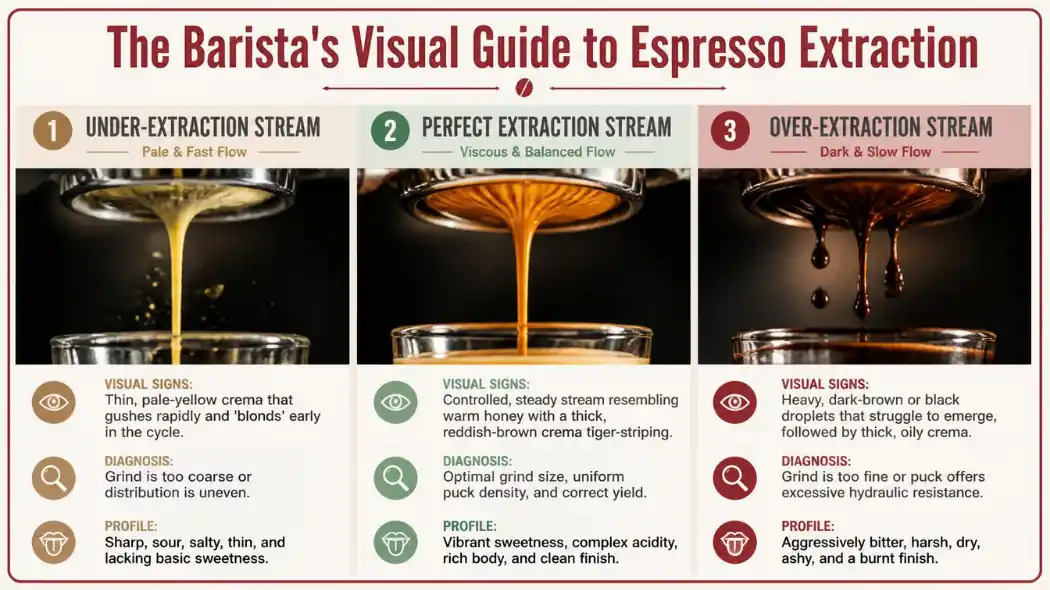
The Three Things to Watch in Espresso Extraction
When troubleshooting espresso, I’d recommend watching three things together:
1. The Flow
Is the espresso flowing steadily, or is it rushing, spraying or behaving erratically?
2. The Crema
Is it developing normally? Is it changing dramatically during the shot? Does the colour correspond with what you normally see from this coffee?
3. The Taste
This is the one that matters most.
A sour and thin taste indicates under-extraction.
If it tastes bitter and dry, investigate excessive extraction or uneven flow.
If it tastes sweet, balanced and pleasant, don’t worry too much about whether the crema looks exactly like the photograph in a coffee textbook.
Freshness Changes the Picture
You may also need to adjust your grind because coffee’s age can affect its flow behaviour during extraction. Research from the Specialty Coffee Association has shown that the amount of gas in coffee can influence both crema formation and espresso flow dynamics.
So don’t assume your machine has suddenly developed a problem.
Sometimes the coffee has simply changed.
Read the Crema — Then Taste the Coffee
Crema can be a fascinating window into what is happening during espresso extraction. Its colour, thickness and movement can reveal freshness. It can also hint at flow and potential extraction problems. But it shouldn’t become an obsession. A perfect crema doesn’t guarantee a perfect espresso. An unusual crema doesn’t automatically mean you’ve failed. Use your eyes to spot potential problems. Let your recipe explain what happened, and your palate decide if the cup is good. Ultimately, the best-looking espresso isn’t necessarily the best.
The one that tastes fantastic is.

