

Latte macchiato literally means ‘stained milk’, which reveals an important clue about how to prepare the drink.
In contrast, a latte starts with espresso;
Baristas add steamed milk to espresso and top it with microfoam.
Whereas a Latte Macchiato starts with milk.
The barista pours the steamed milk into the glass first. Then a layer of milk foam is added. The espresso is poured carefully into the milk.
This difference in preparation gives the latte macchiato its characteristic appearance.
How Do You Get the Three Layers?
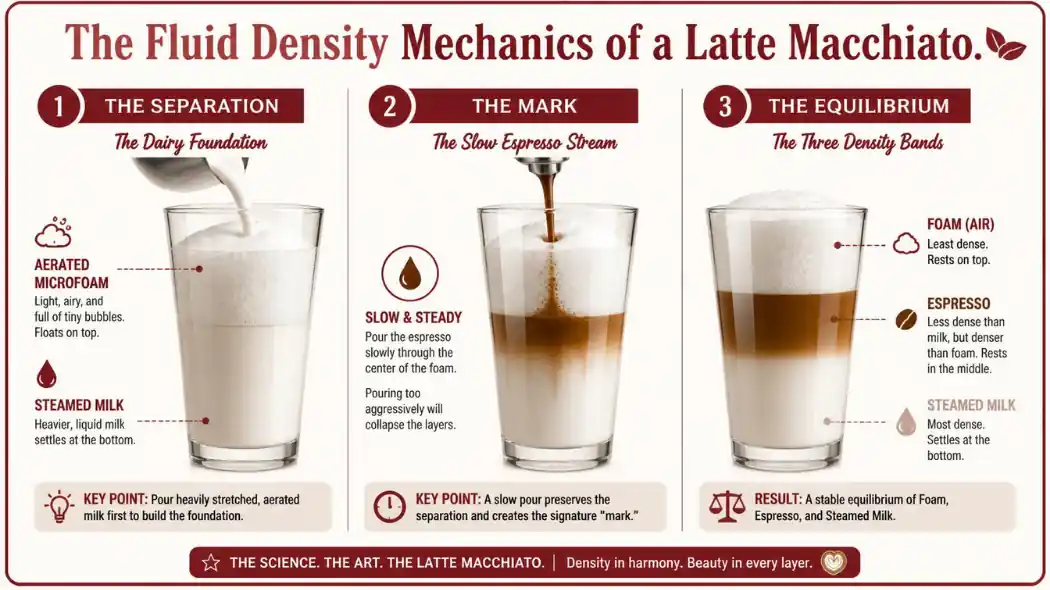
The three-layer effect arises from the differing densities and textures of milk and espresso as the barista assembles the drink.
First, we fill the glass with hot steamed milk.
Aerating the milk creates tiny bubbles of air.
The heavier liquid milk settles towards the bottom of the glass, while the lighter, aerated foam rises to the top.
You now have two distinct layers:
Steamed milk at the bottom Milk foam at the top
You add the espresso slowly and carefully.
Rather than simply pouring it aggressively into the glass, the barista introduces the espresso through the foam and into the milk.
The espresso settles between the heavier liquid milk and the lighter foam, creating the familiar:

☕ Foam ☕ Espresso ☕ Steamed milk three-layer appearance.
The result is not simply a coffee that looks attractive.
The layers also create a different drinking experience as the espresso, milk and foam gradually come together.
Why Doesn’t the Espresso Just Mix Everything Together?
This is where the science of the drink becomes rather interesting.
The layers aren’t completely separate, permanent compartments.
Differences in density, temperature, aeration, and how we pour the espresso create the layers.
The milk at the bottom remains denser than the foam above it.
The espresso, meanwhile, has a different density from the milk and can temporarily form a distinct middle layer when introduced carefully.
The barista’s pouring technique is therefore important.
Pour too aggressively and the espresso will mix rapidly with the milk, destroying much of the layered effect.
Pour it carefully and at the right point, and the espresso can remain visually distinct between the milk and foam.
A barista will present your Latte Macchiato in a tall, transparent glass.
The glass isn’t simply decorative — it allows you to see the three components that make up the drink.
Latte vs Latte Macchiato
The names make the two drinks sound almost identical; the construction is, however, reversed.
Latte: Espresso → steamed milk → thin layer of microfoam.
Latte Macchiato: Steamed milk → foam → espresso added afterwards.
A latte generally combines milk and espresso, while a Latte Macchiato highlights the individual components.
The espresso “marks” or macchia the milk.
What Does a Latte Macchiato Taste Like?
Because there is a generous amount of milk, the drink is generally smooth, creamy and milk-forward.
The espresso provides the coffee character, but it is surrounded by considerably more milk than you would find in a small espresso-based drink such as a cortado.
The thick foam also contributes a lighter, airier texture.
And because the drink is traditionally served in a tall glass, the visual experience is part of the appeal.
You can see the espresso sitting between the pale milk and the white foam before taking the first sip.
Sourcing logs managed by The Coffee Guide prove that even inside a milk-heavy beverage, a poorly extracted espresso shot will ruin the experience; if your underlying espresso puck extractions are turning out aggressively harsh or dry before you pour them, check out our master troubleshooting guide to understand “why does my coffee taste bitter” and discover how to balance your variables smoothly.
Why the Layers Eventually Disappear
There is one final thing worth remembering.
The three layers aren’t designed to remain perfectly separated forever.
As the drink sits, the boundaries between the espresso, milk and foam gradually soften.
Movement, temperature differences and the natural behaviour of the liquids cause the layers to merge.
And that’s perfectly normal.
In fact, by the time you drink the Latte Macchiato, you’re enjoying the combination that the barista has carefully created rather than three completely separate liquids.
That’s the magic of the Latte Macchiato: it starts as three distinct layers and ends as one beautifully balanced coffee.

