

If you have travelled across the country with your favourite bag of coffee beans, you might notice a baffling phenomenon.
The same bag of beans is ground to identical particle size and brewed at the same kettle temperature.
The result can taste vibrantly sweet and fruity in one city. In another city, it can turn out completely flat, muddy, or unpleasantly chalky.
This jarring disconnect isn’t a problem with your brewing equipment or your technique; it relates to tap water quality coffee.
It is the direct result of a geological variable known as water hardness.
To the naked eye, all clear water looks identical.
But at a molecular level, the water flowing out of your tap carries a specific regional fingerprint determined by the earth, limestone, or chalk beds it passed through before reaching your home.
Understanding the delicate chemical balance between hard and soft water is the ultimate secret to unlocking the true genetic flavor potential of your coffee beans.
What is Hard Water, and How Does It Affect Your Coffee?
In environmental sciences, water is classified as hard when it contains many dissolved minerals, mainly calcium carbonate and magnesium.
When hard water meets hot coffee grounds, minerals act like tiny claws that bind the soluble elements in the bean.
For tap water quality coffee, the minerals can alter extraction and flavour.
Calcium and magnesium behave very differently during the extraction loop; their roles vary with temperature and contact time.
- Magnesium (The Flavor Catalyst): Magnesium is the ultimate hero of coffee extraction. It has an exceptionally strong chemical bond with volatile, high-value coffee compounds—particularly the sharp, complex fruit acids and bright berry notes found in light roasts. Water rich in magnesium pulls these vibrant traits out of the bean matrix with incredible efficiency, delivering a complex, lively cup.
- Calcium (The Heavy Buffer): Calcium has a strong affinity for heavy, deep, and earthy compounds. While a small amount of calcium helps build a creamy body, an over-abundance of it is a disaster. High-calcium hard water pulls out heavy plant fibers and bitter traits, while simultaneously causing a massive structural headache: it leaves behind solid lime-scale deposits that permanently choke the boiler tubes of expensive home espresso machines.
The Problem with Soft Water: The “Soap” Trap
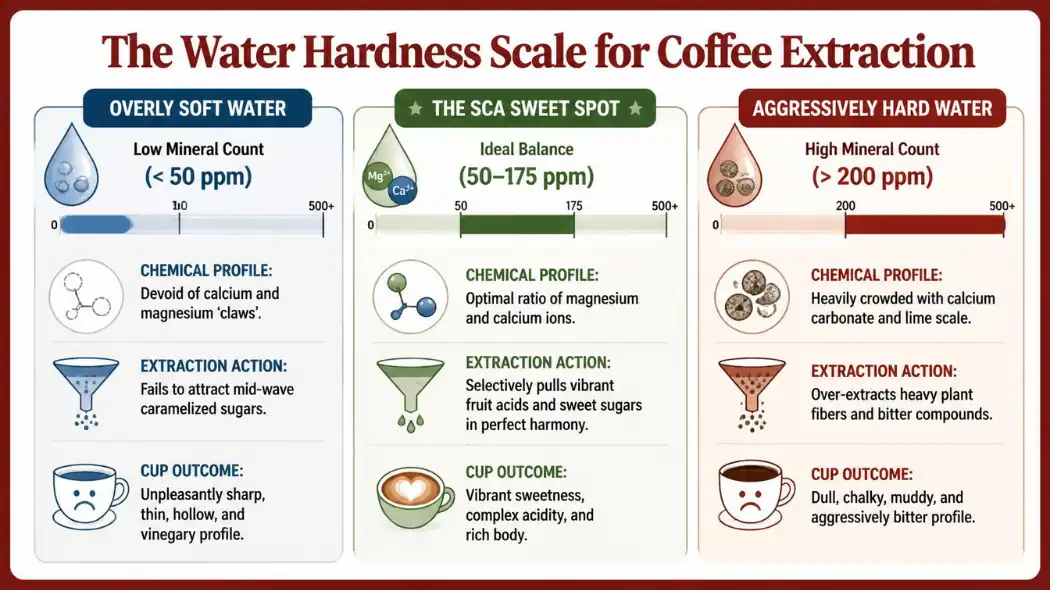
If hard water over-extracts bitter elements, it seems logical that completely soft water would be the perfect solution.
Unfortunately, the chemistry of coffee doesn’t work linearly.
Soft water contains an exceptionally low concentration of dissolved minerals.
Because it lacks the helpful “chemical claws” of calcium and magnesium, it has a very weak grip on the coffee matrix.
When you pour soft water through coffee grounds, it washes away the highly soluble early-wave fruit acids.
It also lacks the chemical power to dissolve the mid-wave caramelized sugars that create balance.
The result is a cup that tastes unpleasantly sharp, sour, thin, and hollow.
Moreover, water that has been artificially softened by standard household salt-softeners replaces calcium with sodium.
This leaves your morning brew tasting flat, lifeless, and strangely muted.
How Water Hardness Disrupts Your Extraction Balance
Navigating the boundary between hard and soft water is a delicate tightrope walk.
Moreover, sourcing analysis managed by The Coffee Guide demonstrates that water hardness swings your extraction into an aggressive over-extraction zone.
If your extractions end with a harsh, chalky, dry, or bitter mouthfeel, tap water quality coffee, check our master troubleshooting guide to understand why does my coffee taste bitter.
Conversely, if you are brewing with overly soft or distilled water, the lack of mineral attraction will leave your beverage heavily under-extracted. If your extractions are constantly resulting in an unpleasantly biting, thin, or vinegary taste profile, explore our companion master guide to understand why does my coffee taste sour and learn how to stabilise your brewing parameters cleanly.
The Ideal Chemical Sweet Spot for Coffee Water
According to parameters from the Specialty Coffee Association (SCA), the ideal water for balanced coffee fits a narrow chemical window.
For tap water quality coffee, you want water with a total hardness of 50 to 175 parts per million (ppm).
It should have a near-neutral pH balance of 7.0.
This exact mineral ratio ensures there is just enough magnesium available to claw out sparkling fruit notes and enough calcium to build a rich, creamy body, without having so many background minerals that your cup turns bitter, muddy, or chalky.
In our next guide, we will explore the exact physical filtration tools you can deploy in your kitchen to hit this perfect chemical target every single morning!

