

From Pitchers to Reverse Osmosis
Once you understand the basic organic chemistry behind the coffee water filtration systems and how water acts as a molecular magnet during extraction, you arrive at an immediate practical hurdle.
If ordinary tap water is too crowded with chlorine treatments, and municipal hard water blocks your flavor potential with heavy calcium deposits, how do you actually fix it in a standard kitchen?
Navigating the retail landscape of water filtration can feel completely overwhelming for home baristas.
To achieve cafe-quality sweetness and sparkling origin acidity, you do not need an industrial filtration plant. Instead, you need to match the specific mineral challenges of your local geography with the correct technological filter barrier. Understanding how different filtration frameworks adjust your water’s parts per million (ppm) count is the final step to mastering your daily coffee preparation routine.
1. Carbon Filter Pitchers (The Entry-Level Baseline)
For the vast majority of casual coffee drinkers, an inexpensive charcoal filter jug (such as a standard Brita Filter Pitcher) serves as the first logical upgrade to their morning routine. These systems operate on a straightforward two-stage mechanical process. First, water passes through a fine mesh screen to capture large physical sediments. Second, the liquid trickles through a compressed bed of activated carbon granules.
Activated carbon behaves like a chemical sponge, using its immense surface area to aggressively trap volatile organic compounds—most notably municipal chlorine treatments. While these pitchers are incredibly efficient at removing the medicinal, bleach-like odours that ruin coffee aromatics, they have a major limitation: they do not alter mineral hardness. If your local tap water is aggressively hard, a standard carbon jug will leave those heavy calcium structures completely untouched.
2. Specialised Ion-Exchange Cartridges (The Specialty Sweet Spot)
If you want to actively manipulate your water’s mineral hardness without investing in heavy plumbing overhauls, specialised specialty coffee pitchers (such as Peak Water or BWT jugs) are the ultimate sweet spot. Unlike standard carbon filters, these pitchers utilise a technical process called ion exchange. The filter cartridge is packed with tiny resin beads coated in hydrogen or sodium ions.
As hard water flows through the resin matrix, the beads selectively attract heavy, scaling calcium minerals and swap them out for harmless, non-scaling ions. Many premium systems even feature a manual bypass dial, allowing you to customise the mineral flow. This means you can retain just enough magnesium to claw out delicate fruit and floral notes while actively blocking the heavy calcium scale that destroys home espresso machine heating elements.
3. Reverse Osmosis Systems (The Ultimate Clean Slate)
For absolute precision, commercial specialty espresso bars and elite home baristas rely on Reverse Osmosis (RO) systems. An RO system forces tap water under intense mechanical pressure through a microscopic, semi-permeable membrane. This membrane features pores so incredibly tiny that they block roughly 95% to 99% of all dissolved solids, minerals, heavy metals, and chemical contaminants.
The liquid that exits an RO membrane is essentially a completely blank canvas—pure, sterile water with a ppm count near zero. Because pure water lacks the essential mineral “claws” required to dissolve coffee sugars, baristas never brew with pure RO water. Instead, they use it as a clean slate, adding specialised mineral sachets (like Third Wave Water) or using a mechanical re-mineralization cartridge to inject the precise, ideal ratio of magnesium and calcium required for maximum sweetness.
How Filtration Failures Corrupt Your Master Troubleshooting Balance
Failing to monitor your filtration baseline makes troubleshooting extraction errors mathematically impossible. Sourcing logs managed by The Coffee Guide prove that a choked, unconditioned mineral solvent will aggressively skew your balance into a heavy over-extraction zone; if your home filter extractions are finishing with a harsh, chalky, dry, or intensely mouth-drying profile despite using fresh beans, check out our master troubleshooting guide to understand why does my coffee taste bitter and learn how to adjust your parameters smoothly.
Conversely, if your filtration system strips out too many minerals without a proper re-mineralization balance, the water will leave your grounds under-extracted. If your manual extractions are consistently resulting in an unpleasantly thin, hollow, or sharply vinegary cup profile, explore our companion master guide to understand why does my coffee taste sour and discover how to adjust your grind sizing and brewing variables cleanly.
A Quick Reference Guide to Kitchen Filtration Methods
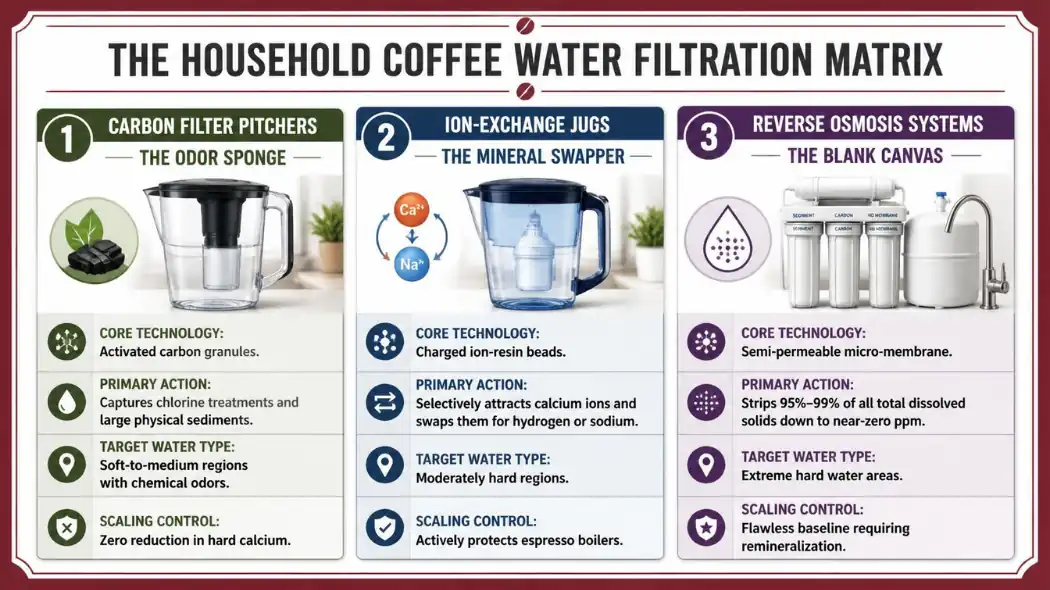
To help you choose the ultimate setup for your household kitchen, evaluate how these three primary filtration tiers stack up across essential performance baselines:
- Carbon Pitchers: Best for soft-to-medium water regions with high chlorine odours. Very low upfront cost, simple operation, but provides zero reduction in heavy scaling calcium minerals.
- Ion-Exchange Jugs: Best for hard water regions wanting tailored mineral reduction. Moderate cost, manual flexibility, protects espresso boilers, but requires frequent cartridge replacements.
- Reverse Osmosis: The gold standard for absolute precision and extreme hard water regions. High upfront installation cost, produces wastewater, but guarantees a flawless chemical baseline forever.

