

The history of coffee beans is a sweeping epic filled with ancient botanical mysteries, high-stakes trade espionage, and bold ocean voyages. Unveiling how a wild mountain berry escaped its home territory to colonise the entire tropical world reveals the true genetic roots behind your favourite morning cup.
Every single morning, hundreds of millions of people across the globe perform the exact same waking ritual: they grind dark, aromatic coffee beans and brew an energising hot elixir to kick start their day. In the modern commercial market, coffee stands as one of the most heavily traded agricultural products in human history. Yet, this massive global phenomenon owes its existence to a handful of wild, mysterious trees that originally grew entirely unnoticed in a single, isolated corner of East Africa.
The history of coffee beans is a sweeping epic filled with ancient botanical mysteries, high-stakes trade espionage, and bold ocean voyages. Unveiling how a wild mountain berry escaped its home territory to colonise the entire tropical world reveals the true genetic roots behind your favourite morning cup.
The Birthplace: Kaldi’s Goats and the Forests of Ethiopia
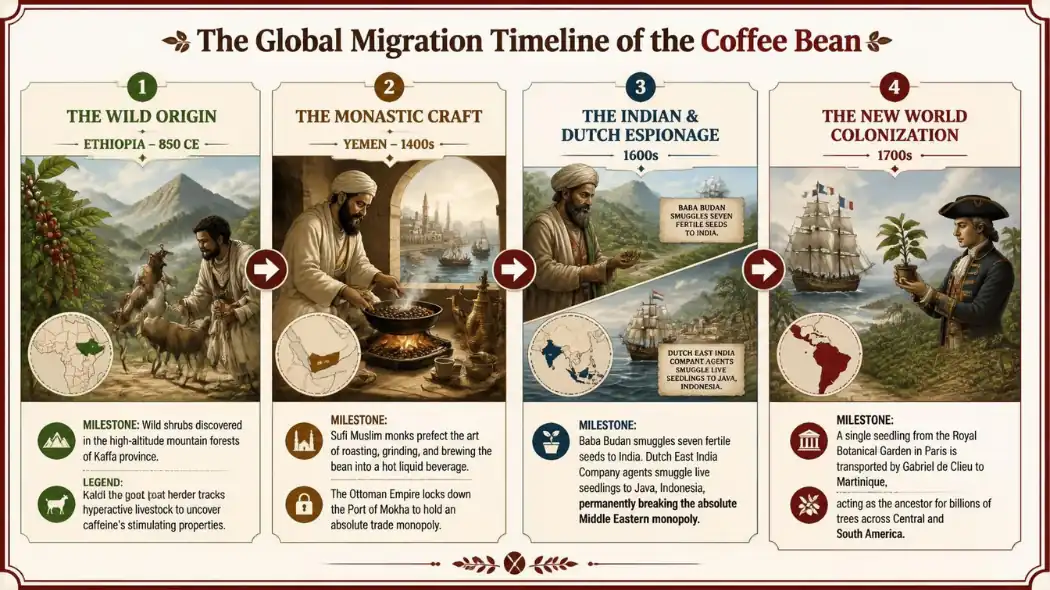
The history of the coffee beans begin in the lush, high-altitude mountain forests of the Kaffa Province in southwestern Ethiopia. According to a beloved, centuries-old historical legend dating back to roughly 850 CE, the energising properties of the plant were first discovered by a young Ethiopian goat herder named Kaldi. The story goes that Kaldi noticed his livestock acting with abnormal, hyperactive energy—jumping, running, and refusing to sleep—after browsing on the bright red cherries of a specific wild shrub.
Intrigued by their behaviour, Kaldi sampled the bitter fruits himself and experienced an instant, overwhelming surge of mental alertness. He rushed to share his discovery with a nearby monastery. The resident abbot, deeply sceptical of the strange fruit’s properties, threw the cherries into a wood fire to destroy them. Within minutes, the burning seeds released a magnificent, deep aroma that completely captivated the monks. They raked the beautifully roasted beans from the embers, ground them, and infused them with hot water, creating the world’s very first primitive cup of coffee.
The Cradle of Brewing: How Yemen Refined the Beverage
While Ethiopia is the genetic birthplace of the coffee tree, the actual cultural practice of roasting, grinding, and brewing the bean into a hot liquid beverage was perfected across the Red Sea in Yemen during the 15th century. Sourcing records verify that Yemeni Sufi Muslim scholars and monks were the first to systematically cultivate the wild African trees on terraced mountain slopes. These mystics adopted the dark drink—which they termed qahwa—as a critical spiritual tool, using the long-lasting stimulant properties of caffeine to maintain rigorous focus and wakefulness during midnight prayers and mystical dances.
For over a century, the Ottoman Empire held a fierce, absolute global monopoly over the entire coffee sector. Recognising the massive wealth generated by the trade, the authorities strictly guarded their borders. They passed strict laws decreeing that no raw, green coffee seeds could ever leave the historic Port of Al-Mokha without being boiled or partially roasted first, making it biologically impossible for foreign merchants to use the seeds to plant competing crops elsewhere.
The Great Smuggling Runs: How Coffee Broke Its Chains
The strict trade monopoly was permanently shattered by two daring acts of international smuggling that completely altered the course of agricultural history. In the early 1600s, a Muslim pilgrim named Baba Budan visited Mecca from India. Fascinated by the magical drink, he managed to secretly tape seven raw, fertile green coffee seeds flat against his stomach, successfully smuggling them out of the territory to plant them in the hills of Mysore, India—establishing the first commercial coffee crop outside Africa and Arabia.
Shortly afterwards, during the late 17th century, bold traders from the Dutch East India Company successfully smuggled live coffee tree seedlings straight out of Yemen. They transported these precious botanical targets to their tropical colony on the island of Java, Indonesia. The volcanic soil and humid climate proved so incredibly perfect for cultivation that the island quickly became a dominant global supplier, permanently engraving the name “Java” into the global lexicon as the ultimate shorthand slang for a fresh cup of coffee.
How Historic Varietal Genetics Corrupt Your Troubleshooting Balance
Every single Arabica coffee tree growing across Central America, South America, and the Caribbean today is a direct descendant of those early Javanese and Yemeni heirloom seeds. Sourcing parameters verified by The Coffee Guide prove that these centuries-old genetic lineages possess highly specific physical bean densities that react aggressively to modern brewing variables; if your home extractions of these high-altitude heirloom lots are finishing with a harsh, dry, or intensely bitter mouthfeel, check out our master troubleshooting guide to understand why does my coffee taste bitter and discover how to adjust your parameters cleanly.
Conversely, if you under-extract these delicate heirloom strains by using incorrect grind sizes or weak water temperatures, you will fail to dissolve the mid-wave sugars. If your kitchen extractions are turning out unpleasantly thin, sharp, or salty, explore our companion master guide to understand why does my coffee taste sour and learn how to stabilise your variables smoothly.
The Western Expansion: The King’s Gift and the Americas
In 1714, the Mayor of Amsterdam presented a young, healthy coffee tree to King Louis XIV of France as a luxurious diplomatic gift. A few years later, a daring young French naval officer named Gabriel de Clieu managed to secure a single seedling from the king’s royal garden. During a harrowing transatlantic voyage to the Caribbean island of Martinique, De Clieu protected the fragile plant from fierce pirate attacks, horrific storms, and even shared his own limited drinking water rations to keep the soil moist. His sacrifice paid off—that single surviving seedling grew rapidly, providing the genetic baseline seeds that were used to plant millions of coffee trees across the Americas, completing the bean’s epic journey around the globe.

