

The History, Science and Flavour of Tanzanian Peaberry
Tanzania 
Tanzania is one of Africa’s respected coffee-producing nations, renowned for its distinctive Arabica coffees and its association with the famous Tanzanian Peaberry. Grown across the country’s northern volcanic highlands and southern mountain regions, Tanzanian coffee offers considerable regional diversity, with cups ranging from bright and lively to sweet, rounded and fruit-forward.
Although peaberries occur naturally in coffee harvests around the world, Tanzania has developed a particularly strong reputation for marketing these unusual rounded beans as a speciality coffee. Their distinctive shape, interesting biological formation and potential roasting characteristics make them an intriguing subject for coffee enthusiasts.

Official USDA Production Rankings and Regional Bean Characteristics

Variety
Arabica – Robusta

Growing Region
Kilimanjaro, Mbeya, Arusha, Mbinga

Processing Methods
Washed – Natural

Flavour Profile
Berry – Chocolate

Harvest Season
July – December

Acidity
Medium High
World Production Ranking
15

Production Per Year
1.45Million
60 Kg Bags

World Production Share
0.81%

Altitude
1000 – 2000 meters

Climate
Tropical – Highland

Body
Medium

Rankings and Production Source: USDA Foreign Agricultural Service – Coffee: World Markets and Trade, 2025/26.
Discover the History and Science Behind Tanzanian Peaberry Coffee
Tanzania is one of Africa’s respected coffee-producing nations, renowned for its distinctive Arabica coffees and its association with the famous Tanzanian Peaberry. Grown across the country’s northern volcanic highlands and southern mountain regions, Tanzanian coffee offers considerable regional diversity, with cups ranging from bright and lively to sweet, rounded and fruit-forward.
Although peaberries occur naturally in coffee harvests around the world, Tanzania has developed a particularly strong reputation for marketing these unusual rounded beans as a speciality coffee. Their distinctive shape, interesting biological formation and potential roasting characteristics make them an intriguing subject for coffee enthusiasts.
What is the historical origin of commercial coffee cultivation in Tanzania?
Tanzania’s commercial coffee industry developed through several stages of colonial administration, smallholder farming and cooperative organisation.

During the late 19th century, when the territory was under German colonial rule and known as German East Africa, coffee cultivation began expanding around the northern highlands. Historical accounts record the introduction of Arabica coffee by missionaries in areas including Bukoba and the slopes of Mount Kilimanjaro between 1893 and 1896.
The development of the coffee industry under British administration
Following the First World War, Tanganyika came under British administration. Coffee production expanded during the 1920s and 1930s, with both European-owned estates and African smallholder farmers contributing to the growing industry.
The northern slopes of Mount Kilimanjaro became an important centre of Arabica cultivation. African growers organised themselves into associations and cooperative structures, helping establish a stronger position within the commercial coffee trade.
One significant development was the growth of the Kilimanjaro Native Planters Association, formed in 1925. This organisation helped provide African coffee growers with a collective voice and laid important foundations for the cooperative movement.
The Kilimanjaro Native Co-operative Union (KNCU) subsequently became a major part of the region’s coffee infrastructure, supporting smallholder farmers and the processing and marketing of their coffee.
Tanzania’s modern coffee-growing regions
Today, Tanzania’s coffee industry extends well beyond Kilimanjaro. Its principal Arabica-growing areas include:
- Kilimanjaro: The historic northern coffee-growing region, known for high-altitude cultivation.
- Arusha and Mount Meru: Producing Arabica coffees from the fertile volcanic landscapes surrounding Mount Meru.
- Mbeya and Songwe: Important southern highland coffee-growing areas.
- Ruvuma: Particularly associated with coffee production around Mbinga.
- Kagera: The country’s principal Robusta-producing area, situated in the north-west.
The northern and southern Arabica-growing regions have different climates, harvest periods and growing conditions. Consequently, Tanzanian coffee should not be treated as having one universal flavour profile.
What is the precise biological definition of a coffee Peaberry?
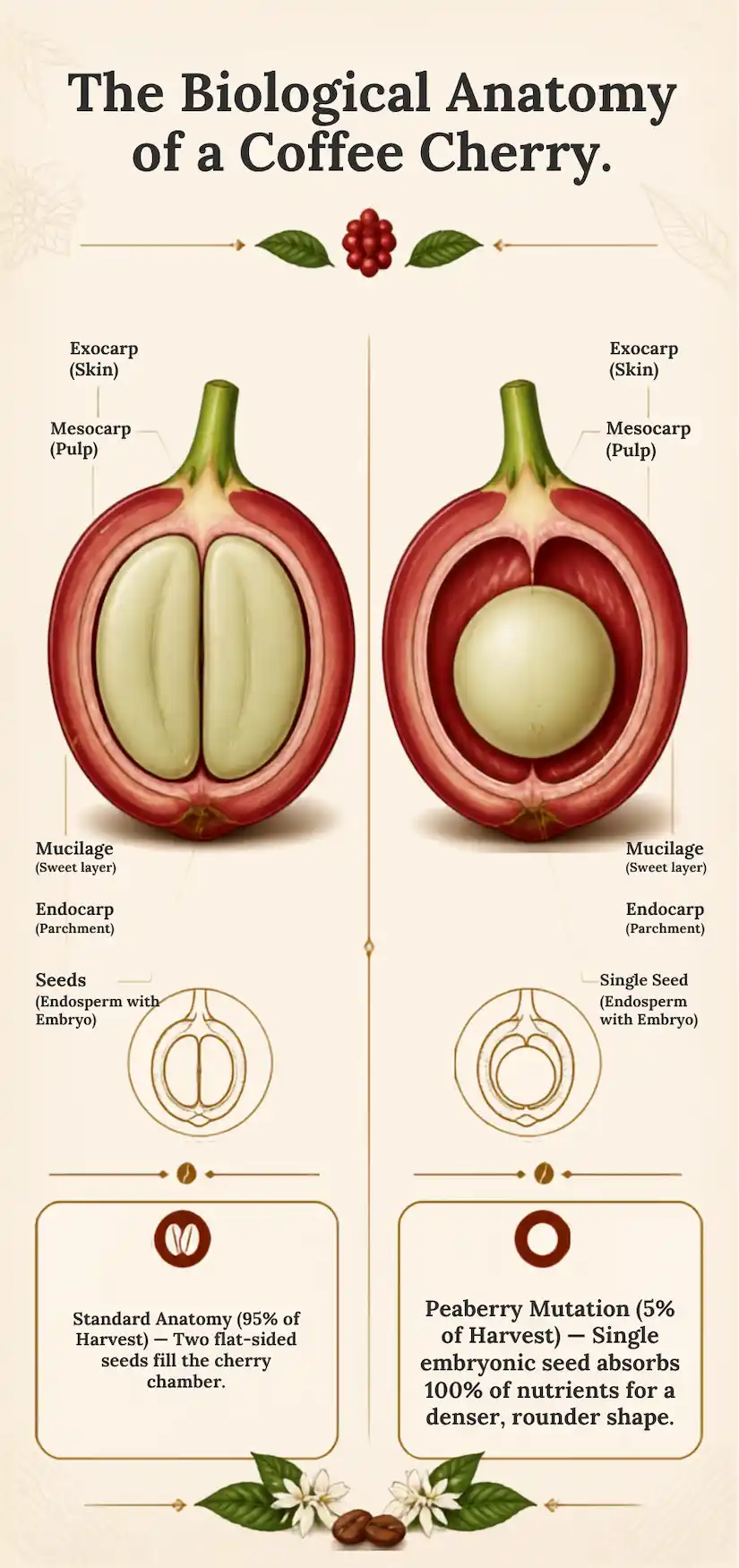
A typical coffee cherry develops two seeds, commonly referred to as coffee beans. These grow alongside one another, with their flat inner faces pressed together. This produces the familiar flat-sided shape seen in most green coffee beans.
A Peaberry forms when only one seed develops within the cherry instead of the usual pair. Without a second seed occupying the opposite side, the surviving seed generally develops into a smaller, rounded or oval shape.
This is a naturally occurring variation in coffee seed development, rather than a separate coffee species or variety.
How common are Peaberries?
Peaberries are relatively uncommon, generally accounting for approximately 5–7% of an Arabica harvest, although the proportion varies between crops and growing conditions.
They are also found in Robusta coffee, so the phenomenon is not exclusive to Arabica.

Because their rounded shape differs from conventional flat beans, peaberries can be separated during processing and grading. This allows producers and exporters to market them as a distinct commercial category.
Why is Tanzanian Peaberry so well known?
Tanzania has developed a particularly recognisable association with peaberry coffee through its export trade and speciality coffee market.
The designation Tanzanian Peaberry, sometimes shortened to PB in commercial grading, identifies a separated category of rounded beans. It is a description of physical shape, not a botanical variety or a guarantee of exceptional cup quality.
The beans are sorted from conventional flat beans because their shape and size differ. Their popularity comes from their distinctive appearance, their association with particular Tanzanian growing regions and the interesting cup profiles that some lots can produce.
What are the structural roasting and flavour characteristics of Tanzanian Peaberry coffee?
The rounded shape of a peaberry creates some interesting differences in how the bean behaves during processing and roasting.
However, it is important to distinguish between physical characteristics that have been demonstrated through research and assumptions that cannot be applied to every coffee.
Does the rounded shape affect roasting?
Because peaberries are generally more rounded than conventional flat beans, they interact differently with heat and movement inside a roasting drum.
A 2023 study published in the Journal of Food Process Engineering investigated the effects of peaberry shape and size on drying, roasting, grinding and cup quality. Using a particular Arabica variety, the researchers found that peaberries dried faster and showed more even roasting characteristics, with fewer scorched spots under the conditions examined.
The findings are interesting, but they should not be treated as proof that every peaberry will roast more evenly than every conventional coffee bean. The study used a specific variety and experimental conditions, and roasting behaviour remains dependent on several factors.
Practical roasting considerations
For roasters working with Tanzanian Peaberry, the best approach is to assess the coffee as an individual lot rather than assume that its rounded shape requires a completely different roasting profile.
Useful considerations include:
- Batch consistency: Keep peaberry lots separate from conventional flat beans where possible, as differences in size and shape can influence roasting behaviour.
- Heat application: Begin with a controlled heat application and monitor how quickly the beans develop colour and aroma.
- Airflow: Maintain suitable airflow to help remove moisture and roasting by-products.
- Development: Evaluate the roast through tasting rather than relying on bean appearance alone.
A carefully developed roast can help reveal the coffee’s sweetness, acidity and aromatic characteristics without allowing excessive roast development to overwhelm its natural flavour.
What does Tanzanian Peaberry taste like?
Tanzanian coffee is often associated with lively acidity, fruit-forward flavours and a pleasant sweetness. Peaberry lots can display similar characteristics, although their flavour depends on the growing region, variety, processing method, harvest conditions and roasting approach.
Common tasting descriptions for Tanzanian Arabica include:
- Blackcurrant and red berries: Giving the cup a fruity, sometimes wine-like character.
- Citrus: Lemon and orange notes can contribute brightness and freshness.
- Black tea: Some coffees have a delicate, tea-like finish.
- Stone fruit: Peach and other soft fruit characteristics may appear in certain lots.
- Chocolate and sweetness: Cocoa, caramel and brown sugar notes can provide balance.
Peaberry coffee is not automatically sweeter, more acidic or more complex than conventional beans from the same harvest. Its flavour should be judged through proper cupping and brewing.
What are the optimal brewing parameters for Tanzanian Peaberry coffee?
The distinctive shape of a peaberry does not automatically mean that it is denser or requires a finer grind than conventional coffee beans.
Although its physical structure can influence processing and grinding characteristics, there is no universal extraction adjustment that applies to every peaberry lot.
For a clean, expressive cup, paper-filter brewing is an excellent starting point. A Hario V60 is particularly useful because it allows the brewer to control water distribution and explore the coffee’s acidity, sweetness and aromatic detail.
Recommended Hario V60 starting recipe
Equipment: Hario V60 brewing method
- Coffee dose: 15g of freshly ground Tanzanian Peaberry.
- Water weight: 240g.
- Coffee-to-water ratio: 1:16.
- Grind size: Medium, adjusted according to the coffee and grinder.
- Water temperature: 93°C–94°C.
- Bloom: 30–45 seconds.
- Target brew time: Approximately 2:30–3:30 minutes.
Step 1: Prepare the filter
Place a suitable paper filter inside your V60 and rinse it thoroughly with hot water. This removes much of the papery taste and preheats the brewer and serving vessel.
Discard the rinse water before adding your coffee.
Step 2: Grind and add the coffee
Weigh 15g of Tanzanian Peaberry and grind to a medium consistency.
Transfer the grounds into the filter and gently level the coffee bed. A consistent bed helps water distribute more evenly during brewing.
Step 3: Bloom the coffee
Start your timer and pour approximately 30–40g of hot water over the grounds, ensuring that all the coffee is saturated.
Allow the coffee to bloom for 30–45 seconds. This gives trapped carbon dioxide an opportunity to escape before the main extraction begins.
Step 4: Continue pouring
Gradually pour the remaining water using a controlled circular motion. Aim to maintain even saturation without pouring aggressively against the filter walls.
Continue until you reach the full 240g water weight.
Step 5: Complete the extraction
Allow the water to drain through the coffee bed. A total brewing time of approximately 2:30–3:30 minutes is a useful starting point, although the ideal time will depend on your grinder, filter, coffee and pouring technique.
Remove the dripper, gently swirl the brewed coffee and serve.
Adjusting the recipe to taste
If the finished cup tastes excessively sharp or thin, try grinding slightly finer or increasing the water temperature.
If it tastes harsh, bitter or excessively dry, try grinding slightly coarser or reducing the water temperature.
Small adjustments are usually more helpful than making several changes simultaneously.
Final thoughts: why Tanzanian Peaberry deserves its reputation
Tanzanian Peaberry is an interesting speciality coffee category, combining an unusual natural seed formation with the agricultural heritage of one of Africa’s established coffee-producing nations.
Its rounded shape distinguishes it from conventional flat beans, while its association with Tanzania has helped it develop a recognisable identity in the international coffee market.
However, the shape alone does not guarantee superior flavour. The real character of a Tanzanian Peaberry comes from the combination of its growing region, coffee variety, harvesting, processing and roasting.
For coffee enthusiasts, it offers an opportunity to explore the diversity of Tanzanian coffee and discover how a small natural variation in the coffee cherry can create a distinctive product worth exploring.


