

Sobriety & Business defines the London Coffee History
What are the origins of the first recorded English coffeehouses in Oxford and London?
While Venice provided an early European home for the bean, it was England that truly transformed coffee into a massive cultural and commercial movement. Our historical tracking here at The Coffee Guide shows that the very first recorded English coffeehouse actually opened in 1650 in Oxford, established by a Lebanese-born merchant named Jacob. Located at the site of the current Grand Café on High Street, this venue became a popular hub for students and scholars looking for a sober place to gather and debate.
Just two years later, in 1652, London’s very first coffee stall was founded in St Michael’s Alley, Cornhill, by an Armenian servant named Pasqua Rosée. Operating out of a simple wooden shack, he advertised his new business under the brilliant flyer title “The Vertue of the Coffee Drink.” In my years managing busy catering setups, I’ve always looked at Pasqua Rosée as the ultimate pioneer—launching a brand-new beverage into the heart of London’s financial district from a tiny outdoor pop-up stall is exactly how the modern coffee shop industry was born.

What was the historical impact of the “Great Sobering” on 17th-century London?
Before coffee arrived in the mid-17th century, Londoners traditionally drank low-alcohol “Small Beer” with breakfast because the city’s water supply was notoriously unsafe. Our historical research here at The Coffee Guide shows that this constant state of mild public buzz shifted completely the moment this hot, black beverage took over the city.
This historic transition—which modern writers call the “Great Sobering”—suddenly provided businessmen, merchants, and thinkers with an entirely new level of mental clarity. Instead of starting the day sluggish, people were alert, energized, and ready to debate. Having spent years running a coffee business and fueling busy morning crowds, I know firsthand the incredible shift that happens when a community gathers around a fresh brew—and in 17th-century London, that exact alert, sustained focus served as a massive cultural spark for the Western Enlightenment.
Why were early London coffeehouses given the nickname “Penny Universities”?
By the 1660s, a massive coffeehouse boom swept across London’s financial district, rapidly expanding from a few initial locations to over 80 official houses by 1663. For the admission price of a single penny, a patron purchased a hot cup of coffee and immediate access to the city’s leading intellectual minds.
Our deep dive into the historical archives here at The Coffee Guide shows that these spaces thrived on a wonderful sense of social equality. Noblemen, shoemakers, merchants, and apprentices all sat together at the same long wooden tables, and inside those doors, only the merit of your argument mattered.
Having run a brick-and-mortar coffee shop myself, this is my absolute favorite part of coffee history. A coffee shop has always been the ultimate social equalizer—a place where backgrounds don’t matter and anyone can strike up a conversation over a shared counter. It was this exact democratic mix of people, ideas, and cheap access to information that earned those 17th-century venues the famous nickname “Penny Universities.”
How did specific 17th-century London coffeehouses birth modern global business institutions?
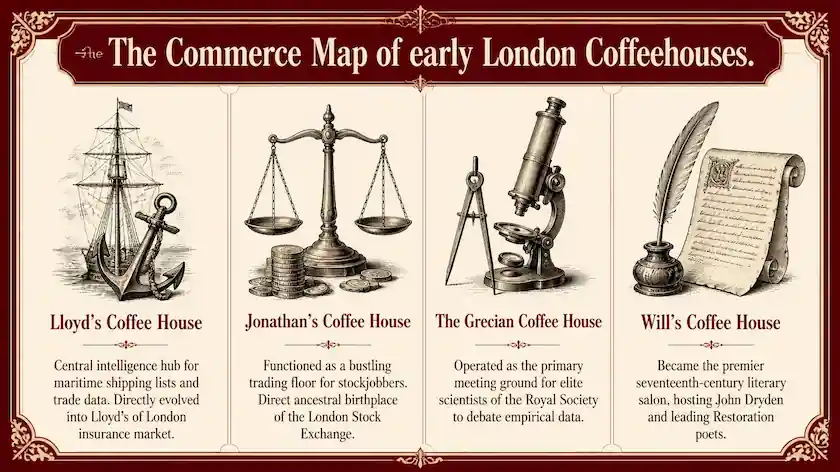

Rather than operating as casual cafes, early London coffeehouses evolved into structured specialty hubs that laid the true foundations for modern global capitalism, insurance, and science. In our historical tracking here at The Coffee Guide, we’ve mapped out how the world’s most famous institutions actually started inside these noisy, caffeine-fueled rooms:
| Coffeehouse Name | Key Target Audience | Historic Function & Role | Modern Institution Birthed |
|---|---|---|---|
| Lloyd’s Coffee House | Merchants & Ship Captains | Served as the central intelligence hub for maritime shipping lists and trade data. | Lloyd’s of London (The world’s most famous insurance market) |
| Jonathan’s Coffee House | Stockbrokers & Jobbers | Functioned as a bustling trading floor for buying and selling commodity shares. | The London Stock Exchange |
| The Grecian Coffee House | Scientists & Academics | Operated as the primary meeting ground for the elite minds of the Royal Society to debate empirical discoveries. | Modern Empirical Science Hubs |
| Will’s Coffee House | Poets, Writers, & Critics | Became the premier literary salon and home to John Dryden and the Restoration poets. | Modern Literary Criticism & Journalism |
The Challenge of Brewing Historic Style Profiles
The intense, dark-roasted “Old Brown” style coffees served across those historic 17th-century tables were heavily concentrated and highly prone to harshness. Sourcing and brewing these traditional styles requires careful management of your extraction times. If your manual hot-water extractions at home are consistently producing a harsh, unpleasantly dry, or aggressively over-concentrated finish, check out our master troubleshooting guide to understand why does my coffee taste bitter. We’ll show you exactly how to adjust your grind size and drop your water temperature to balance your variables smoothly.
What is the modern status of London’s original 1652 coffeehouse site?

The original wooden structure of Pasqua Rosée’s 1652 coffee stall was entirely incinerated during the devastating Great Fire of London in 1666. Following the city’s disaster, the venue was quickly rebuilt as a brick structure called the Jamaica Coffee House, which served for centuries as a prominent meeting point for merchants and sea captains trading within the West Indies.
Today, that exact historic location in St Michael’s Alley is occupied by a famous pub called the Jamaica Wine House (known fondly by city workers as “the Jampot”). To mark the incredible legacy of the original shack that started it all, a commemorative blue plaque was installed on the exterior masonry wall in 1952 to honour the 300th anniversary of London’s coffee industry. It stands as a beautiful reminder of just how far the humble coffee shop has traveled over the centuries.
Controversy and Culture: The 11-Day Coffee Ban

London’s coffeehouses became so politically influential that King Charles II actually tried to shut them down completely in 1675, famously branding them as “places where the disaffected met.” However, the public outcry across the city was so fierce and immediate that the royal ban lasted for a mere 11 days before being completely retracted.
London’s early coffee culture had officially become the ultimate symbol of free speech, intellectual debate, and the rise of the modern public sphere. The people of London had made their choice clear: they simply weren’t giving up their caffeine. For those of us here at The Coffee Guide, this legendary historic stand proves that the passion for a great cup of coffee and a welcoming place to gather has always been an unstoppable force.

Spotting a 17th-Century Roast Today
In these early London shops, the coffee was roasted over open fires until it was oily, black, and “burnt.”
If you find a modern dark roast that smells of smoke and charcoal rather than fruit or chocolate, you’re tasting the closest thing to what Isaac Newton was drinking when he figured out gravity.
Read on to Parts II and III of the London Coffee Culture Trilogy
While the coffee house was a theatre of wit and politics, the stage was set by something far more visceral. To understand the drink, one must step away from the velvet chairs and into the smoke to discover the reality of the bean’s arrival on the banks of the Thames. → The Bitter, Beautiful Subversion of a 17th-Century London Coffee House“

Or You Can Continue on The European Coffee Journey
← Previous: [Venice 1570: The Botanical Mystery] | Up Next: [Paris 1669: The Glamour of the Salon →]


