
Papua New Guinea  Land of Mountains, Diversity and Coffee
Papua New Guinea coffee is celebrated for its distinctive highland character, often displaying bright acidity, fruity complexity and a rounded, sometimes wine-like quality. Grown predominantly by smallholder farmers across the country’s mountainous interior, coffee benefits from a combination of favourable elevations, tropical rainfall, varied soils and traditional farming practices. Its history is particularly interesting because some of the country’s earliest commercial Arabica plantings came from Jamaican Blue Mountain seed stock, establishing a lasting connection between two very different coffee-growing regions.

Production Rankings and Regional Bean Characteristics

Variety
Arabica – Robusta

Growing Region
Eastern and Western Highlands Jiwaka, Simbu, Morobe

Processing Methods
Washed – Washed

Flavour Profile
Tropical Fruit, Cocoa, Spice

Harvest Season
April – September

Acidity
Medium
World Production Ranking
20

Production Per Year
0.80Million
60 Kg Bags

World Production Share
0.45%

Altitude
1300 – 2000 meters

Climate
Tropical – Highland

Body
Medium/Full

World Rankings and Production Figuers taken from ICO
Rankings and Production Source: USDA Foreign Agricultural Service – Coffee: World Markets and Trade, 2025/26.
The History and Science of Papua New Guinea Coffee: The Jamaican Blueprint
What is the historical origin of commercial coffee cultivation in Papua New Guinea and its connection to Jamaica?
Papua New Guinea (PNG) has a distinctive place in coffee history, largely because of its early connection with Jamaica’s celebrated Blue Mountain coffee. The story begins before commercial production became established, with coffee introduced to the territory during the late nineteenth century.
Although coffee was being grown on a small scale earlier, the development of a commercial industry gathered momentum during the 1920s. In 1926, approximately 18 commercial estates were established using seed stock brought from Jamaica’s Blue Mountains. Commercial production followed soon afterwards, with coffee becoming an increasingly important agricultural export.

The connection is botanical as well as historical. Jamaica’s traditional Blue Mountain coffee is associated with the Typica lineage of Coffea arabica. The variety introduced into Papua New Guinea became known as Blue Mountain Typica, and it was among the first recognised commercial coffee varieties cultivated in the country.
However, it is important to distinguish between the variety and the geographical designation. Jamaican Blue Mountain is a protected coffee-growing designation associated with a specific region of Jamaica.
Papua New Guinea’s Blue Mountain coffee shares historical varietal ancestry, but it is not Jamaican Blue Mountain coffee.
The introduction of these plants helped establish Arabica cultivation in the PNG highlands. Over subsequent decades, other varieties were introduced, plantations expanded and local communities increasingly became involved in growing coffee as a cash crop.
By the 1950s and 1960s, improvements in infrastructure, processing facilities and transport helped the industry develop further. From the 1980s onwards, production became increasingly decentralised, with smallholder farmers taking a much greater role in the country’s coffee economy.
This transition helped create the distinctive structure of Papua New Guinea’s coffee industry today: a combination of established plantations, small family holdings and locally organised production.
How does the traditional smallholder ‘village garden’ framework function across the PNG highlands?
One of the most distinctive features of Papua New Guinea coffee production is its reliance on smallholder farming. Rather than being dominated by enormous industrial estates, the industry is built around thousands of individual growers cultivating coffee alongside other crops.
Industry estimates commonly indicate that smallholders account for approximately 90% of the country’s coffee production. Many manage relatively small plots, sometimes containing only a few hundred coffee trees.
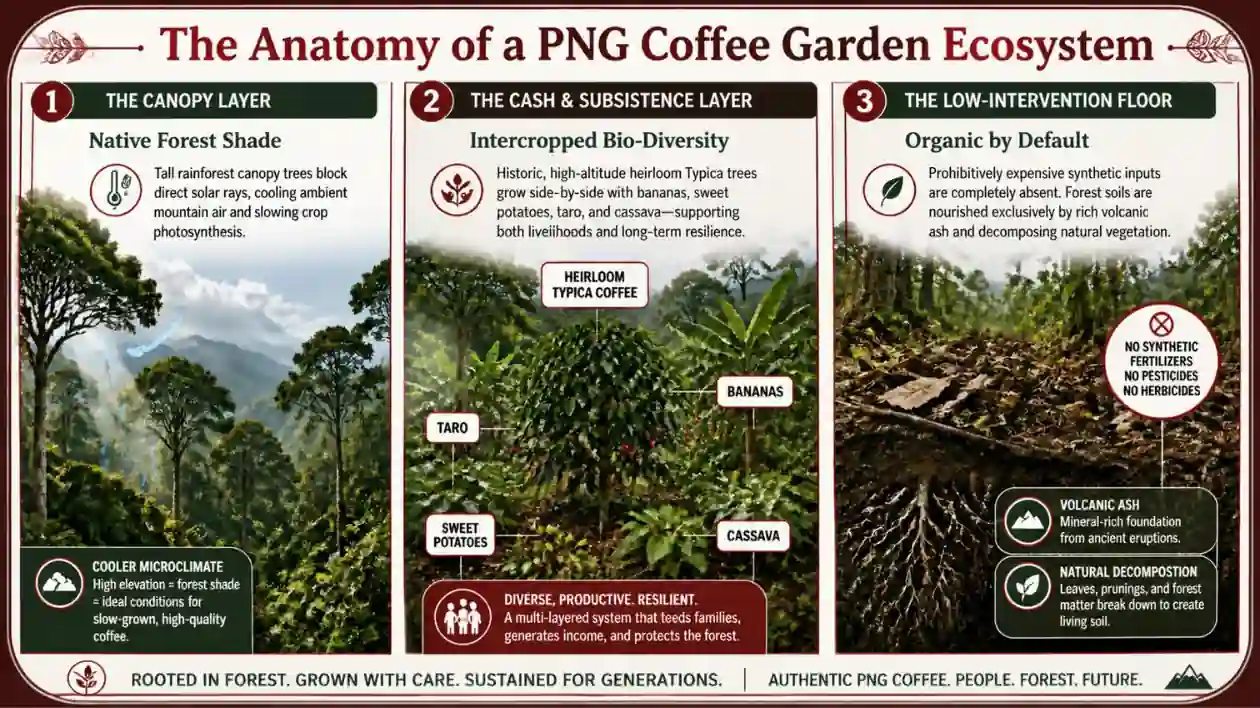
The traditional village garden combines coffee cultivation with other crops and vegetation.
These family holdings are often described as coffee gardens. The term reflects the way coffee is integrated into traditional agricultural landscapes rather than cultivated exclusively in large, uniform plantations.

Coffee trees may grow beneath shade trees and alongside subsistence crops such as bananas, sweet potatoes, taro and cassava. This mixed farming approach allows households to produce coffee for sale while maintaining crops for their own food requirements.
The system also creates a varied growing environment. Shade, surrounding vegetation, soil conditions and local management practices can differ considerably between farms and valleys.
Most smallholder coffee is harvested by hand. Farmers select ripe cherries before pulping and drying them, either using their own equipment or taking the harvest to local processing facilities. The quality of the final coffee therefore depends on several stages, including cherry selection, fermentation, washing, drying and storage.
The village-garden system is not simply an agricultural curiosity. It is central to the livelihoods of many highland communities and helps explain why Papua New Guinea coffee can show considerable variation between farms, growing districts and individual harvests.
What is the scientific relationship between PNG’s mountain altitude and its bean chemistry?
Papua New Guinea’s mountainous geography provides many of the environmental conditions associated with high-quality Arabica cultivation.
Much of the country’s coffee is grown in the highland provinces, where elevations commonly range from around 1,200 to 2,000 metres above sea level. The Coffee Industry Corporation’s growing guidance identifies altitude, rainfall, drainage and soil conditions as important factors when assessing land suitable for Arabica production.
At higher elevations, cooler temperatures can slow the development and ripening of coffee cherries. This may extend the time available for the seed to develop, influencing the physical and chemical characteristics of the coffee.
Altitude is not, however, a guarantee of a particular flavour or bean density. The final characteristics are also affected by variety, soil, rainfall, shade, crop management, ripeness at harvest and post-harvest processing.
PNG’s volcanic and mountainous landscapes contribute to the diversity of its growing environments. Soil conditions vary across the country, so it would be misleading to suggest that every coffee-growing area has identical volcanic soil or mineral characteristics.
The combination of elevation, tropical climate and varied terrain nevertheless provides a favourable environment for Arabica cultivation. These conditions help explain why coffees from the Eastern Highlands, Western Highlands and other growing districts can develop distinctive regional characteristics.
Why is Papua New Guinea recognised as a naturally organic coffee origin by default?
Papua New Guinea has a strong tradition of smallholder coffee farming, and many family gardens use relatively low-input agricultural practices. However, it is important not to confuse traditional cultivation with certified organic production.
Some growers may use few or no synthetic agricultural chemicals, while others may use fertilisers or crop-protection products where they are available and appropriate. Practices also vary between individual farms and regions.
PNG’s rugged landscape and limited transport infrastructure can make agricultural supplies and technical services difficult to access in certain rural communities. These challenges can encourage low-input farming, but they do not prove that every farm is chemical-free.
Organic certification requires more than the absence of synthetic chemicals. Producers must meet defined standards covering matters such as permitted inputs, farm management, record keeping, processing and inspection. Certification must be verified through an appropriate certification scheme.
This distinction matters to coffee buyers. A coffee can be traditionally grown, shade-grown or produced using low-input methods without necessarily carrying organic certification.
Papua New Guinea’s smallholder structure and traditional garden systems remain important strengths. They provide opportunities for sustainable agricultural development, but the environmental and certification credentials of each coffee should be assessed on its own merits.
What are the distinct sensory traits and regional flavour markers of Papua New Guinea coffee?
Papua New Guinea coffee is known for its varied and sometimes complex flavour profiles. The country’s smallholder production system, different Arabica varieties, highland environments and range of processing practices all contribute to this diversity.
Rather than having one fixed national flavour, PNG coffees can display a broad spectrum of characteristics depending on their origin and preparation.
A well-developed cup may offer a medium to full body, balanced sweetness and lively acidity. Commonly reported tasting notes include:
- Chocolate and cocoa: Often providing a rounded, comforting foundation.
- Brown sugar and caramel: Contributing sweetness and depth.
- Citrus and stone fruit: Adding freshness and brightness.
- Tropical fruit: Sometimes appearing in more expressive lots.
- Sweet spices and herbal notes: Providing additional complexity.
- Cedar and woody characteristics: Occasionally found in the more savoury end of the flavour spectrum.
The balance between these characteristics varies. A washed coffee may present a cleaner, brighter profile, while differences in fermentation and drying can influence sweetness, body and fruit expression.
If your manual extractions of these multi-layered coffees are shifting towards an unpleasantly sharp or sour profile, it is worth checking your brewing variables. Grind size, water temperature, brew time and coffee-to-water ratio can all affect extraction. Our guide explains why coffee tastes sour and how to fix it.
The country’s traditional Blue Mountain Typica heritage is an important part of its identity, but modern Papua New Guinea coffee is not limited to this one variety. Bourbon, Arusha, Mundo Novo and Catimor are also among the varieties found in the country’s coffee-growing sector.
This combination of historical varieties, smallholder cultivation and diverse highland environments gives Papua New Guinea a distinctive position in the international speciality coffee market.
Ultimately, the appeal of Papua New Guinea coffee lies in its diversity. From traditional village gardens to established highland farms, each growing area contributes to an industry shaped by its geography, history and the people who cultivate it.
]


