

Malaysia  The Liberica Outlier
Most coffee origin stories are shaped by geography, trade and changing consumer tastes. Malaysia’s is also a story of agricultural necessity — a coffee-growing industry influenced by disease, changing commercial priorities and the survival of a species that became increasingly uncommon elsewhere.
While Arabica and Robusta dominate international coffee production, Malaysia has maintained a particularly strong association with Liberica (Coffea liberica). Its unusually large cherries, distinctive beans and characteristic fruity flavours make it one of the most recognisable coffee species in the country.
From traditional family-run plantations in Johor to the familiar Kopitiams serving generations of coffee drinkers, Malaysian coffee offers a fascinating alternative to the more familiar Arabica and Robusta traditions.

Production Rankings and Regional Bean Characteristics

Variety
Variety Liberica, Robusta, Arabica

Growing Region
Sabah, Sarawak, Johor

Processing Methods
Washed – Natural

Flavour Profile
Jackfruit, Dark Chocolate, Smoky Spice

Harvest Season
November to February/March

Acidity
Low
World Production Ranking
14

Production Per Year
1.5Million
60 Kg Bags

World Production Share
0.84%

Altitude
300 – 1200 meters

Climate
Tropical – Highland

Body
Full

Rankings and Production Source: USDA Foreign Agricultural Service – Coffee: World Markets and Trade, 2025/26.
Malaysia: The Liberica Outlier and the Elephant Bean
What is the historical origin of commercial Liberica coffee cultivation in Malaysia?
The history of Malaysian coffee is closely connected to the devastating coffee leaf-rust epidemic that affected plantations across Asia during the nineteenth century.
Coffee leaf rust, caused by the fungus Hemileia vastatrix, spread through major coffee-growing regions, severely damaging Arabica plantations. The outbreak in Ceylon (now Sri Lanka) during the late 1860s and subsequent spread through Southeast Asia encouraged planters to investigate alternative coffee species.
One of the most promising candidates was Liberica, a species native to tropical West and Central Africa. It attracted attention because it appeared more resistant to coffee leaf rust than Arabica and could tolerate warmer, wetter growing conditions.
Commercial cultivation of Liberica in Peninsular Malaysia began around 1880–1890, making the country one of the important destinations for this African coffee species.
Liberica initially offered an attractive alternative to Arabica, particularly in the warmer, lower-lying agricultural areas where traditional Arabica cultivation was less suitable.
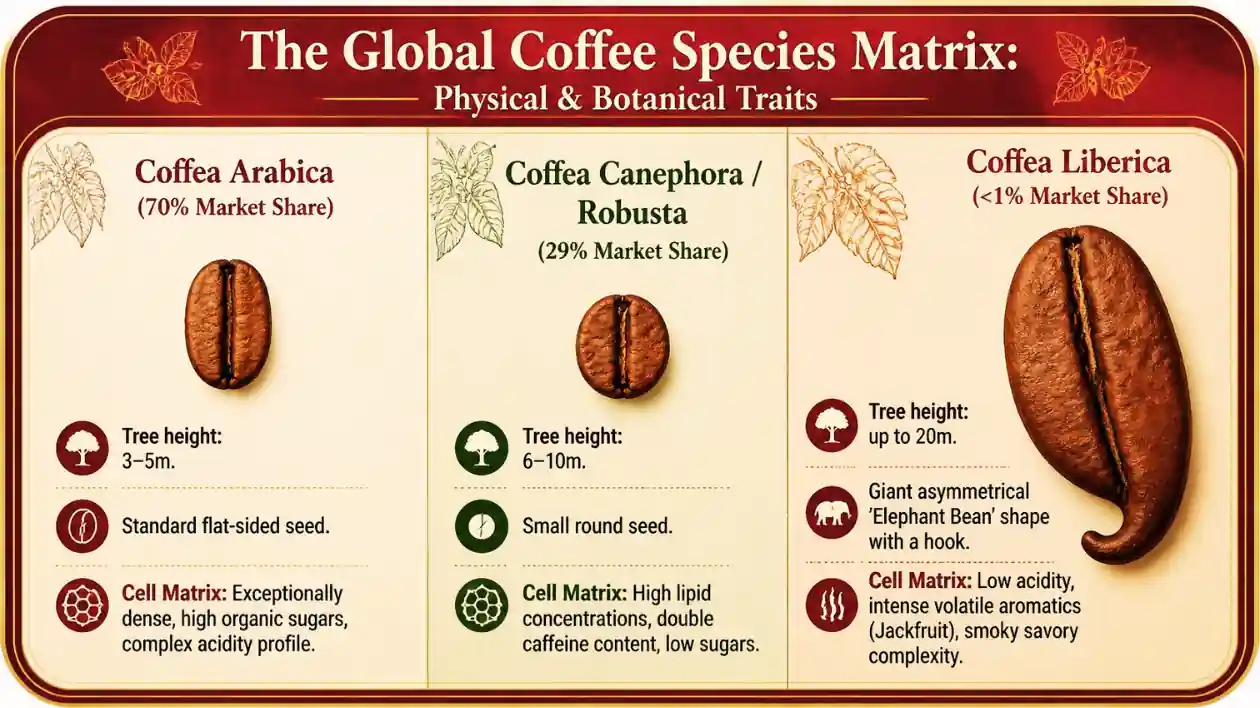
Liberica is botanically distinct from both Arabica and Robusta.
However, Liberica was not destined to dominate the international coffee industry. Although it offered advantages in certain growing environments, it presented commercial challenges, including relatively low productivity, difficult harvesting and a flavour profile that was less familiar to many coffee drinkers.
Robusta eventually became the more commercially attractive alternative in much of Southeast Asia because of its productivity and suitability for large-scale cultivation.
Malaysia nevertheless retained a strong Liberica tradition, particularly in Johor, where the species became closely associated with local coffee farming and traditional coffee culture.
Today, Malaysia remains one of the relatively few countries where Liberica has an important place in commercial coffee cultivation. This makes its coffee industry particularly interesting for anyone exploring the diversity of the Coffea genus.
What are the unique botanical and physical characteristics of the Liberica Elephant Bean?
Liberica is a separate coffee species, not a mutation or hybrid of Arabica or Robusta. Its botanical differences are visible in the tree, leaves, flowers, cherries and seeds.
One of its most striking characteristics is its size. Liberica trees can grow considerably taller than conventional Arabica and Robusta plants, with mature trees capable of reaching heights of around 15–20 metres under suitable conditions if left unpruned.
Commercial cultivation usually requires careful pruning and management to make harvesting more practical.
Liberica also produces unusually large cherries and distinctive seeds. The beans are often irregular in shape, with a characteristic appearance that differs from the more familiar oval Arabica and Robusta seeds.
The nickname Elephant Bean is associated with their comparatively large size. However, individual bean dimensions vary according to variety, growing conditions and processing.
The larger tree structure and extensive root system help explain why Liberica can grow successfully in warm, humid environments. Its ability to tolerate conditions that can challenge Arabica has contributed to its continued cultivation in Malaysia.
It is also important not to describe Liberica as completely immune to coffee leaf rust. Although the species has historically shown greater resistance than Arabica in many circumstances, it can still be affected by the disease.
These botanical characteristics make Liberica particularly interesting to coffee growers and researchers. Its genetic diversity may also offer useful opportunities for future coffee breeding programmes.
What does Malaysian Liberica coffee taste like, and what is the traditional Kopi-O roast?
Malaysian Liberica has a flavour identity that can be quite different from the familiar chocolate, nut and citrus characteristics associated with many Arabica coffees.
Its most recognisable sensory association is jackfruit — a tropical fruit with a powerful, sweet aroma. Depending on the coffee, tasters may also encounter notes of ripe fruit, banana, tropical sweetness, caramel, chocolate and occasionally woody or savoury characteristics.
The overall flavour can be bold and distinctive, with a relatively full body. However, Liberica is not automatically low in acidity or intensely bitter. Its final character depends on the variety, growing environment, processing method and roast development.
Some traditional Liberica coffees are roasted quite dark, producing a strong, robust cup that suits the local preference for coffee served with sugar and condensed milk.
The traditional Malaysian roasting approach
Traditional Malaysian Kopitiam coffee has a long association with dark roasting. Some traditional roasters use combinations of sugar, margarine or butter and other ingredients during roasting to create a distinctive dark, aromatic coffee.
The added ingredients contribute to the characteristic flavour and appearance of certain traditional coffee styles. Sugar can caramelise during roasting, while fats contribute to the roasting mixture and mouthfeel.
These methods are not universal, however. Modern Malaysian Liberica producers also experiment with lighter and medium roasts to reveal more of the fruit character and natural sweetness.
The distinction between traditional roasting and the finished drink is important when discussing Kopi-O.
Kopi-O is a traditional Malaysian and Singaporean coffee preparation made with black coffee, generally served with sugar unless ordered without it. It is not a separate coffee species or a particular roasting method.
In a Malaysian Kopitiam, customers may encounter several familiar variations:
- Kopi: Coffee served with condensed milk.
- Kopi-O: Black coffee, usually with sugar.
- Kopi-O Kosong: Black coffee without sugar.
- Kopi-C: Coffee served with evaporated milk and sugar.
These drinks are an important part of everyday Malaysian food culture, and their popularity demonstrates how local preferences have shaped the way coffee is roasted, prepared and enjoyed.
What are the optimal brewing parameters and culinary pairings for Malaysian Liberica coffee?
Liberica’s distinctive flavour and fuller body make it an interesting coffee to explore using different brewing methods.
Traditional Malaysian preparation often uses a cloth filter known as a coffee sock. This reusable filter allows brewed coffee to pass through while retaining much of the fine sediment. It also permits more of the coffee’s natural oils to enter the finished cup than a typical paper filter.
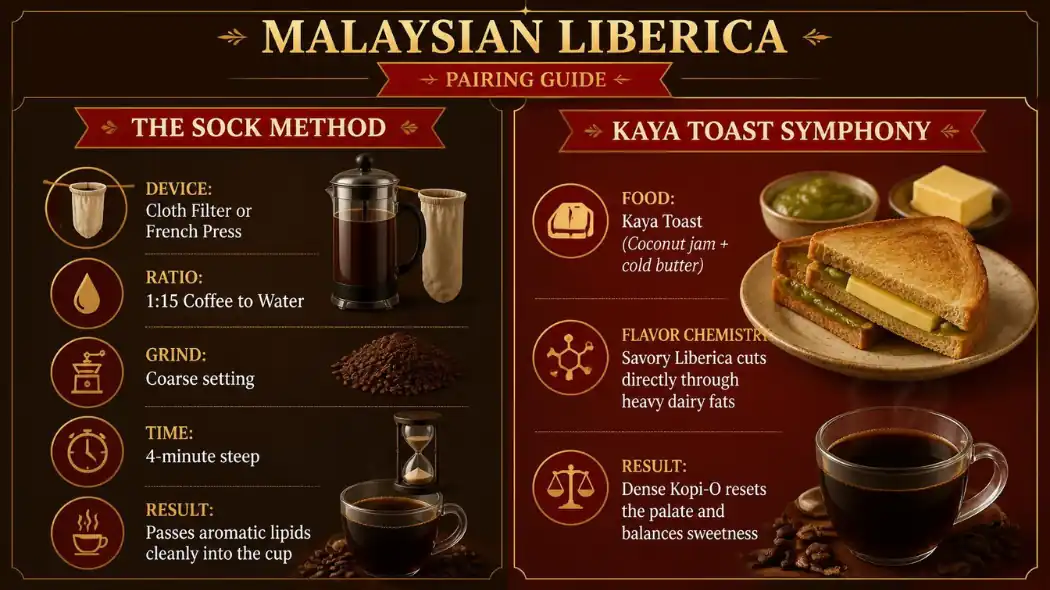
Traditional cloth-filter brewing and the familiar Malaysian Kopitiam pairing.
The traditional cloth-filter method
A cloth sock is particularly suitable for recreating the style of coffee commonly served in Malaysian Kopitiams.
For a home-brewing starting point, try:
- Coffee: 20g
- Water: 300ml
- Ratio: 1:15
- Grind: Medium-coarse
- Water temperature: 92–94°C
- Brewing time: Approximately 3–4 minutes, adjusting to taste
Add the ground coffee to the cloth filter and pour the hot water through steadily. Allow the coffee to drain naturally rather than forcing it through the cloth.
The result should be a rounded, full-bodied cup with a more traditional texture than many paper-filtered brews.
Can you use a French Press?
Absolutely. The French Press is another suitable option for Liberica because its metal mesh filter allows more suspended oils and fine particles to remain in the finished coffee.
French Press – The Ultimate Guide to Mastering the Brew
A useful starting recipe is:
- Coffee: 20g
- Water: 300ml
- Ratio: 1:15
- Grind: Coarse
- Water temperature: 93–94°C
- Steeping time: 4 minutes
Pour the water over the grounds, stir gently, fit the lid and allow the coffee to steep. Press slowly and serve immediately.
Paper filters should not be ruled out either. They can produce a cleaner cup by retaining more oils and fine particles, allowing different aspects of Liberica’s fruit and acidity to come through. The choice depends on whether you prefer a cleaner or fuller-bodied result.
The Kaya Toast pairing
One of Malaysia’s most recognisable coffee accompaniments is Kaya Toast.
This traditional breakfast consists of crisp toasted bread spread with kaya, a sweet coconut and egg jam, usually accompanied by butter. It is frequently served with soft-boiled eggs and a cup of Kopi or Kopi-O.
The pairing works because the coffee’s roasted character and body can balance the sweetness of the kaya and richness of the butter.
For Liberica drinkers, the combination offers an opportunity to experience the coffee in a familiar Malaysian setting. Its bold flavour can stand up to the sweetness of the toast without becoming lost.
The future of Malaysian Liberica coffee
Malaysia’s Liberica industry occupies a distinctive position in the international coffee market. While Arabica and Robusta account for the overwhelming majority of global production, Liberica offers an alternative with its own botanical identity, growing characteristics and flavour possibilities.
There is renewed interest in developing Malaysian Liberica as a speciality coffee. Improvements in harvesting, processing, roasting and quality control are helping producers explore its potential beyond traditional dark-roasted Kopitiam blends.
The challenge is to combine the heritage of Malaysian coffee culture with modern approaches to quality and consistency.
From the large Elephant Beans of the Liberica tree to the unmistakable jackfruit aroma and the familiar cloth-filtered coffee of the Kopitiam, Malaysia has a coffee story unlike almost any other.
Its continued cultivation is a reminder that the world of coffee extends far beyond Arabica and Robusta — and that some of its most interesting flavours come from the species that refused to disappear.
“A rare treasure in the coffee world, Malaysia focuses on the bold and exotic flavours of the Liberica and Excelsa varieties.
Discover the rare varieties that hide within the fringes of The Coffee Belt.“


