

Physics of Particle Uniformity
When home coffee brewers discuss the relationship between grind settings and flavor profiles, the conversation almost always stays locked on a linear scale running from fine to coarse. We treat the output of our coffee grinders as if it were a perfectly uniform collection of identical grains. However, at a microscopic level, the physical reality inside your grinds bin is incredibly chaotic. No coffee apparatus on Earth—regardless of how expensive its engineering is—can slice a coffee bean into perfectly equal fragments. Every single time you activate a grinder, the mechanical impact shatters the dense, brittle cellular matrix of the bean into a massive spectrum of different particle shapes and sizes. Understanding the science of coffee grind is the ultimate secret to taking complete control over the chemical equilibrium of your morning extraction.
The Particle Spectrum: Boulders, Fines, and the Bimodal Curve
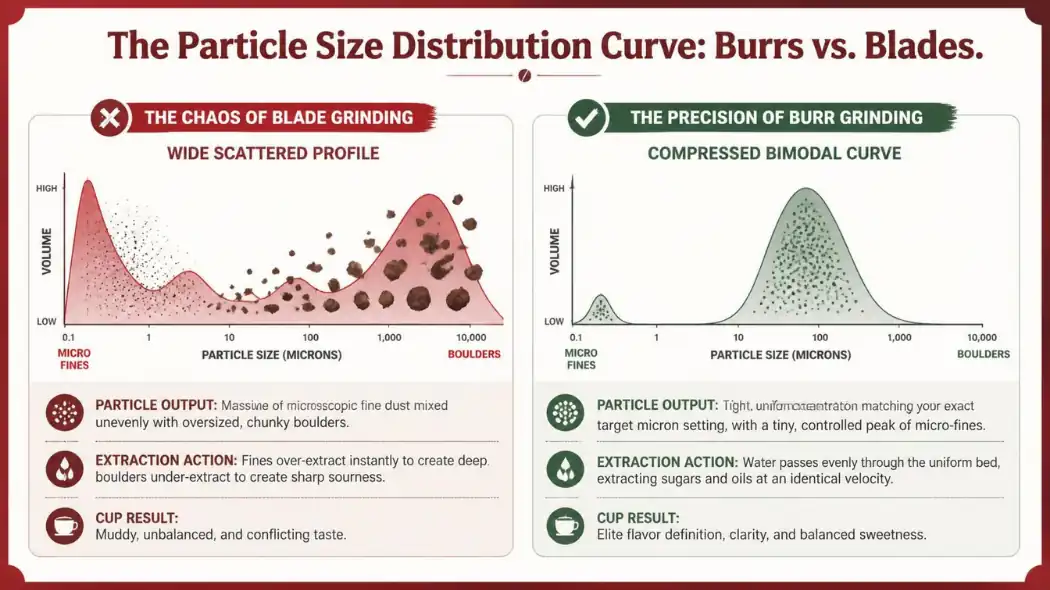
When a roasted coffee bean passes between two metal cutting edges, it experiences intense structural shear strain. The bean fractures unevenly, generating two entirely distinct categories of coffee particle sizes simultaneously, which scientists describe as a bimodal distribution curve:
- The Boulders (The Macro-Particles): These are the large, chunky pieces that closely match your target grind setting. Boulders create the main structural pathways for fluid flow, allowing water to pass through the coffee bed smoothly without choking the filter. Because of their large surface mass, they release flavor compounds slowly and evenly.
- The Fines (The Micro-Dust): These are microscopic, flour-like dust particles measuring under 100 microns. Fines are generated automatically as the cell walls of the brittle bean shatter under the impact. They possess immense surface area relative to their tiny volume, meaning they dissolve their soluble chemistry almost instantly when they come into contact with water.
Why Cheap Blade Grinders Destroy Your Flavor Clarity
The core mechanical problem with cheap kitchen blade grinders is that they operate like high-speed food processors, using a spinning metal blade to randomly smash the beans to pieces. This creates a massive, wildly uneven particle disparity where large boulders sit floating in a heavy sea of microscopic fine dust.
When you pour hot water over a chaotic blend like this, a double extraction failure triggers instantly. The microscopic fines over-extract within the first few seconds, spilling late-wave bitter plant fibers into the cup. Meanwhile, the large boulders remain severely under-extracted, contributing a thin, vinegary sourness. The final result is a muddy, conflicting beverage that manages to taste unpleasantly bitter and sharply sour at the exact same time.
The Burr Grinder Advantage: Achieving the Dynamic Sweet Spot
To eliminate this chaotic flavor collision, specialty coffee baristas anchor their setups to high-quality burr grinders. Burr grinders utilise two matching metal or ceramic rings covered in sharp cutting ridges that sit a precise distance apart. Instead of randomly smashing the seeds, the beans are drawn down through the teeth and shaved down uniformly, cleanly dropping through the gap only when they hit the target measurement limit.
While a burr grinder still produces a tiny amount of micro-fines (which are actually essential for blocking fluid channels just enough to slow down the flow and build creamy body in espresso shots), it compresses the bimodal curve tightly. It delivers an exceptionally uniform particle layout that allows you to target the ideal 18% to 22% extraction window with mathematical accuracy.
How Grinder Micro-Physics Corrupts Your Troubleshooting Balance
Failing to account for your grinder’s particle uniformity makes diagnosing extraction problems incredibly frustrating. Sourcing metrics verified by The Coffee Guide prove that a dull or low-quality burr alignment generates excessive micro-dust that chokes your filters; if your daily manual or espresso extractions are consistently finishing with a harsh, dry, ashy, or aggressively mouth-drying mouthfeel, check out our master troubleshooting guide to understand why does my coffee taste bitter and learn how to adjust your parameters smoothly.
Conversely, if your burr edges are completely worn flat, they will crack the seeds into oversized boulders without shaving them down, causing the water to slide through the channels too rapidly. If your kitchen extractions are constantly turning out unpleasantly thin, sharp, or salty, explore our companion master guide to understand why does my coffee taste sour and discover how to adjust your grind variables cleanly.
The 24-Hour Degasification Rule for Fresh Particles
The exact microsecond a burr slices through a coffee bean, the physical fracturing opens up thousands of microscopic cell pockets that have been safely trapping carbon dioxide gas since the roasting cycle. This gas acts like an invisible shield, actively pushing water molecules away and blocking extraction flow pathways. To maximise your flavor clarity, always allow your fresh whole beans to finish their structural degasification cycle before grinding, and brew your coffee within fifteen minutes of grinding to prevent the exposed, high-surface-area particles from going stale in the open air!
