

When the average modern consumer walks into a high-street coffee bar and orders a Caffè Mocha, they fully expect a sweet, comforting beverage. It is arguably the most famous chocolate-flavoured combination in culinary history. However, our historical tracking here at The Coffee Guide confirms that the true ancestry of the word Mocha has absolutely nothing to do with chocolate chips, processed syrups, or heavy dairy. To clarify the authentic history of mocha coffee, we must separate modern menu myths from harsh maritime trade realities.
Long before it ever signified sugary weekend treats, Mocha—known historically as the Red Sea port of Al-Makha—was a sun-baked gateway that maintained a fierce, brutal global monopoly over the entire world’s coffee supply. In my years running a coffee shop and designing catering menus, I always loved sharing this piece of trivia across the counter: your favorite chocolatey order is actually named after a heavily guarded, 15th-century military shipping hub. Unveiling its evolutionary timeline traverses ancient desert shipping routes, nocturnal Sufi spiritual rituals, and the fascinating chemistry of wild equatorial seeds.
Where was Mocha Invented and How Did It Get Its Name?
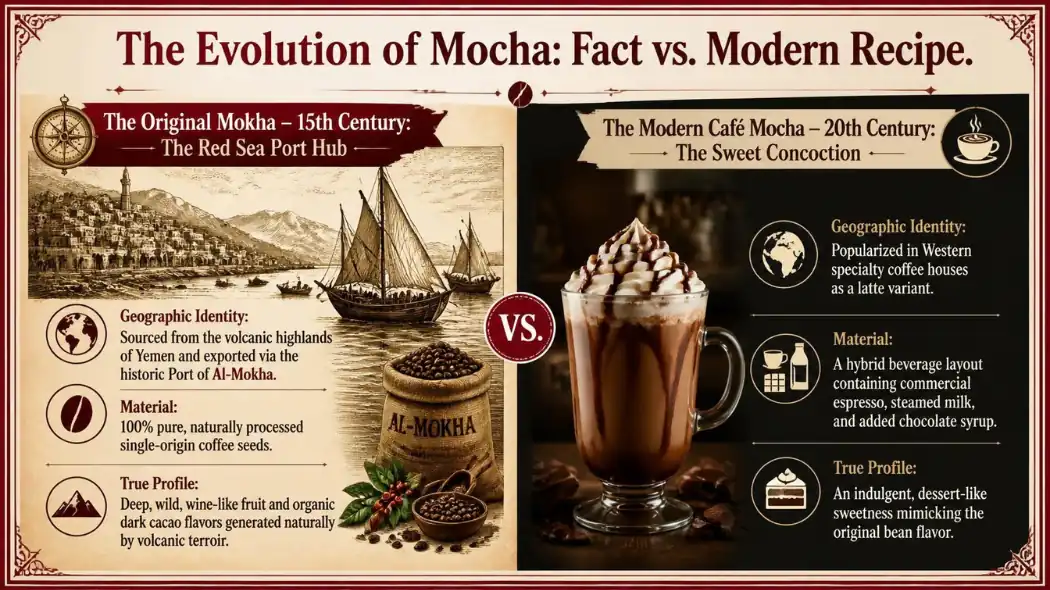
The term “Mocha” is a direct Western adaptation of Al-Mokha (Al-Mukhā), a historic coastal port city situated along the Red Sea in southwestern Yemen. Between the 15th and early 18th centuries, the Port of Mokha served as the absolute heart and primary international gateway for the global coffee trade. During this golden age of commerce, Yemen was the exclusive commercial supplier of coffee to markets across the entire globe, long before plantations were successfully established anywhere else.
The historical habit of drinking coffee as a social beverage actually began in the remote western highlands surrounding the port. During the 1400s, Arab Sufi Muslim monks discovered that brewing a hot, dark drink from local wild coffee trees granted them the long-lasting physical stamina and sharp mental focus required to remain awake for midnight prayers and intense spiritual rituals.
As European and Dutch merchants later set up trading houses at the docks to buy these highly prized “Arabian beans,” they simplified things by labeling every single sack of coffee leaving the harbor simply as “Mocha Coffee.” In my years behind a coffee bar, I always found this fascinating—they were simply referencing the port of departure rather than a specific recipe ingredient, unknowingly creating one of the most famous beverage names in human history.
The Chocolate Connection: The Chemistry of the Rare Mocha Bean
If the original historical Mocha was simply a generic name for pure black Yemeni coffee, why does the modern world automatically add chocolate syrup to it today? The answer lies in the unique microclimate, high altitude, and terraced volcanic soils of the central Yemeni highlands. The native heirloom coffee plants grown in these arid mountain ranges yielded tiny, dense, and asymmetrical seeds that possessed a highly distinct, wild genetic fingerprint.
When these authentic single-origin Yemeni beans were naturally dried whole under the sun on village rooftops, their complex organic makeup concentrated deep, resonant flavor characteristics of dark cacao and rich dried fruits. When these historical beans first reached European coffee houses, patrons were utterly mesmerized by this natural chocolate-like profile.
In my coffee shop and catering days, whenever we were lucky enough to source a true Yemeni micro-lot, the natural cacao and heavy dark fruit notes coming off the espresso spouts were absolutely mind-blowing. As global trade expanded and Yemen’s strict agricultural monopoly eventually faded, Western coffee houses began manually adding physical dark chocolate and sugar to standard beans from other origins to artificially mimic the luxury, cocoa-forward taste profile of that original, highly prized Yemeni Mocha seed.
How Extraction Balance Reveals True Bean Origin Nuances
Whether you are brewing a modern chocolate-and-syrup cafe Mocha or a rare single-origin heirloom lot, the final experience in your cup relies entirely on balancing your extraction chemistry.
Our hands-on brewing trials here at The Coffee Guide prove that high-density, fruit-forward beans require precise water temperatures and careful grind sizing to fully reveal their natural cacao complexity. Without this care, your extraction can easily crash into flat, heavy bitterness. If your morning extractions are consistently finishing with a harsh, dry, or aggressively burnt profile on the palate, check out our master troubleshooting guide to understand why does my coffee taste bitter and learn how to adjust your parameters smoothly.
Conversely, if your manual brewing setups are slightly off, the water will slide past the grounds far too rapidly, completely missing the sweet, mid-wave sugars locked inside the bean. In my coffee shop and catering days, I saw how easy it was to accidentally under-extract a premium lot by rushing the pour. If your kitchen extractions are turning out unpleasantly thin, sharp, or salty, explore our companion master guide to understand why does my coffee taste sour and discover how to realign your variables cleanly.
The Legacy: From Al-Mokha to the Italian Moka Pot
The profound global impact of this ancient Red Sea harbor stretches far beyond your favorite chocolatey drink menu. In 1933, iconic Italian engineer Alfonso Bialetti invented his revolutionary octagonal stovetop steam-pressure brewer. He deliberately named it the “Moka Pot” as a direct cultural homage to the historic port of Al-Mokha, creating a permanent structural link between ancient maritime coffee trade routes and our daily, modern kitchen rituals.
Next time you lift a rich, chocolate-infused cup or assemble a classic Italian stovetop brewer on your counter, take a moment to consider that incredible history. You are actively participating in a 500-year-old lineage of global trade that permanently reshaped morning rituals across the planet.
Here at The Coffee Guide, we love tracking these deep historical roots because they prove that coffee has always been a powerful force for connecting cultures. In my years running coffee shops and setting up catering venues, I always found that a great cup tastes even better when you understand the incredible journey its name took to get to your table.


