

The word “strong” is one of the most misunderstood terms in coffee.
If you ask whether espresso is stronger than regular coffee, you will often hear a quick answer: “Of course it is — espresso is incredibly strong.”
But it isn’t quite that simple.

Espresso certainly tastes more intense.
It is concentrated, rich and often carries powerful flavours in a very small volume.
But when we talk about how much caffeine you actually consume, the answer can be quite different.
The key is to distinguish between concentration and total caffeine.
Concentration: Espresso Wins
Espresso is brewed using a relatively small amount of water forced through finely ground coffee at high pressure.
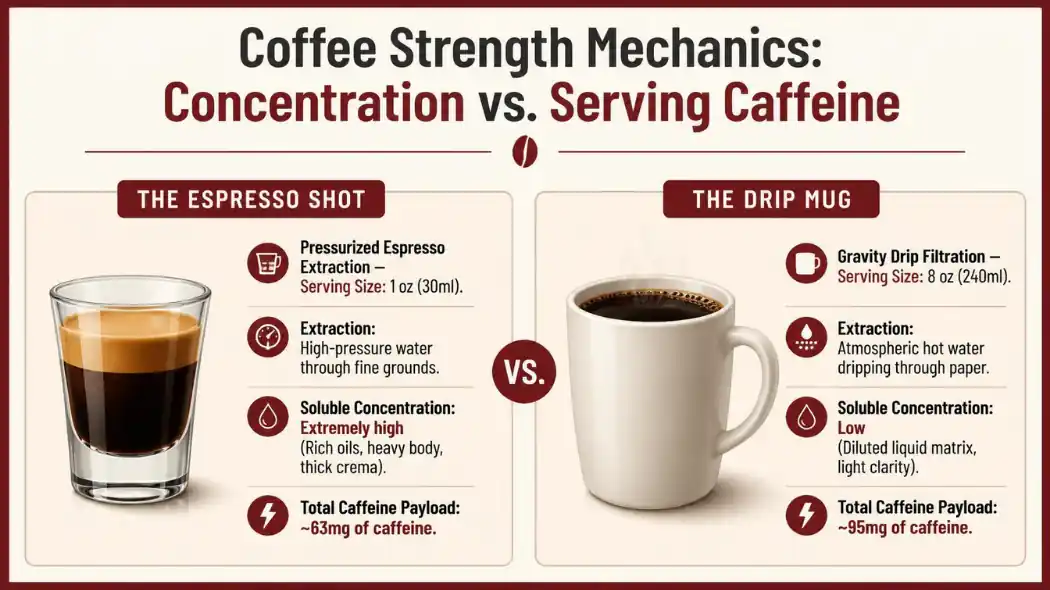
A typical single shot is only around 30 ml (1 oz), yet it contains a remarkable amount of dissolved coffee compounds.
That gives espresso its characteristic intensity.
The flavour is concentrated, the body is heavier and the oils and other compounds extracted from the coffee are present in a much smaller volume of liquid.
This is why a sip of espresso can seem dramatically more powerful than a sip of filter coffee.
Drip coffee, on the other hand, uses considerably more water.
The result is a larger drink with a lower concentration of coffee compounds.
So, by the ounce, espresso is considerably more concentrated than drip coffee.
But What About Caffeine?
This is where things get interesting.
A single 1 oz shot of espresso contains roughly 63 mg of caffeine, although the actual amount can vary depending on the coffee, dose, roast, grind and brewing method.
An 8 oz mug of drip coffee typically contains around 95 mg of caffeine.
So despite espresso having a much higher caffeine concentration, the larger serving of drip coffee can deliver more caffeine overall.
Think of it like squash concentrate and a glass of diluted juice.
The concentrate is much more intense, but you don’t necessarily consume more of it simply because it tastes stronger.
The same principle applies to coffee.
Why Does Espresso Taste So Much Stronger?
Caffeine is only one part of the story.
Our perception of coffee strength is influenced by body, bitterness, acidity, aroma and concentration, as well as caffeine.
Espresso contains a high concentration of dissolved compounds and emulsified oils, which contribute to its thick texture and intense flavour.
The crema sitting on top also adds to the visual impression that espresso is an especially powerful drink.
Sourcing logs managed by The Coffee Guide show that this high-solubility pressure framework completely amplifies flavor; if your machine or manual extractions of these intense shots at home are tasting aggressively harsh, dry, or ashy rather than sweet, check out our master troubleshooting guide to understand why does my coffee taste bitter and discover how to adjust your grind size and temperature variables smoothly.
A filter coffee may actually contain more caffeine in total, but because that caffeine is distributed throughout a much larger quantity of liquid, the drink doesn’t necessarily taste as intense.
This is why someone can take a tiny sip of espresso and immediately describe it as strong, while happily drinking a large mug of filter coffee.
Does the Roast Make a Difference?
There is another common misconception here: dark-roasted coffee isn’t necessarily higher in caffeine.
Roasting changes the physical and chemical characteristics of the bean, affecting flavour, aroma, body and solubility.
Dark roasts tend to produce the bold, smoky and bittersweet flavours that many people associate with a “strong” coffee.
But bold flavour doesn’t automatically mean more caffeine.
In fact, caffeine is relatively stable during roasting compared with many of the other compounds in coffee. The amount you actually consume depends much more on the coffee itself and, importantly, how much coffee you use to make your drink.
Espresso Doesn’t Always Mean More Caffeine
It is also worth remembering that when people order espresso-based drinks, they aren’t necessarily drinking a single shot.
A traditional espresso might contain one shot, but drinks such as lattes, cappuccinos and flat whites can contain one or two shots depending on the cafe and the size of the drink.
A double espresso therefore contains roughly twice the caffeine of a single shot, assuming everything else is equal.
This is why a large latte can contain considerably more caffeine than someone might expect. The milk makes the drink taste smoother and less intense, but it doesn’t remove the caffeine from the espresso underneath.
So Which Coffee Is Stronger?
It really depends on what you mean by stronger.
If you mean flavour concentration and intensity, espresso wins easily.
If you mean caffeine concentration per ounce, espresso also wins.
But if you mean the total amount of caffeine in a typical serving, a standard mug of drip coffee can actually contain more.
That’s why the simplest answer is:
By the ounce, yes; by the cup, no.
Espresso is a concentrated coffee designed to deliver a lot of flavour and aroma in a very small package. Drip coffee takes a different approach, using more water to produce a much larger drink.
Neither is inherently “stronger” in every sense. They are simply different ways of extracting and experiencing coffee.
And perhaps that’s the most important point: when someone says they want a “strong coffee”, it’s always worth asking what they actually mean — strong in flavour, strong in body, or strong in caffeine?
Those three things aren’t necessarily the same.
If you want to examine how caffeine affects your body – we have the answer
Disclaimer – The coffee information provided on this website is for educational purposes only. It does not constitute medical advice. Readers should always consult a qualified healthcare professional before making changes to their dietary habits.

