

The Science of Scent: Why the smell of Coffee Tricks Our Brains

The freshly brewed coffee smell is almost magical.
Open a bag of freshly roasted beans, grind them, or pour hot water over the grounds and the aroma can fill the room.
Then you take a sip — and sometimes the coffee doesn’t seem nearly as impressive as it smelled.
So what’s going on?
The answer lies in the surprisingly complicated relationship between smell, taste and the brain.
What we commonly call “taste” is actually a combination of several different senses working together, and coffee is particularly good at stimulating our sense of smell.
When it Comes to Coffee Smell Your Nose Does More Work Than Your Tongue
When you taste coffee, your tongue detects a relatively small number of basic sensations: sweet, sour, salty, bitter and umami .
Your sense of smell detects the thousands of individual aromas that make coffee taste like chocolate, berries, caramel, nuts or flowers.
That’s why holding your nose while drinking coffee makes it surprisingly difficult to identify its flavour.
Much of what you think of as taste is actually smell travelling from the mouth to the nose.
This is where something called Retronasal Olfaction comes into play.
What Is Retronasal Olfaction?
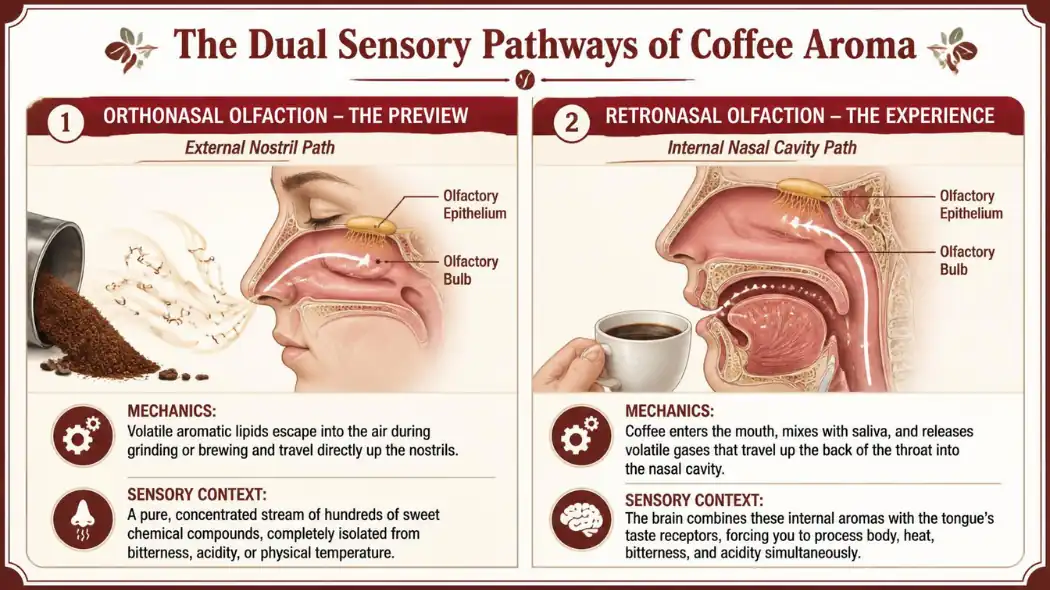
There are actually two main ways that coffee aromas reach your nose.
The first is the obvious one: Orthonasal Olfaction.
This is when you smell coffee through your nostrils before drinking it.
The second is Retronasal Olfaction.
When you sip and move the coffee, you release volatile aromatic compounds that travel to the nasal cavity.
Your brain then combines those aromas with the sensations detected by your tongue, creating what you perceive as flavour.
So when you drink coffee, your nose still plays a major role in the tasting process. It simply receives the aromas through a different route.
Why Does Fresh Coffee Smell So Incredible?
Freshly roasted coffee contains hundreds of volatile compounds responsible for its aroma.
Grinding the beans dramatically increases the surface area exposed to the air, allowing these compounds to escape.
Then hot water comes along and extracts and releases even more of them.
This is why the smell of freshly ground coffee can be so powerful.
You receive a concentrated burst of aromatic compounds directly in your nasal passages before you take a sip.
And your brain is very good at interpreting those smells.
You might immediately recognise chocolate, caramel, nuts, citrus, berries or flowers, depending on the coffee bean profile.
But that isn’t necessarily what your tongue is experiencing.
Then You Take a Sip…
Once the coffee enters your mouth, the sensory experience changes.
The coffee is now interacting with your saliva, tongue, temperature receptors and the rest of your oral environment.
Different release patterns of the volatile compounds cause some compounds responsible for coffee’s bitterness to stand out more.
Your brain is now receiving a completely different combination of signals.
Instead of simply smelling “chocolate and caramel”, you might experience:
aroma + bitterness + acidity + sweetness + body + temperature + texture.
Your brain combines all of these signals into one overall perception of flavour.
And sometimes that combination isn’t quite as appealing as the aroma that initially attracted you.
Temperature Makes a Difference Also to Coffee Smell
Coffee’s temperature can also influence how we perceive its flavour and aroma.
Hot coffee releases volatile aromatic compounds more readily, and this explains why freshly brewed coffee smells so powerful.
As coffee cools, different aromas become noticeable and the balance of flavours can change.
This is why a coffee that smells wonderful when it’s just been brewed can taste completely different once it has cooled.
Interestingly, cooling isn’t necessarily a bad thing.
Some speciality coffees actually become more interesting as they cool, revealing fruity or floral characteristics that were hidden behind the heat.
Your Brain Is Making the Final Decision
Perhaps the most fascinating part of all this is that flavour isn’t simply something contained inside the coffee.
Your brain is effectively constructing the experience from all the sensory information it receives.
It combines what your eyes see, what your nose smells, what your tongue detects and even what you expect the coffee to taste like.
This helps explain why the smell of coffee can create such a strong emotional response before we’ve even taken a sip.
The aroma of freshly brewed coffee can be associated with mornings, cafés, relaxation and familiarity — all of which can influence how we perceive the drink itself.
Why Can the Smell Be Better Than the Flavour?
Think of smelling freshly ground coffee as receiving a preview.
You’re experiencing a concentrated stream of aromatic compounds without yet having to deal with bitterness, acidity, temperature or texture.
Once you drink it, the preview becomes the full experience. And just like a film trailer, the preview can sometimes be more exciting than the finished product! This is particularly noticeable with coffee that has been poorly brewed. A beautifully roasted coffee can smell fantastic, but if it is under-extracted, over-extracted or brewed with poor-quality water, the resulting cup may not live up to the aroma. Sourcing parameters verified by The Coffee Guide show that extraction defects completely throw off flavor clarity; if your aromatic extractions at home are finishing with a harsh, dry, or aggressively burnt profile that ruins the sensory experience, check out our master troubleshooting guide to understand why does my coffee taste bitter and learn how to adjust your brewing variables smoothly.
The Aroma Is Part of the Coffee Experience
So the next time you lift your cup and think, “Why does this smell so much better than it tastes?”, don’t blame your coffee — blame your wonderfully complicated brain.
Coffee is simultaneously stimulating your sense of smell, taste and touch, while your brain attempts to turn all those signals into a single experience.
And that is why coffee aroma is so important.
The smell of the beans isn’t simply something that happens before you drink the coffee.
It’s one of the biggest parts of what you actually taste.
For a deeper look at what happens between your nose, your brain and your morning cup:
The Science of Scent: Why the Aroma of Coffee Tricks Our Brains…
Disclaimer – The coffee information provided on this website is for educational purposes only. It does not constitute medical advice. Readers should always consult a qualified healthcare professional before making changes to their dietary habits.

