

If you’ve ever finished your morning coffee, a coffee stimulant, and found yourself heading for the bathroom, you’re not alone.
For some people, it happens almost like clockwork. One minute you’re enjoying the coffee stimulant. Consequently, your digestive system seems to have received a clear instruction: Time to get moving.
However, while caffeine is partly responsible, there’s more going on than simply coffee stimulant giving you a boost of energy.
Coffee appears to have a surprisingly powerful effect on the digestive system, and scientists have identified several possible reasons why.
Caffeine Is Only Part of the Story
The obvious suspect is caffeine.
Caffeine is a natural stimulant that affects the central nervous system, helping you feel more alert and awake.
But its stimulating effects aren’t necessarily limited to your brain.
Caffeine can also influence the muscles of the digestive tract, encouraging movement through the intestines.
This process is known as gastrointestinal motility.
In simple terms, things start moving.
But here’s the interesting part: coffee can stimulate the bowel even when there isn’t much caffeine involved.
That’s why some people experience the same effect after drinking decaffeinated coffee.
So if caffeine were the only explanation, decaf shouldn’t have quite the same effect. Clearly, something else is happening.
Coffee Can Trigger Your Digestive Hormones as a coffee stimulant
One of the more fascinating explanations involves hormones.
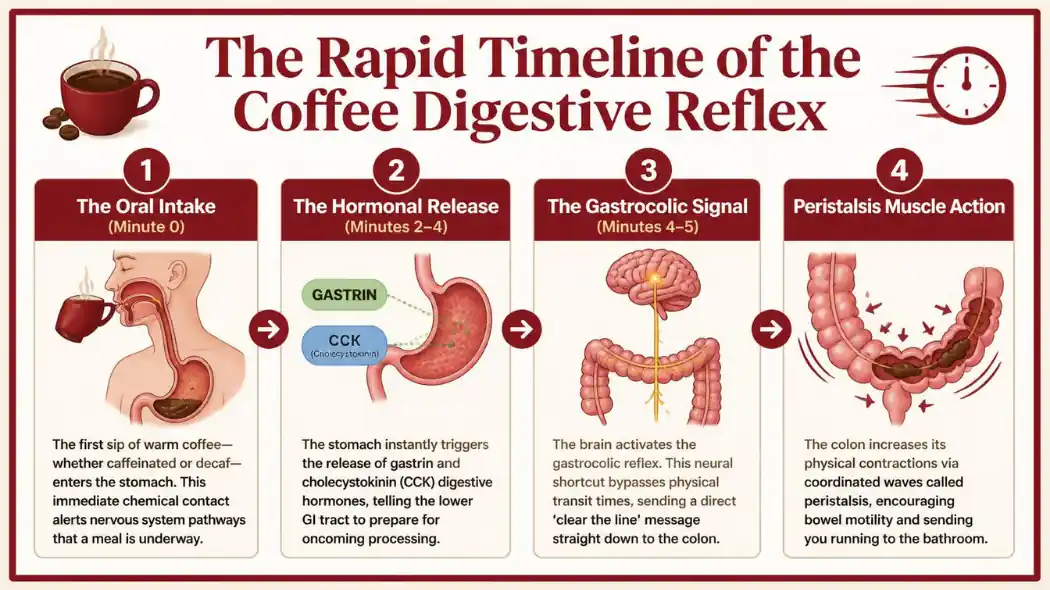
Drinking coffee can be a coffee stimulant and influence the release of gastrin, a hormone involved in the digestive process. Gastrin encourages the stomach to produce acid and can also promote movement within the digestive tract.
Coffee may also influence other digestive signalling mechanisms, including cholecystokinin (CCK), which is involved in digestion and the movement of food through the gastrointestinal system.
These chemical signals effectively tell your digestive system that something is happening and that it should get ready to process it.
And your colon can respond by increasing its contractions.
This movement is called peristalsis — the coordinated muscular contractions that move material through your digestive tract.
So that morning cup isn’t necessarily acting like a traditional laxative. Instead, it can be encouraging your existing digestive system to speed things up.
Why Does It Happen So Quickly?
This is perhaps the strangest part.
For some people, the urge can arrive remarkably quickly — sometimes within minutes of drinking coffee.
But the coffee you have just swallowed hasn’t travelled through your entire digestive system in that time.
So what’s happening?
The answer is a phenomenon called the gastrocolic reflex.
When something enters your stomach, your body can respond by signalling the colon to contract. It’s essentially your digestive system making room for what’s coming next.
Coffee appears to be particularly effective at stimulating this response in some people.
And if you drink coffee shortly after waking, you’re adding another factor into the equation.
Your Morning Routine May Be Helping
Your digestive system naturally becomes more active when you wake up and begin eating and drinking.
For many people, coffee is simply part of an established morning routine: wake up, have a drink, perhaps eat breakfast, and then head to the bathroom.
Over time, your body can become conditioned to this sequence.
So it may not be just the coffee.
It could be the combination of waking up, drinking a warm beverage, eating breakfast, caffeine, hormones and the gastrocolic reflex all arriving at roughly the same time.
Coffee may simply be the final piece of the puzzle.
Why Does Decaf Do It Too?
This is where things get particularly interesting.
If caffeine were entirely responsible for coffee’s effect on the bowel, you’d expect decaffeinated coffee to have little or no effect.
Yet some people find that decaf produces exactly the same bathroom response.
That suggests that other components of coffee are involved.
Scientists are still investigating exactly which compounds are responsible and how the various mechanisms interact. Coffee is an incredibly complex beverage, containing hundreds of different chemical compounds, and its effects on the body are not all explained by caffeine.
This is a useful reminder that coffee is much more than a delivery system for caffeine.
Why Doesn’t It Affect Everyone?
Of course, not everyone gets the coffee-and-bathroom combination.
Our digestive systems are remarkably individual.
Some people are particularly sensitive to caffeine, while others aren’t. Diet, gut sensitivity, genetics, the amount of coffee consumed and even the type of coffee can all potentially influence the response.
The strength of the reaction can also vary.
One person might happily drink several cups without noticing anything, while another may find that a single morning espresso is enough to activate the digestive system.
Does Stronger Coffee Mean a Stronger Effect?
Not necessarily.
A stronger-tasting coffee doesn’t automatically mean it will have a greater effect on your digestive system.
As we’ve already discovered in the question about espresso, flavour intensity, caffeine concentration and total caffeine aren’t the same thing.
An intensely flavoured espresso isn’t necessarily going to send everyone rushing for the bathroom. The immediate effect depends on the brew and personal tolerance.
A large mug of filter coffee might have a much more noticeable effect simply because of the amount consumed. The coffee stimulant effect is shaped by extraction quality and caffeine content.
Sourcing logs managed by The Coffee Guide show that these high-volume filter extractions can magnify underlying brewing errors. If your larger morning cups taste sharp, hollow, or sour, check our troubleshooting guide to adjust grind and water.
So, Should We Blame the Coffee?
Perhaps “blame” isn’t quite the right word.
For most people, the effect is simply a normal response to a combination of caffeine, coffee compounds, digestive hormones and the body’s natural gastrocolic reflex.
In fact, that predictable morning routine is one reason coffee and breakfast have become such a familiar pairing.
So the next time your freshly brewed coffee sends you heading towards the bathroom, don’t necessarily assume there’s something wrong.
Your coffee hasn’t suddenly become a laxative.
It may simply have reminded your digestive system that it’s time to get moving.
Disclaimer – The coffee information provided on this website is for educational purposes only. It does not constitute medical advice. Readers should always consult a qualified healthcare professional before making changes to their dietary habits.

