

Table of Contents
What Is an Espresso Macchiato and How Did It Get Its Name?
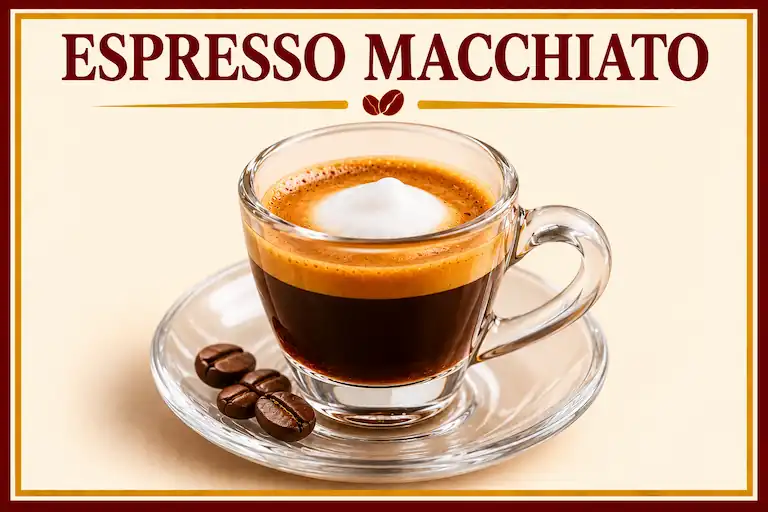
An Espresso Macchiato is a small, traditional Italian coffee consisting of a single or double shot of espresso marked with a little steamed milk or milk foam.
The word macchiato comes from Italian and translates as stained, spotted or marked. It describes the appearance of the espresso after a small amount of milk has been added.
The drink is traditionally associated with Italian espresso-bar culture, where the addition of milk helped distinguish an espresso with milk from a straight espresso. The popular explanation is that baristas used the small milk mark to help waiting staff identify the customer’s order.
Although the exact history is not firmly documented, the explanation captures the drink’s defining characteristic: espresso remains the main ingredient, while milk plays a supporting role.
Unlike a Latte or Cappuccino, the Espresso Macchiato contains very little milk. Its purpose is not to transform the espresso into a milk-based drink, but to soften its intensity slightly while preserving its concentrated coffee character.
As explained in NESCAFÉ’s guide to the Macchiato, the traditional Espresso Macchiato uses a small amount of milk to mark the espresso without overwhelming its flavour.

How to Prepare a Traditional Espresso Macchiato
The traditional Espresso Macchiato is deliberately simple. It requires a properly extracted espresso and just enough textured milk to create the characteristic mark on its surface.
The finished drink should remain predominantly dark espresso, with a small white area of milk or foam visible on top.
1. Prepare the espresso base
Begin by preparing a single or double espresso using freshly ground coffee.
A useful starting point for a modern double shot is:
- Ground coffee: Approximately 18g.
- Espresso yield: Approximately 36g.
- Extraction time: Around 25–30 seconds as a starting guide.
These are practical espresso parameters rather than fixed Macchiato rules. The coffee, roast and machine will influence the ideal recipe.
Extract directly into a small, pre-warmed espresso cup or demitasse, allowing the crema to develop naturally.
2. Prepare the milk
Use a small quantity of fresh, cold milk. Whole milk produces a creamy result, although suitable barista-style alternatives can also be used.
Steam the milk gently, introducing enough air to create a fine, stable texture. You do not need a large quantity because the Macchiato requires only a small addition.
The aim is to produce a little silky microfoam rather than the thick, voluminous foam associated with a Cappuccino.
3. Add the milk mark
Traditionally, a small spoonful of milk foam is placed directly onto the centre of the espresso crema.
This creates the characteristic white mark that gives the drink its name.
Some modern baristas pour a small amount of textured milk directly from the pitcher instead. Both approaches can produce a good Espresso Macchiato, provided the milk remains a minor component of the finished drink.
4. Serve immediately
Serve the Macchiato while the espresso is freshly prepared and the milk texture is still integrated.
A small ceramic espresso cup or glass demitasse is ideal. The compact serving allows the coffee’s aroma and concentrated flavour to remain at the centre of the experience.
What Are the Structural Differences Between a Macchiato, Espresso and Cortado?
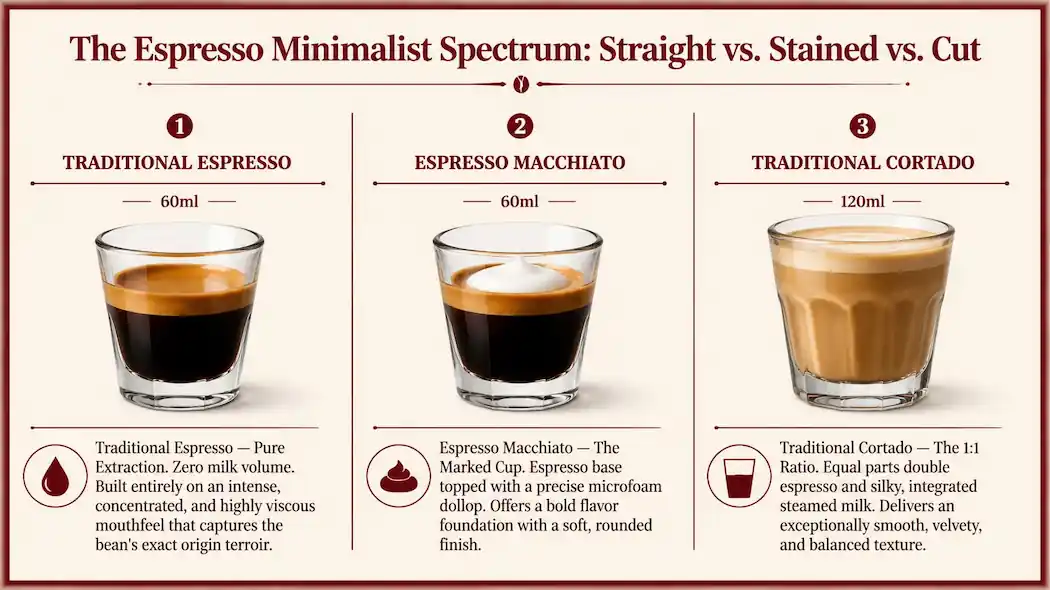
These three drinks may look similar because they are all served in relatively small cups, but their milk proportions create very different experiences.
| Beverage | Core composition | Milk quantity | Resulting character |
|---|---|---|---|
| Espresso | Espresso only | None | Concentrated, intense and full-bodied |
| Espresso Macchiato | Espresso with a small amount of milk or foam | Minimal | Strong espresso character with a softer finish |
| Cortado | Espresso combined with approximately equal parts milk | Considerably more | Smooth, balanced and creamy |
The most important distinction is the quantity and texture of the milk.
A Macchiato is still essentially an espresso, while the Cortado is a more integrated coffee-and-milk drink. The Cortado’s larger milk volume softens the espresso more noticeably and produces a smoother, less concentrated drinking experience.
For another explanation of these differences, The Manual’s comparison of Cortado and Macchiato explores how the two drinks differ in milk quantity, texture and overall flavour.
Is an Espresso Macchiato Stronger Than a Standard Caffè Latte?
In terms of perceived coffee intensity, generally yes.
An Espresso Macchiato contains considerably less milk than a conventional Latte. This means the espresso remains much more prominent, allowing its natural flavour characteristics to be experienced with relatively little dilution.
A Latte, by comparison, combines espresso with a substantially larger volume of steamed milk. This produces a smoother, milk-forward drink in which the coffee’s intensity is softened.
There is, however, an important distinction between flavour strength and caffeine content.
If both drinks contain the same espresso dose, they will contain broadly similar amounts of caffeine. The Macchiato simply tastes more concentrated because there is less milk surrounding the espresso.
The small addition of milk can soften some of the espresso’s sharper characteristics, but it does not turn the drink into a mild or particularly milky coffee.
The result is a compact, expressive drink that retains the character of the original espresso.
Espresso Macchiato or Latte Macchiato: Why the Difference Matters
One of the most common sources of confusion is the difference between an Espresso Macchiato and a Latte Macchiato.
Although they share the same Italian name, they are prepared in opposite ways.
Espresso Macchiato
The espresso is prepared first and then marked with a small amount of milk or foam.
Coffee is the dominant ingredient, and the finished drink is small and concentrated.
Latte Macchiato
The milk is prepared first, usually steamed and foamed before being poured into a taller glass. A shot of espresso is then added, marking the milk with coffee.
Milk is the dominant ingredient, producing a much larger and generally milder drink.
The distinction is straightforward: an Espresso Macchiato is espresso marked with milk, whereas a Latte Macchiato is milk marked with espresso.
A Small Coffee With a Distinctive Character
The Espresso Macchiato demonstrates how a very small change to a traditional espresso can create an entirely different drinking experience.
Its defining feature is restraint. A little milk softens the coffee, but the espresso remains firmly in control.
Whether finished with a traditional spoonful of foam or a small pour of silky milk, the Macchiato offers a simple, elegant alternative to larger milk-based drinks.
Bold, compact and unmistakably espresso-led, it remains one of the classic choices for anyone who enjoys their coffee with just a little milk.
Visit the history and origins of the world’s most popular coffees, and explore how each much-loved drink found its place in coffee culture.


