

Table of Contents
The Science of Coffee Roasting
Coffee roasting is one of the most fascinating stages in the journey from seed to cup. What begins as a hard, pale-green seed undergoes a remarkable transformation when exposed to heat, developing the colour, aroma and flavour characteristics that define the coffee we eventually brew.
Understanding coffee roasting means looking beyond the changing colour of the beans. Inside each seed, moisture escapes, chemical reactions take place and the physical structure gradually changes. The roaster’s challenge is to control these transformations, developing the desirable characteristics of the coffee without allowing excessive heat to destroy its natural qualities.
Whether you’re using a traditional roasting pan or a modern commercial drum roaster, the underlying principles remain remarkably similar.

What Are the Five Stages of Coffee Roasting?
Although roasting is a continuous process rather than five completely separate operations, it is useful to divide it into five recognisable stages.
1. The Drying Phase
Green coffee beans contain moisture, generally around 10–12% by weight when properly prepared for export.
As heat is applied, this moisture begins to evaporate. The beans gradually change from green to yellow, while their fresh grassy aroma develops into something more reminiscent of hay or warm cereal.
The drying phase is important because the beans need to lose moisture before their more complex roasting reactions can develop effectively.
2. The Maillard Reaction
As the temperature increases, the beans begin to brown through a series of chemical reactions, including the Maillard reaction.
This occurs when reducing sugars and amino acids interact, producing a wide range of flavour and aroma compounds.
These reactions contribute to the familiar characteristics of roasted coffee, including toasted bread, nuts, chocolate and caramel-like aromas.
The Maillard reaction is not a single event that happens at one precise temperature. It develops progressively as the beans heat up.
3. First Crack
One of the most recognisable milestones in coffee roasting is First Crack.
As internal pressure builds, the expanding beans undergo structural changes that produce a series of audible cracking sounds. The sound is often compared to popcorn popping.
First crack is an important reference point for the roaster. It signals that the coffee has entered a later stage of development, although the exact temperature varies with the coffee, equipment and measurement method.
Some light roasts are finished shortly after first crack, preserving more of the coffee’s delicate origin characteristics and brightness.
4. The Development Phase
After first crack begins, the coffee enters what roasters commonly call the development phase.
This is where the roaster decides how much further to develop the flavour before removing the beans from the heat.
A shorter development may preserve more brightness and delicate aromatic characteristics, while additional development can produce greater roast sweetness, body and deeper flavours.
However, longer development does not automatically mean better coffee. Too much heat or excessive time can flatten the coffee’s character and introduce harsh, smoky or bitter notes.
5. Second Crack
If roasting continues, the beans may eventually reach Second Crack.
This is generally quieter and sharper than first crack, indicating further structural breakdown within the bean.
As the roast progresses, the beans become darker and more brittle, and their natural oils may begin to appear on the surface.
Second crack is associated with darker roast development. Continuing too far beyond this point increases the risk of producing smoky, carbonised flavours that overwhelm the coffee’s original character.
How Does Coffee Roast Level Influence Brewing Method?
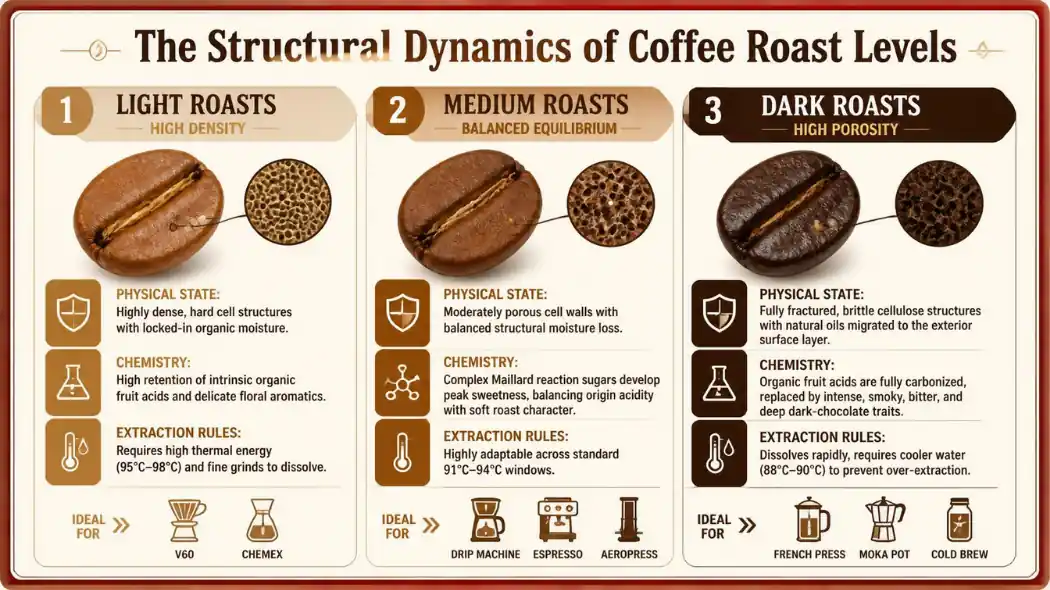
The roast level affects the physical structure and solubility of coffee beans, which in turn influences how they behave during brewing.
Light, medium and dark roasts can all produce excellent coffee, but they often respond differently to grind size, water temperature and extraction time.
Light Roasts
Light roasts generally retain more of their original density and can be less soluble than darker coffees.
They often display brighter acidity, floral aromas and more distinctive origin characteristics. Because they can be more challenging to extract, they may benefit from slightly finer grinding or hotter brewing water, depending on the coffee and brewing equipment.
They are particularly popular with clarity-focused filter methods such as the Hario V60 and Chemex.
Medium Roasts
Medium roasts offer a useful balance between origin character and roast development.
They can retain some of the coffee’s original acidity while developing greater sweetness, body and familiar flavours such as chocolate, nuts and caramel.
Their versatility makes them suitable for a wide range of brewing methods, including the AeroPress, filter machines and espresso equipment.
Dark Roasts
Dark roasts are generally more porous and soluble than lighter roasts, meaning they can extract more readily.
Their flavour characteristics often include dark chocolate, toasted nuts, smoke and roasted sweetness. Depending on the coffee and degree of development, they may have a fuller body and more pronounced roast character.
They are frequently used with immersion and concentrated brewing methods such as the Vietnamese Phin Filter, French Press and Moka Pot.
These are useful starting points rather than strict rules. Any roast level can work with different brewing methods when grind size, water temperature and extraction are adjusted accordingly.
What Are the Five Common Coffee Roasting Defects?
Even small mistakes during roasting can influence the appearance and flavour of the finished beans. Understanding common defects makes it easier to identify what has gone wrong and improve future batches.
1. Over-Roasting
Over-roasting occurs when coffee is exposed to excessive heat or allowed to develop too far.
The beans become very dark, brittle and sometimes heavily coated with surface oils. Their original origin characteristics become increasingly difficult to detect, replaced by smoky, ashy and carbonised flavours.
2. Scorching
Scorching happens when the bean surface experiences excessive direct heat, particularly early in the roasting process.
It can leave dark, charred patches on the flat faces of the beans. The resulting coffee may taste acrid, smoky or reminiscent of burnt toast.
3. Tipping
Tipping is a form of localised scorching that appears around the pointed ends or edges of the bean.
It is generally associated with excessive heat application or uneven heat transfer during roasting. The affected beans can develop harsh, sharp and unpleasant flavours.
4. Baking
A baked roast can occur when the roast loses momentum or develops too slowly.
Rather than developing the desirable sweetness and complexity associated with a well-managed roast, the coffee may taste flat, dull and lifeless, sometimes resembling cardboard or stale cereal.
5. Underdevelopment
Underdevelopment occurs when the beans are removed from the roaster before sufficient flavour development has taken place.
The finished coffee may taste grassy, vegetal, sharply sour or unpleasantly raw. Its appearance alone is not always enough to identify the problem; tasting is essential.
If your brewed coffee has an unpleasantly sharp, grassy or vegetal character, our troubleshooting guide explains why coffee tastes sour and how brewing adjustments can help.
The Coffee Guide: The Roast and Brewing Method Master Map
The following comparison provides a useful starting point when matching roast levels with brewing equipment.
| Brewing method | Suggested roast level | Main flavour objective |
|---|---|---|
| Pour-over (V60, Chemex) | Light to medium | Clarity, brightness and delicate aromatics |
| Phin Filter | Medium to dark | Fuller body and deeper chocolate notes |
| AeroPress | Any roast | Adaptable brewing, from clarity to body |
| Espresso | Medium to medium-dark | Balance between sweetness, acidity and body |
| French Press | Medium to dark | Full-bodied coffee with a richer mouthfeel |
| Filter machine | Light to medium | Balanced sweetness and approachable flavour |
Remember that these are recommendations rather than restrictions. The coffee itself, its freshness, grind size and brewing recipe all influence the final result.
The London Roasting Journey: From the Docks to the Fire
To enter a London coffee house in the 1660s was to encounter a very different coffee culture from the one we know today.
London’s coffee houses were places of business, conversation, political discussion and exchange. But before coffee could be served to customers, the raw green beans had to be roasted, and this was a considerably more hands-on operation than modern roasting.
Coffee arrived in London through international trading networks, particularly those connecting British merchants with the Ottoman world. Once the beans reached the city, they needed to be roasted, ground and brewed before they could become the familiar dark drink served in the coffee houses.
The Art of the Iron Pan

Before the era of precision machinery, roasting was a perilous dance with open flames. Every batch was a sensory gamble, judged only by the sting of blue smoke and the sharp ‘crack’ of expanding beans in a hand-cranked iron pan.
Early coffee roasting relied on relatively simple equipment and the experience of the person handling the beans.
Roasters used open iron pans over charcoal or other fires, stirring or shaking the beans to prevent them from burning. Cylindrical roasting vessels were also developed, allowing the beans to be turned more continuously and helping produce a more even result.
By the late seventeenth century, rotating cylindrical roasters were being described in accounts of coffee preparation. In 1699, for example, a description of the roasting process explained how beans were heated in a perforated metal cylinder over a charcoal fire and continually turned until they developed a dark brown colour and an oily appearance.
This gives us a fascinating glimpse into the practical knowledge of early coffee roasters.
For further historical context, see Andrew Chapman’s account of how coffee was prepared in 1699.
Before modern temperature probes and automated roasting controls, coffee roasting depended heavily on observation and experience. The roaster watched the beans change colour, listened for the sounds of expansion and judged the aroma as the batch developed.
Every roast required attention. Too little heat could leave the beans underdeveloped, while excessive heat could quickly scorch them.
Spotting a Seventeenth-Century Dark Roast
Historical descriptions offer some clues about the appearance of roasted coffee during this period.
The Dark Finish: A 1699 account describes beans being roasted until they reached a dark brown colour and their oils became visible. This suggests that a relatively developed roast was familiar to coffee drinkers at the time.
The Glossy Surface: The appearance of oil was regarded in that particular account as an indication that the beans had been properly roasted. Today, however, visible surface oil is not a universal measure of roast quality.
The Uneven Finish: Early roasting equipment offered considerably less control than modern machines. Differences in heat distribution and manual handling could produce uneven results, although we should not assume every seventeenth-century roast looked the same.
The Roast Character: Darker roasting could produce strong, smoky and bitter characteristics, but the flavour of historical coffee also depended on the origin of the beans, how they were ground and how the drink was prepared.
The Thames Water Question
One particularly interesting aspect of London’s early coffee culture was the water used to prepare the drink.
The River Thames was an important source of water for London, and historical accounts indicate that river water was commonly used in coffee preparation. Some contemporary writers even discussed whether spring water or Thames water produced the better cup.
However, there is no reliable evidence that London roasters deliberately pushed coffee into extreme dark roasts to disguise the taste of polluted river water.
It is a tempting historical explanation, but the roasting methods of the period are better understood through the equipment available, the preferences of contemporary drinkers and the practical challenges of controlling heat.
The story is still fascinating without needing to turn that theory into historical fact.
From Crack to Cup: The Journey Continues
Coffee roasting is both a science and a craft. It combines chemical reactions, heat transfer and physical changes with the experience and judgement of the person operating the roaster.
Every change in colour, every shift in aroma and every crack provides information about the developing coffee.
But roasting is only one part of the journey. Once the beans have cooled, their characteristics are influenced by storage, grinding, water quality, brewing temperature and extraction.
Understanding the roast gives you a better starting point for appreciating why different coffees taste the way they do and how to bring out their best qualities.
Conclusion: From Seventeenth-Century London to Your Kitchen
The journey of coffee roasting has changed enormously since the early London coffee houses of the seventeenth century.
What once depended on iron pans, charcoal fires and a roaster’s senses has developed into a sophisticated process involving temperature probes, airflow controls, computerised profiles and carefully measured roasting curves.
Yet the essential objective remains the same: to use heat to unlock the flavour potential of the coffee bean without destroying its character.
By understanding the stages of roasting, recognising common defects and matching roast levels to suitable brewing methods, you can develop a much deeper appreciation of the work that goes into every cup.
The next time you open a bag of freshly roasted coffee, take a moment to look at the beans. Their colour, surface and aroma tell a story that began long before they reached your grinder.
From the first crack to the final extraction, every stage contributes to the coffee you enjoy.
Disclaimer – The coffee information provided on this website is for educational purposes only. It does not constitute medical advice. Readers should always consult a qualified healthcare professional before making changes to their dietary habits.


