

Table of Contents

The flavour of coffee begins developing long before the beans reach a roastery.
It starts with coffee growing conditions, where soil, rainfall, temperature, altitude and sunlight influence the health of the coffee plant and the development of its fruit.

These natural conditions help determine how successfully a coffee tree grows, how its cherries mature and the characteristics that develop within the seeds. However, no single environmental factor guarantees a particular flavour. The coffee species, variety, farming practices, harvesting decisions and processing methods all contribute to the final result.
When I was running my coffee shop, customers would sometimes look at tasting notes such as blueberry, milk chocolate or citrus on a bag of beans and ask where those flavours came from. It was a good question, because the answer begins well before roasting or brewing.
I wasn’t a coffee farmer, but sourcing coffee for customers taught me to appreciate how much the growing environment can influence the character of a bean. Let’s explore the natural conditions behind the coffee we drink.
1. Soil: the foundation of healthy coffee growth
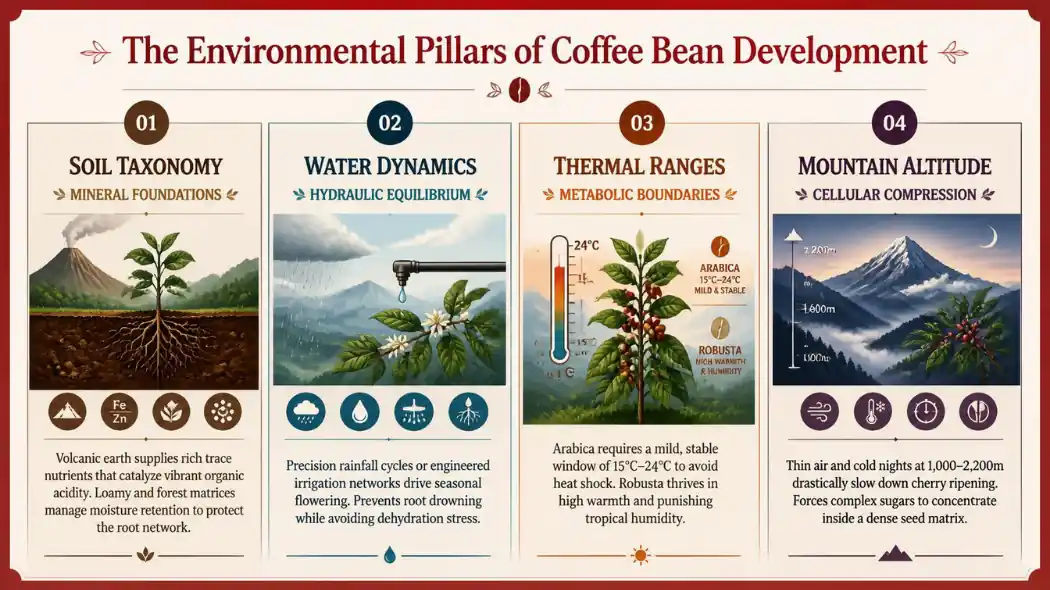
Soil does much more than anchor a coffee tree. It provides the physical environment in which roots develop and supplies water and essential nutrients needed for healthy growth.
The structure, depth, drainage and organic matter content of the soil all influence how effectively a coffee plant can establish itself and support its developing crop.
Coffee grows in several different soil types, provided the conditions are suitable. Deep, fertile and well-drained soils are generally favourable because they allow roots to spread while maintaining access to moisture and oxygen.
Volcanic soils: naturally mineral-rich growing environments
Volcanic soils occur in several established coffee-growing regions, including parts of Central America and East Africa. Depending on their age and composition, these soils can contain useful mineral nutrients and have physical characteristics that support healthy root development.
Their structure may also provide good drainage and water retention, although this varies considerably between locations.
Healthy soil supports a healthy coffee tree, which in turn helps the plant develop and fill its cherries. However, volcanic soil does not automatically produce fruity, floral or bright-tasting coffee. Those characteristics depend on a combination of genetics, climate, growing conditions and post-harvest practices.
Loamy soils: balancing moisture and drainage of coffee growing conditions
Loam is a mixture of sand, silt and clay, often containing organic matter. In suitable proportions, these components provide a useful balance between drainage and moisture retention.
This is particularly important for coffee roots. They need access to water, but they also require oxygen. Soil that remains waterlogged can restrict root function, while excessively free-draining soil may leave plants vulnerable during dry periods.
Good soil structure helps maintain the conditions needed for steady plant development and fruit production.
Organic matter and forest environments
In some coffee-growing regions, fallen leaves, decomposing vegetation and other organic material contribute to the soil. As this material breaks down, it helps recycle nutrients, improve soil structure and support moisture retention.
Coffee farms incorporating shade trees and other vegetation may also benefit from greater biodiversity and protection against certain environmental stresses.
The important distinction is that soil and vegetation influence the growing environment rather than directly determining the taste of the finished coffee. A coffee grown in forest-rich surroundings can display a wide range of flavour characteristics.
2. Rainfall and water: timing is as important as quantity
Coffee plants need water throughout their development, particularly during periods of flowering, leaf growth and cherry formation. However, the amount of rainfall is only part of the story. Its timing and distribution can be just as important.
In many coffee-growing regions, a distinct dry period followed by rainfall helps stimulate flowering. When the rain arrives, dormant flower buds can develop and open, sometimes producing a large flowering event across the plantation.
Irregular rainfall can result in several flowering periods, meaning cherries mature at different times. This can make harvesting more complicated because growers may need to return to the same trees several times to collect ripe fruit.
Natural rainfall and seasonal development
Where coffee farms depend mainly on natural rainfall, the timing of wet and dry seasons can have a considerable influence on crop development.
Insufficient water can cause stress, restrict fruit growth and contribute to the loss of flowers or young cherries. Excessive rainfall can create other problems, including waterlogged soil, erosion and increased disease pressure.
The distribution of rainfall also affects how uniformly cherries develop. A more consistent pattern of flowering and fruit maturation can make it easier for farmers to manage the harvest.
Irrigation: managing water availability
In areas where rainfall is unreliable, irrigation can help maintain suitable moisture levels during important stages of development.
Some producers use carefully managed irrigation to support young plants, reduce drought stress or encourage more uniform flowering. The approach depends on the local climate, soil conditions, available water and the needs of the crop.
More water is not necessarily better. Excessive irrigation can create poor drainage conditions, while insufficient water can leave plants under stress.
Good water management supports the development of healthy cherries and gives the coffee crop a better opportunity to reach maturity.
3. Temperature: influencing growth and cherry maturation
Temperature affects almost every stage of coffee development, from vegetative growth and flowering to the rate at which cherries mature.
Arabica and Robusta have different temperature preferences, which helps explain why they are commonly cultivated in different environments.
Arabica: generally suited to cooler conditions
Arabica (Coffea arabica) is generally associated with cooler growing environments, particularly at higher elevations. Average temperatures around 15–24°C are often used as a broad guide, although suitable conditions vary with variety, location and seasonal patterns.
When temperatures become excessively high, Arabica plants can experience heat stress. This may affect flowering, fruit development and crop yields.
Cooler conditions can slow the maturation of coffee cherries, allowing the fruit and developing seeds more time to mature. Research has associated these longer maturation periods with changes in bean composition and, in some growing environments, improved sensory characteristics.
Arabica is often associated with floral, fruity and complex flavour profiles, but these characteristics cannot be attributed to temperature alone.
Robusta: more tolerant of warmer conditions
Robusta (Coffea canephora) is generally better adapted to warmer growing environments and is widely cultivated in tropical lowland regions.
It is also known for its greater tolerance of certain environmental stresses compared with Arabica, although it still requires suitable growing conditions.
Robusta often produces a fuller-bodied coffee with stronger, more pronounced flavour characteristics. It also naturally contains more caffeine than Arabica.
The differences between the two species are influenced by their genetics as well as the environments in which they are grown.
For further information about coffee-growing environments and cultivation requirements, see the FAO’s Arabica coffee cultivation guide.
4. Altitude: why elevation can influence coffee quality
Altitude is one of the most frequently displayed details on specialty coffee packaging. It is often used as an indication of where the coffee was grown and the environmental conditions in which it developed.
As elevation increases, temperatures generally become cooler, although the precise relationship depends on latitude, topography, exposure and local climate.
In many coffee-growing regions, cooler temperatures at higher elevations slow the development and ripening of coffee cherries. This extended maturation period can influence the accumulation of compounds within the developing seeds.
Higher-grown coffees are frequently associated with greater bean density and more pronounced acidity, although neither characteristic is guaranteed by altitude alone.
The variety, rainfall, shade, soil and farm management also contribute to the result.
What does bean density mean?
Bean density describes how much mass is contained within a given volume of green coffee. It is influenced by the way the bean develops and fills during the maturation process.
Denser beans can behave differently during roasting because heat moves through them differently. Roasters may need to adjust their profiles to achieve the desired development.
However, density is not a direct measure of flavour quality. A dense bean is not automatically superior to a less dense one, and the final result depends on the coffee’s characteristics and how it is roasted.
Altitude should therefore be considered a useful piece of information about a coffee’s growing environment rather than a guarantee of quality.
5. Sunlight and shade: finding the right balance
Sunlight provides the energy coffee plants need for photosynthesis, supporting leaf growth and the development of fruit.
However, the amount of direct sunlight a coffee plant receives can influence its temperature, water requirements and overall growing conditions.
Some coffee farms grow their plants beneath shade trees, while others use more open cultivation systems.
Shade-grown coffee
Shade trees can help moderate temperatures, reduce direct solar exposure and limit moisture loss from the soil. They may also support biodiversity and provide additional benefits to the farm environment.
In particularly hot regions, shade can help protect coffee plants from excessive heat and reduce certain forms of environmental stress.
However, too much shade can restrict available light and affect flowering, fruit development and crop yields. The most suitable level depends on the coffee variety, local climate and farm management.
Shade can influence the conditions in which the beans develop, but it does not automatically produce a particular flavour profile.
6. How the environment influences the flavour potential of coffee
The growing conditions discussed above interact throughout the coffee plant’s development. They influence plant health, flowering, fruit maturation and the way the seeds develop inside the cherries.
These processes can affect the chemical composition of the beans, which contributes to the potential aroma, acidity, sweetness and body of the finished coffee.
For example:
- Temperature: Can influence the speed of cherry maturation and the development of compounds within the beans.
- Altitude: Often influences local temperature and the length of the maturation period.
- Rainfall: Affects plant water availability, flowering and fruit development.
- Soil: Supports root health and the supply of nutrients required for growth.
- Sunlight and shade: Influence temperature, photosynthesis and moisture conditions.
These factors do not work independently. A particular combination of climate, soil, elevation and farm management may produce very different results from another growing environment.
A useful scientific review, Does Coffee Have Terroir and How Should It Be Assessed?, examines how environmental conditions, coffee genetics and agricultural practices interact to influence the sensory characteristics of coffee.
7. Nature is only the beginning: processing and roasting matter too
Although the growing environment helps establish the potential characteristics of a coffee bean, the journey does not end when the cherries are harvested.
Processing has a significant influence on the way the coffee develops after picking. Natural, washed and honey processing methods each involve different approaches to removing the fruit and drying the beans.
Storage conditions, roasting and brewing also influence the final sensory experience.
For example, a coffee with naturally delicate floral characteristics may express them differently depending on the roast profile and brewing method. Similarly, a coffee with pronounced acidity may taste unbalanced if it is poorly extracted.
This is why tasting notes should be considered the result of several connected stages rather than the direct product of one growing condition.
Conclusion: nature shapes the potential, not the entire flavour
The natural environment plays an important role in shaping the character of coffee. Soil, rainfall, temperature, altitude and sunlight influence how coffee plants grow, how their cherries mature and the characteristics that develop within the seeds.
However, there is no single perfect soil type, altitude or rainfall pattern that guarantees exceptional coffee. Quality comes from the interaction between the coffee’s genetics, its growing environment, farming practices and the decisions made after harvesting.
The next time you open a bag of coffee, take a moment to look beyond the tasting notes. Consider its origin, growing elevation and processing method. These details offer a glimpse into the natural conditions and careful work behind the beans.
From the soil beneath the roots to the conditions in which the cherries ripen, nature has an important part to play in every cup.

“When these high-altitude sugars reach peak maturity, the agricultural chapter closes. Read our complete guide to Harvesting-The Final Process of the Coffee Bean’s Growth


