

Table of Contents
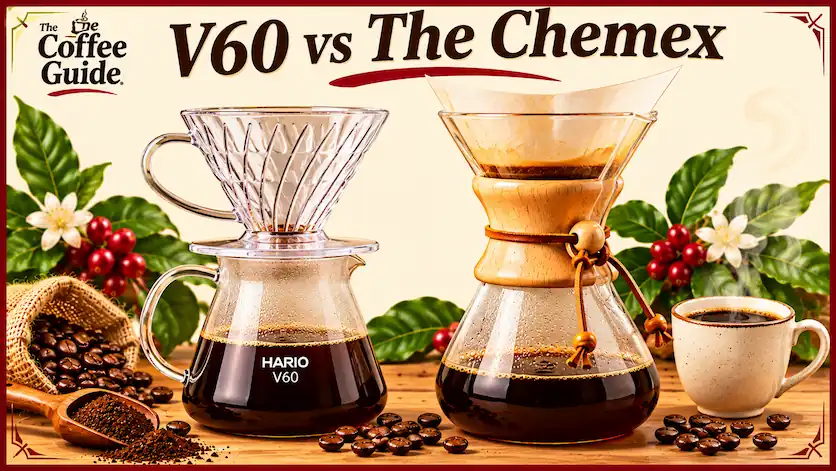
While both the Hario V60 and the Chemex rely on the manual pour-over method to brew coffee, the distinct differences in their shape, material, and filter design produce completely opposite flavor profiles. Comparing the V60 vs the Chemex to a casual drinker, might look like similar glass cones, but behind the counter, we know that these two brewers behave entirely differently in action.
What are the design and extraction features of a Hario V60?
The Hario V60 is a highly responsive, cone-shaped pour-over brewer engineered by Hario in Japan. Its unique extraction style is driven by three clever design features: a precise 60-degree cone angle, distinct interior spiral ridges that promote airflow, and a large central drainage hole at the base.
Our ongoing brewing trials here at The Coffee Guide highlight how these variables speed up the water flow, transferring total control over the brew time directly to your choice of grind size and pouring speed. When paired with its signature thin paper filters, this method yields an incredibly bright, complex, and high-clarity cup that maximizes vibrant fruit and floral acidity.

What are the design and extraction features of a Chemex?
Invented in 1941 by German chemist Dr. Peter Schlumbohm, the Chemex is an iconic, hourglass-shaped glass carafe that relies entirely on specialized filtration to shape your final cup profile. The defining secret behind a Chemex is its proprietary bonded paper filters, which are engineered to be 20% to 30% thicker than standard drip filters.
In my coffee shop and catering days, we always used the Chemex when serving large groups who wanted a light, smooth, and incredibly approachable brew. Our hands-on testing here at The Coffee Guide shows that this thick, dense paper matrix captures nearly all insoluble fine sediments and heavy coffee oils. By trapping those elements, the Chemex produces an exceptionally clean, crisp, and tea-like beverage with virtually zero perceived bitterness.
How do Hario V60 and Chemex filters affect body and flavour?
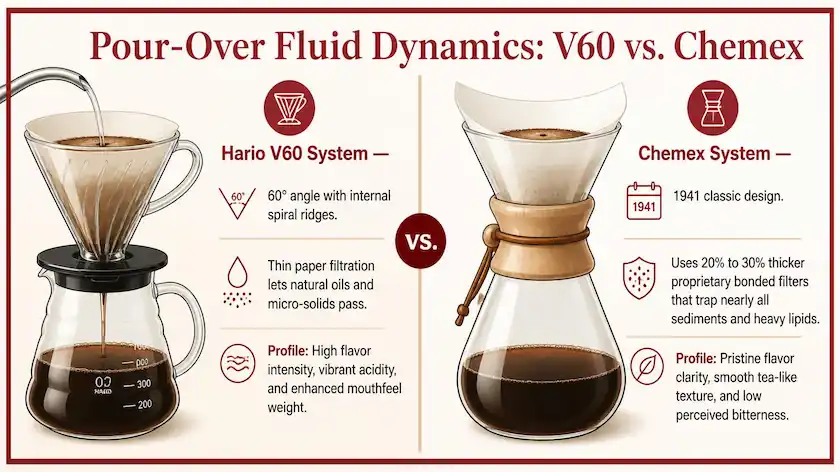
The absolute biggest difference between a V60 and a Chemex comes down to the thickness and design of their paper filters. In my experience behind the counter, switching the filter type is the easiest way to completely alter the style of coffee you serve.
Our brewing team here at The Coffee Guide has mapped out exactly how these two paper barriers change your final cup profile:
| Brewer Type | Filter Construction | Impact on Oils & Sediments | Signature Body & Flavor Profile |
|---|---|---|---|
| Hario V60 | Thin, highly porous paper. | Allows more natural coffee oils and microscopic fine particles to pass through into the cup. | Delivers a heavier body, enhanced mouthfeel weight, and high, punchy flavor intensity. |
| Chemex | Heavy, triple-bonded dense paper. | Traps nearly all heavy oils and ultra-fine particles inside the paper matrix. | Creates an unmatched flavor clarity and pristine finish, removing sensory background noise so delicate notes shine. |
Mastering the Pour-Over Flow Rate
While the Chemex’s dense filtration yields an incredibly clean cup, that thick paper makes the brew highly sensitive to your technique. If your grinder isn’t dialed in correctly, the water can easily stall out in the cone. If your manual pour-overs at home are taking too long or turning out unpleasantly sharp and sour, check out our master troubleshooting guide to understand why does my coffee taste sour. We break down exactly how to manage your grind variables and water parameters to balance your extraction smoothly.
Hario V60 vs The Chemex Technical Comparison Chart
To help you quickly see how these two iconic manual methods compare across essential structural, brewing, and flavor traits, our team at The Coffee Guide has organized this clean technical overview:
| Performance Metric | System | System |
|---|---|---|
| Extraction Difficulty | High (Rewards precise pouring technique) | Medium (Highly forgiving of simple pour variance) |
| Ideal Coffee Roasts | Light roasts, Ethiopian, and Kenyan fruit-forward crops | Delicate washed coffees and bright, floral single-origins |
| Beverage Profile | Vibrant, complex body with a sharp, lively acidity | Pristine flavor clarity, exceptionally smooth, and tea-like |
| Serving Capacity | 1 to 2 Cups (Optimized for personal single brewing) | 3 to 8 Cups (Perfect for batch, hosting, and group brewing) |
Does a Hario V60 or a Chemex extract more caffeine?
Neither brewing apparatus inherently produces a higher concentration of caffeine on its own. In manual coffee extraction, your total caffeine output is determined by your dry coffee dose, the chosen bean variety (such as Arabica vs Robusta), and your water-to-coffee brew ratio, rather than the structural design of the glass or ceramic cone itself.
When prepared with identical technical recipes and saturation timelines, a Hario V60 and a Chemex will deliver near-identical total milligrams of caffeine in the cup.
V60 vs Chemex: The Coffee Guide Verdict
In my coffee shop and catering days, choosing between these two systems always came down to the specific crowd we were serving. If you want a personal, ritualistic brew that coaxes out every ounce of punchy, vibrant fruit acidity from a light roast, the Hario V60 is your champion.
On the other hand, if you are hosting a group or simply prefer an exceptionally clean, smooth, and tea-like cup with zero bitterness, the Chemex remains an absolute masterpiece of industrial design. Both deserve a spot on your kitchen counter, depending entirely on how you want to experience your favorite beans each morning.


