

Table of Contents

Espresso is one of the most recognisable coffee drinks in the world, yet the story behind that small, concentrated cup is anything but simple. From bulky steam-powered machines in nineteenth-century Italy to the high-pressure lever systems that transformed coffee extraction, espresso has evolved through more than a century of engineering, experimentation and changing café culture.
The word espresso describes coffee prepared individually and served freshly, but it also represents a particular brewing method in which hot water is forced through finely ground, compacted coffee under pressure. The result is a concentrated drink with an intense flavour, a distinctive texture and, when conditions are right, a golden layer of crema.
To understand modern espresso, it helps to look back at the machines, inventors and mechanical breakthroughs that made it possible.

What does espresso mean, and where did the idea begin?

Where Does the Word Espresso Come From?
The word espresso has an interesting connection with the way coffee was traditionally served in Italian cafés. Rather than referring simply to coffee being forced or pressed through a machine, the name reflects the idea of preparing a drink specifically for the customer who ordered it.
In Italian, caffè espresso came to describe coffee made individually, on demand, using a specialised coffee machine. The term caffè espresso became associated with coffee prepared on the spot using a specialised pressure-operated machine. Historical Italian dictionary records document this meaning by 1918, reflecting the growing distinction between individually prepared espresso and coffee brewed in advance.
This made espresso different from coffee brewed in advance and served from a pot. Each cup was prepared for the person ordering it, bringing together speed, convenience and a more individual approach to coffee service.
The four major stages in the evolution of espresso machines
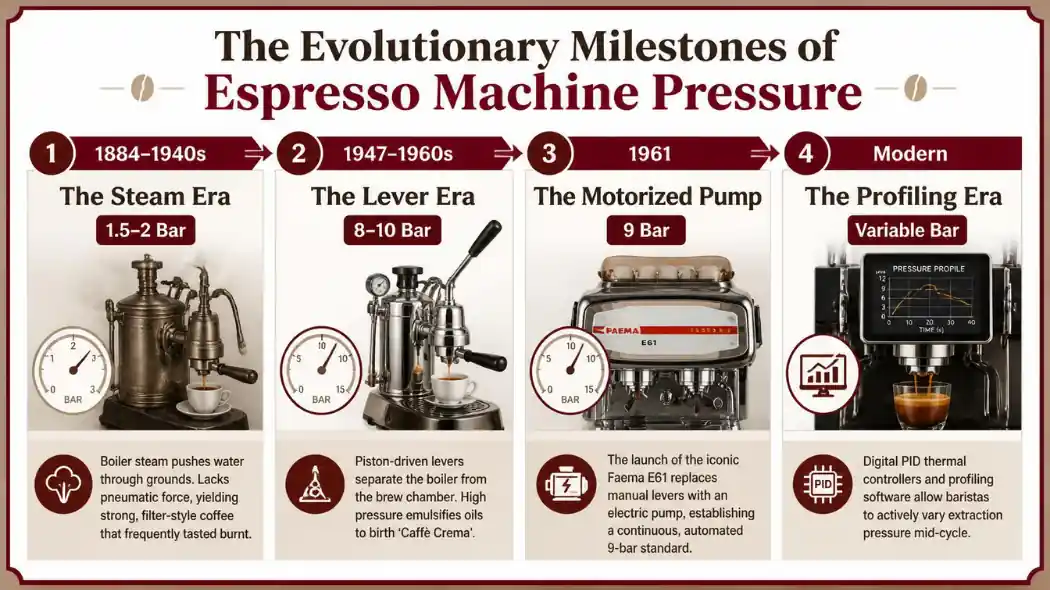
The history of espresso machinery can be divided into four broad stages. Each introduced a significant improvement in speed, pressure control or consistency.
| Technology era | Key inventors and machines | Main development | Impact on the cup |
|---|---|---|---|
| The Steam Era (1884–1940s) | Angelo Moriondo and Luigi Bezzera | Steam-powered machines used pressure to accelerate brewing | Faster preparation and individual servings, but brewing conditions differed considerably from modern espresso |
| The Lever Era (1947–1960s) | Achille Gaggia’s spring-piston lever machines | Mechanical pistons generated much higher brewing pressure | Helped produce the rich, concentrated espresso and crema associated with modern coffee |
| The Motorised Pump Era (1961 onwards) | Faema E61 and later pump-driven machines | Electric pumps provided more consistent brewing pressure | Improved repeatability and helped establish the familiar nine-bar approach |
| The Modern Profiling Era | Contemporary electronic and manual pressure-control machines | Baristas can vary pressure during different stages of extraction | Greater control over flow, pre-infusion and the development of different flavour profiles |
1. The Steam Era: Moriondo and Bezzera
The story begins in Turin in 1884, when Angelo Moriondo patented a steam-powered coffee machine. His invention was designed to prepare coffee more quickly than traditional methods, particularly in busy cafés.
Moriondo’s machine was a substantial piece of equipment, using steam and water pressure to accelerate the brewing process. It was an important early step, although it did not produce espresso in exactly the form we recognise today.
In Milan, Luigi Bezzera developed further improvements around 1901. His machine allowed coffee to be prepared in individual portions, helping establish the idea of freshly made coffee served directly to customers.
Desiderio Pavoni subsequently acquired Bezzera’s patent and began commercial production of the La Pavoni Ideale machine in 1905. The two developments helped move espresso from an engineering experiment towards a recognisable café beverage.
These early machines still relied on boiler steam and relatively low brewing pressures. Their results were quite different from the thick, crema-topped espresso produced by later lever machines.
2. The Lever Era: Achille Gaggia changes everything

Stefano, CC BY-SA 2.0 https://creativecommons.org/licenses/by-sa/4.0, via Wikimedia Commons
A major breakthrough came with Achille Gaggia’s development of a spring-piston lever machine.
Gaggia filed an important patent in 1947, and the first machines appeared commercially in 1948. Instead of relying on steam pressure alone to force water through the coffee, the lever mechanism used a piston to generate substantially greater brewing pressure.
This changed the extraction process and helped produce a new characteristic: a dense, golden-brown foam on the surface of the coffee.
That foam became known as crema, and it helped distinguish the new style of espresso from the earlier steam-brewed versions.
The early Gaggia machines carried the slogan Crema Caffè Naturale, promoting the crema as a natural feature of the new brewing method. The drink was also associated with the name Caffè Crema, helping customers recognise this unfamiliar style of coffee.
It is sometimes repeated that customers initially rejected the crema, believing it to be a defect or contamination. Although the new appearance was certainly a departure from what customers had previously expected, the stronger historical evidence concerns Gaggia’s deliberate promotion of crema as a desirable feature. The dramatic rejection story should therefore be treated as an anecdote rather than established fact.
3. The Motorised Pump: The arrival of the Faema E61
The next major development arrived in 1961 with the introduction of the Faema E61, designed by Ernesto Valente.
The E61 replaced the manual lever mechanism with an electric pump, allowing water to be delivered through the coffee at a much more consistent pressure. It also introduced an important heat-exchanger arrangement and a thermally stable group head.
The familiar nine-bar pressure setting became closely associated with this generation of espresso machines and remains a common reference point today.
For café owners, the change was significant. Baristas no longer needed to operate a heavy lever for every shot, and the machine could support a faster, more consistent service.
The E61 became one of the most influential machines in espresso history and helped shape the modern Italian coffee-bar experience.
4. The Modern Profiling Era: More control over extraction
Modern espresso machines offer a level of control that early inventors could scarcely have imagined.
Some machines allow baristas to adjust pressure during extraction, rather than maintaining one fixed pressure throughout the entire process. This is known as pressure profiling.
A barista might begin with a gentle pre-infusion stage, allowing water to wet the coffee puck before increasing pressure. The pressure can then be reduced towards the end of the extraction, depending on the coffee and the intended result.
These adjustments can influence flow rate, extraction behaviour and the balance of flavours in the cup.
Not every espresso machine offers this facility, and there is no single pressure profile that suits every coffee. The important development is the greater control available to modern baristas.
Why early steam machines produced a different style of coffee
The early steam-powered machines were ingenious for their time, but they had limitations.
Steam pressure was used to drive hot water through the coffee, meaning the brewing water was closely connected to the boiler’s temperature and pressure conditions. This could expose the grounds to temperatures higher than those normally used in modern espresso brewing.
It is not quite accurate to say that every early steam machine scorched the coffee. However, the difficulty of controlling brewing temperature and pressure made it harder to produce the consistent extraction expected from a modern machine.
Today’s espresso machines generally use water at a controlled brewing temperature, commonly around 90–96°C, although the ideal setting depends on the coffee and the recipe.
If your home espresso tastes unpleasantly harsh, dry or excessively bitter, the cause may be an unsuitable grind size, an uneven extraction, excessive brewing temperature or a combination of variables. Our guide to why coffee tastes bitter and how to correct it explains how to identify and improve these problems.
Why does espresso develop a layer of crema?
Crema is the golden or reddish-brown foam that forms on the surface of a freshly extracted espresso.
It develops through the interaction of hot water, dissolved coffee compounds and gases released from the roasted coffee. Carbon dioxide remaining in the beans after roasting plays an important role, while oils and other coffee components contribute to the texture and appearance of the foam.
The higher pressure used in espresso extraction helps disperse these gases and compounds into the liquid. As the coffee reaches the cup, tiny bubbles form and create the characteristic crema layer.
Crema is often treated as a sign of a good espresso, but its appearance alone cannot tell you whether the coffee tastes balanced. Bean freshness, roast level, blend composition and extraction technique all influence its quantity and colour.
A thick crema is not automatically a guarantee of excellent flavour.
Why is espresso traditionally served in a small demitasse cup?
The traditional espresso cup, known as a demitasse, is a small vessel designed for serving a concentrated coffee in a modest portion.
Its compact size reflects the nature of espresso itself. Unlike filter coffee, which is usually served in a larger volume, espresso is intended to be enjoyed in a relatively small serving.
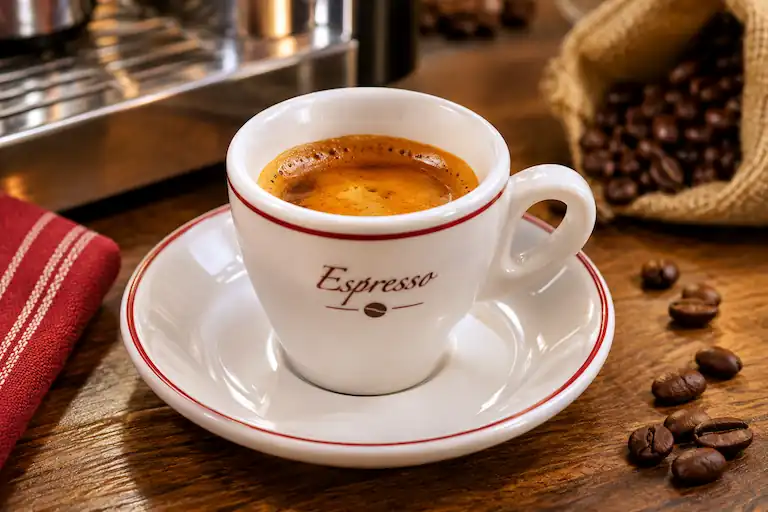
There are several practical reasons why traditional espresso cups are often made from thick porcelain.
| Cup feature | Traditional design | Practical purpose |
|---|---|---|
| Small capacity | Usually around 60–90ml, although sizes vary | Provides room for a single or double espresso without requiring a large vessel |
| Thick walls | Substantial ceramic or porcelain | Helps retain heat and reduces rapid temperature loss |
| Pre-warmed interior | Cup warmed before serving | Helps prevent the hot espresso from cooling too quickly |
| Rounded interior | Curved base and sides | Provides a practical shape for pouring and drinking a small serving |
The small cup also suits the traditional Italian café ritual, where customers may enjoy an espresso while standing at the counter, rather than settling in for a long drink.
The shape of the cup can influence the drinking experience, but it is not a magical way of preserving every aroma or keeping crema intact. Cup temperature, material, shape and the time between extraction and drinking all contribute.
Pressure, steam and the modern espresso counter
From Moriondo’s early steam-powered experiments to Gaggia’s revolutionary lever machines and the motorised Faema E61, espresso has developed through a remarkable series of engineering advances.
Each generation addressed a different challenge: faster service, greater brewing pressure, improved consistency and, eventually, more precise control over extraction.
Yet the basic idea remains the same. A carefully prepared bed of finely ground coffee is exposed to hot water under pressure, producing a concentrated drink that brings together the character of the beans and the skill of the person preparing it.
Next time you watch a fresh espresso pour into a small demitasse cup, take a moment to appreciate the engineering behind it. That golden crema and concentrated flavour are the result of more than a century of experimentation, invention and refinement.
Visit the history and origins of the world’s most popular coffees, and explore how each much-loved drink found its place in coffee culture.


