

The Nicaraguan Coffee Production at a Glance
Nicaragua  The Elephant Bean and a Coffee Industry Built on Resilience
Nicaraguan coffee has a fascinating place in the speciality coffee world, combining a history of agricultural resilience with distinctive varieties and highland growing conditions. Best known among coffee enthusiasts for the exceptionally large Maragogype, often called the elephant bean, Nicaragua also produces a diverse range of Arabica coffees from its mountainous northern regions.
From the coffee-growing landscapes of Jinotega and Matagalpa to the speciality farms of Nueva Segovia, the country has developed an international reputation for balanced coffees, cooperative farming and increasingly varied processing methods.
Its story is one of recovery and reinvention, with smallholder producers continuing to play an important role in shaping the modern coffee industry.

Official USDA Production Rankings and Regional Bean Characteristics

Variety
Arabica – predominantly Caturra, Bourbon, Catuaí, Paca, Catimor and Maragogype, with Pacamara and newer rust-resistant cultivars also grown. Robusta accounts for a much smaller share of production.

Growing Region
Jinotega, Matagalpa, Nueva Segovia, with additional production in other departments.

Processing Methods
Washed, Honey and Natural.

Flavour Profile
Chocolate, caramel, cocoa, nuts, citrus and gentle fruit notes. Higher-altitude speciality lots may offer floral and more pronounced fruit characteristics.

Harvest Season
November – March, with timing varying according to region and altitude.

Acidity
Medium, although some higher-altitude coffees display brighter acidity.
World Production Ranking
12th
based on the USDA’s July 2026 production estimates.

Production Per Year
Approximately 2.40 million 60 kg bags – MY 2025/26.

World Production Share
Approximately 1.3% – calculated against estimated global production of 178.83 million 60 kg bags.

Altitude
Approximately 365–1,500 metres across the reported Arabica-growing areas, with many speciality farms situated in the northern highlands.

Climate
Tropical highland, with regional variations in rainfall, temperature and humidity.

Body
Medium, with variations between varieties, farms and processing methods.

Rankings and Production Source: USDA Foreign Agricultural Service – Coffee: World Markets and Trade, 2025/26.

What Is the Historical Origin and Recovery Story of Nicaragua’s Coffee Industry?
Coffee cultivation became commercially established in Nicaragua during the nineteenth century. Although coffee had been grown earlier, its expansion gathered momentum during the second half of the century, when government policies encouraged agricultural investment and the development of plantations.
The northern highlands of Jinotega, Matagalpa and Nueva Segovia became increasingly important growing areas. By the late nineteenth century, coffee had become one of Nicaragua’s most significant agricultural exports.
The industry subsequently experienced considerable political and economic disruption, with conflict, changing land ownership, weather events and international price fluctuations affecting production over several generations.
Revolution, conflict and the disruption of coffee production
The Sandinista Revolution of 1979 brought an end to the Somoza family’s rule and led to major changes in land ownership and agricultural organisation.
Some large estates were confiscated or redistributed, while state-run enterprises and agricultural cooperatives became more prominent. The subsequent Contra conflict during the 1980s created further difficulties for farmers, particularly in the northern coffee-growing regions.
The United States introduced a trade embargo against Nicaragua in 1985, adding further complications to international trade. Political instability, disrupted transport, reduced investment and difficulties accessing export markets all placed pressure on coffee producers.
The industry also experienced the effects of international coffee price crises and, later, serious agricultural challenges including the spread of coffee leaf rust.
The growth of cooperatives and speciality coffee
During the 1990s, Nicaragua’s coffee industry began rebuilding. Smallholder farmers increasingly organised themselves into cooperatives, allowing producers to share resources, improve processing facilities and develop stronger relationships with international buyers.
Cooperative organisation became particularly important in the growth of fair trade and speciality coffee networks. By working collectively, smaller farms gained opportunities to improve quality, obtain certifications and access export markets that might otherwise have been difficult to reach independently.
International recognition grew further through speciality coffee competitions, including the Cup of Excellence, which first came to Nicaragua in 2002. These competitions helped introduce outstanding individual farms and coffee lots to buyers around the world.
Today, coffee remains an important source of rural employment and income. According to the USDA Foreign Agricultural Service, the sector supports more than 330,000 people across its value chain.
The modern industry continues to face challenges, including labour shortages, limited access to long-term finance and the need to renovate older coffee plantations. Nevertheless, producers continue to invest in improved varieties, agricultural practices and speciality coffee production.
What Is the Biological Definition of the Maragogype Elephant Bean?
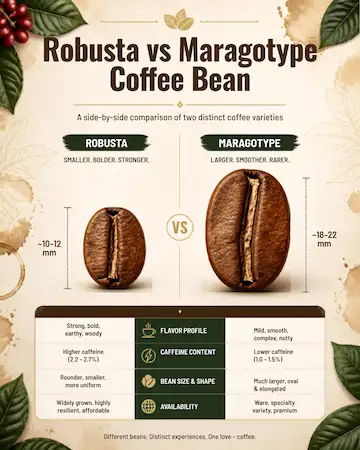
One of the most recognisable varieties associated with Nicaragua is Maragogype, also spelt Maragogipe and widely known as the elephant bean.
Its unusually large seeds make it one of the most visually distinctive Arabica varieties in the coffee world.
The origin and genetics of Maragogype
Although closely associated with Central American coffee production, Maragogype did not originate in Nicaragua. It was discovered near the Brazilian city of Maragogipe in 1870 and is a natural mutation of Typica-related Arabica.
According to World Coffee Research’s Maragogipe variety profile, the mutation affects several characteristics of the plant, including the size of its leaves, the spacing between its branches and the dimensions of its seeds.
The unusually large growth characteristics are associated with a single dominant gene.
Maragogype subsequently spread to other coffee-producing countries, including Nicaragua, where it became an interesting speciality variety.
Why is Maragogype called the elephant bean?
The name comes from the unusually large size of its coffee seeds.
Compared with many standard Arabica varieties, Maragogype beans are noticeably larger and flatter. They can reach very large screen sizes, sometimes approaching 20, although actual dimensions vary between individual lots.
Coffee screen size refers to the physical dimensions of the bean rather than its weight or overall density.
This distinction matters because a larger bean is not automatically heavier or denser than a smaller one. Maragogype’s unusual appearance is primarily the result of its genetic characteristics.
Growing and processing Maragogype
Maragogype is not among the most widely cultivated commercial Arabica varieties. Its relatively low productivity makes it less attractive to farmers who prioritise high yields.
However, its unusual appearance and distinctive cup characteristics have helped it maintain a following among speciality coffee enthusiasts.
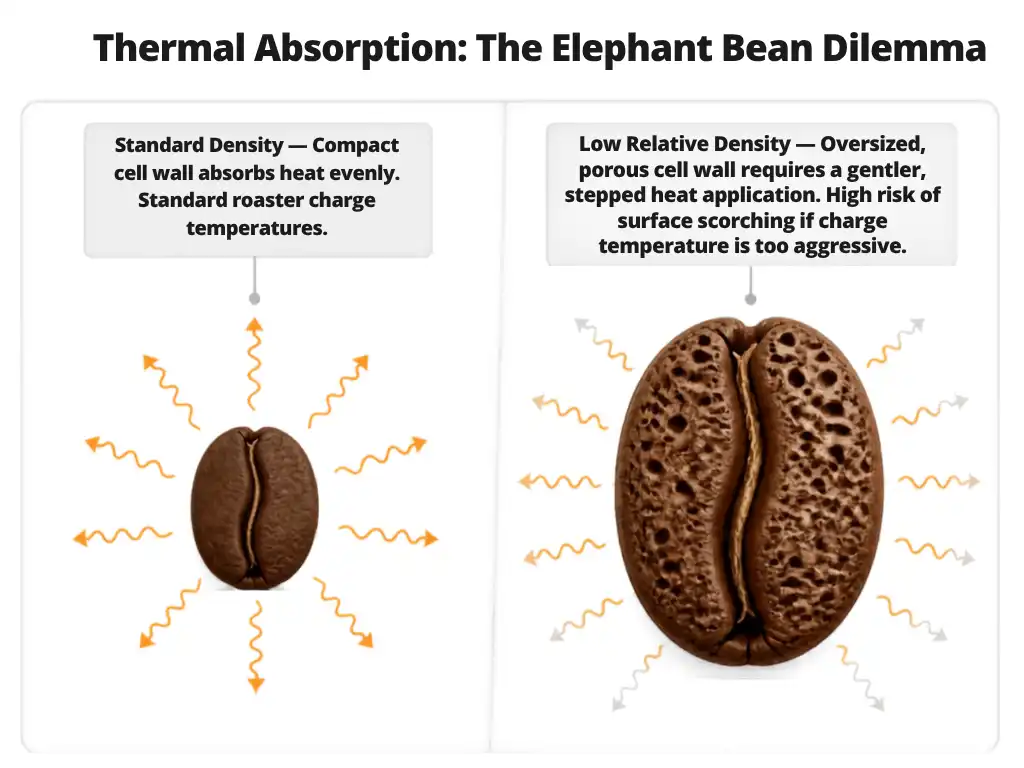
The variety is also interesting to roasters because its larger physical dimensions can influence how individual beans respond during roasting. Roasters need to assess the green coffee’s moisture, density, screen size and response to heat rather than simply applying a standard profile designed for smaller beans.
There is no universal roasting temperature or development time for Maragogype. The best approach is to monitor the roast carefully and adjust the profile according to the characteristics of the particular lot.
Its genetic importance extends beyond its own production. Maragogype was also used in the development of Pacamara, a hybrid created by crossing Maragogype with Pacas.
What Is the Distinct Flavour and Mouthfeel Profile of Nicaraguan Coffee?
Nicaraguan Arabica is often appreciated for its balanced sweetness, moderate acidity and approachable body. The country’s different growing regions produce a range of flavour characteristics, making it difficult to assign one profile to every coffee.
Common tasting descriptions include:
- Milk and dark chocolate: A familiar sweetness that provides depth and balance.
- Caramel and brown sugar: Rounded sweetness that can make the cup particularly approachable.
- Nougat and toasted nuts: Softer, nutty characteristics often associated with traditional washed coffees.
- Citrus: A refreshing acidity that can resemble orange or lemon.
- Stone fruit: Peach and other gentle fruit notes can appear in selected speciality lots.
- Floral and berry notes: More expressive characteristics can develop in carefully produced coffees from higher-altitude farms.
These are general tasting descriptions rather than guaranteed characteristics. Variety, altitude, soil, processing and roasting all influence the final cup.
The Maragogype flavour profile
Maragogype is often associated with a delicate and relatively mild cup profile. Depending on its growing conditions and processing, it can display gentle sweetness, floral characteristics, subtle fruit notes and a smooth mouthfeel.
Its large beans do not automatically produce a heavier or more syrupy cup. Some Maragogype coffees are valued for their softer, more refined character.
This is one reason the variety attracts interest from speciality roasters and coffee enthusiasts who enjoy exploring less common Arabica cultivars.
The influence of Nicaragua’s growing regions
Three particularly important coffee-growing areas are Jinotega, Matagalpa and Nueva Segovia.
Jinotega
Jinotega is one of Nicaragua’s principal coffee-producing regions. Its mountainous landscape and high-altitude farms provide favourable conditions for Arabica cultivation.
Coffees from the area are often associated with chocolate sweetness, caramel, nuts and balanced acidity. Some higher-grown lots can also display floral and fruit characteristics.
Matagalpa
Matagalpa has a long coffee-growing history and is known for its mountainous terrain and traditional coffee farms.
Its coffees can offer a rounded body, chocolate and nut characteristics, with gentle fruit acidity depending on the farm and processing method.
Nueva Segovia
Nueva Segovia has developed a strong reputation for speciality coffee, particularly from farms situated at higher elevations.
Coffees from the region can display more pronounced acidity, floral aromas and fruit-forward characteristics, alongside sweetness and complexity.
The differences between these regions demonstrate why a country’s coffee should not be judged by a single flavour description. Even neighbouring farms can produce quite different cups.
If your own extractions are missing the natural balance of these coffees and tasting unpleasantly sharp or watery, our guide to why coffee tastes sour explains how grind size, water temperature and extraction time can influence the final cup.
What Are the Best Brewing Methods for Nicaraguan Single-Origin Coffee?
Nicaraguan coffee is versatile and can be enjoyed through several brewing methods. The best approach depends on the variety, roast level and characteristics you want to bring forward.
Two particularly interesting methods are the AeroPress and cold brew.
1. The AeroPress method

The AeroPress is a useful method for exploring the sweetness and body of Nicaraguan coffee. Its combination of immersion and gentle pressure gives the brewer considerable control over strength and extraction.
For a balanced starting recipe, try:
- Coffee: 15g
- Water: 195g
- Coffee-to-water ratio: 1:13
- Water temperature: 90–92°C
- Grind: Medium-fine
- Steeping time: Approximately 90 seconds
- Pressing time: Approximately 30 seconds
This recipe should produce a concentrated but balanced cup. Adjust the grind and steeping time according to the coffee’s roast level and how it tastes.
For Maragogype, it is worth experimenting with the grind and brewing ratio rather than assuming that its larger green beans require a particular extraction method. The roasted bean’s density and development are more useful guides when adjusting a recipe.
2. The cold brew method

Cold brew offers another way to explore the chocolate and caramel characteristics often associated with Nicaraguan coffee.
The longer extraction at a lower temperature produces a different flavour balance from hot brewing, often resulting in a smoother-tasting and less sharply acidic cup.
Suggested cold brew concentrate recipe:
- Coffee: 100g
- Water: 800g
- Coffee-to-water ratio: 1:8
- Grind: Coarse
- Brewing temperature: Refrigerated, approximately 4–6°C
- Steeping time: 14–18 hours
- Filtration: Strain through a suitable coffee filter
Once filtered, the concentrate can be diluted with water or milk to taste. A starting point is one part concentrate to one part water, although personal preference and coffee strength will influence the final ratio.
Cold extraction does not completely eliminate bitterness, but it can produce a smooth and enjoyable alternative to traditional hot brewing.
Nicaraguan Coffee: A Story of Resilience, Diversity and Distinctive Varieties
Nicaragua’s coffee industry has experienced considerable political, economic and agricultural challenges, yet its producers have continued to develop new ways of improving quality and reaching international markets.
The country’s northern highlands provide a diverse range of growing environments, while its smallholder farmers and cooperatives have helped strengthen its position within the speciality coffee sector.
Maragogype remains one of its most fascinating varieties, recognised for its exceptionally large beans and distinctive genetic history. However, Nicaragua’s reputation extends far beyond the elephant bean.
From the balanced chocolate and caramel characteristics of traditional Arabica coffees to the more expressive lots emerging from higher-altitude farms, Nicaragua offers a varied and rewarding coffee experience.
Its story is ultimately one of resilience, adaptation and continued development – a country whose coffee industry has much more to offer than its famous elephant bean.
“With its famous ‘Elephant’ beans and mild, pear-like notes, Nicaragua is a hidden gem of Central America. Find out how Nicaragua’s climate compares to the rest of the world in The Coffee Belt.“


