

Table of Contents
Coffee extraction is where everything that has happened to a coffee bean finally comes together. From cultivation and harvesting through processing and roasting, each stage influences the potential flavour of the finished coffee. But it is during brewing that those flavours are released into the cup.
Understanding the science of coffee extraction helps explain why one brew tastes sweet and balanced while another comes out sharp, bitter or disappointingly weak.
It also explains why changing something as simple as grind size, water temperature or brewing time can make such a noticeable difference.
In my coffee shop days, helping the team understand extraction was one of the most important parts of barista training. Once you understand what’s happening inside the brewing equipment, adjusting a recipe becomes much less like guesswork and much more like a controlled experiment.
Let’s look at what actually happens when water meets coffee, how extraction influences flavour and how to recognise when something has gone wrong.

What exactly is coffee extraction?
Coffee extraction is the process of dissolving and transferring water-soluble compounds from ground coffee into the brewing water.
A roasted coffee bean contains hundreds of chemical compounds, including organic acids, caffeine, carbohydrates, oils, minerals and aromatic substances. Some dissolve readily in water, while others are less soluble or remain within the solid coffee material.
Around 30% of roasted coffee may consist of potentially water-soluble material, although the precise proportion varies with the bean and roasting conditions. The remainder is largely insoluble structural material, including cellulose and other plant components.
The aim of brewing isn’t to extract everything. It’s to dissolve enough of the desirable compounds to produce a pleasant, balanced drink.
In coffee science, two measurements help us understand what has happened:
1. Total Dissolved Solids (TDS)
TDS measures the concentration of dissolved coffee material in the finished beverage. It tells us how strong the coffee is.
For example, a higher TDS generally means a more concentrated drink, while a lower reading indicates a weaker one.
2. Extraction Yield
Extraction yield measures the proportion of the original dry coffee dose that has dissolved into the beverage.
For example, if 20% of the dry coffee dose has been extracted, the extraction yield is 20%.
The traditional Specialty Coffee Association Golden Cup brewing control chart identifies an extraction yield of approximately 18–22%, alongside a beverage strength of 1.15–1.35% TDS, as its classic target range for filter coffee.
These figures provide a useful reference, but they aren’t a universal recipe for every coffee. Different beans, brewing methods and personal preferences can produce enjoyable results outside these boundaries.
It’s also important to understand that strength and extraction are not the same thing. You can make a strong coffee that is under-extracted, or a weak coffee that has been extracted quite thoroughly.
For a deeper look at these measurements, the Specialty Coffee Association’s Brewing Control Chart provides useful background on the relationship between beverage strength and extraction yield.
In what chronological order do flavours dissolve during coffee brewing?
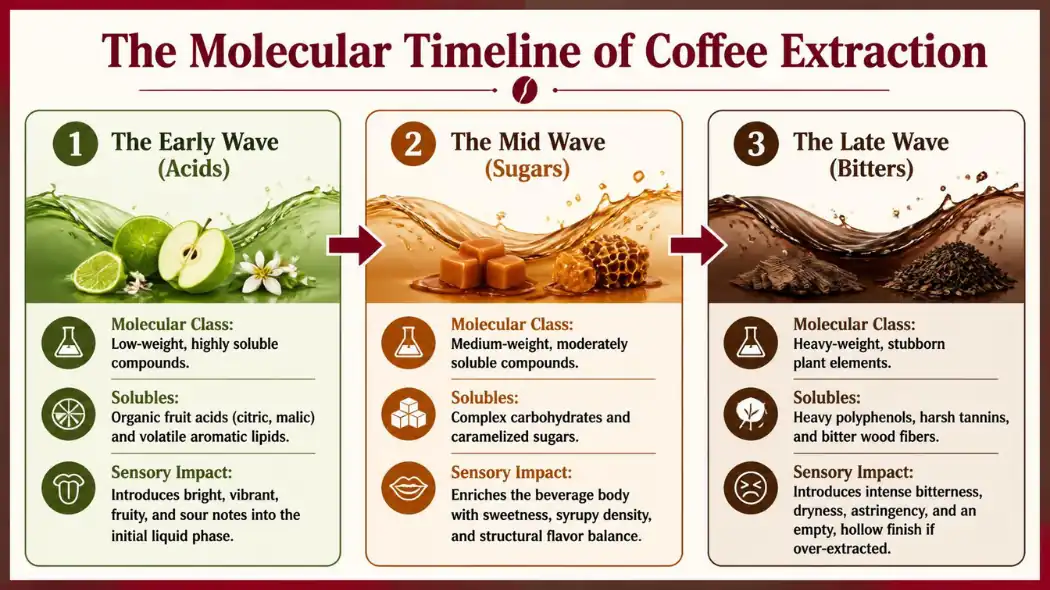
When water meets ground coffee, different soluble compounds enter the liquid at different rates. Their solubility, concentration, molecular properties and the conditions of brewing all influence how quickly they are extracted.
This is sometimes illustrated using three broad stages: an early phase associated with acidity and aromatics, a middle phase associated with sweetness and balance, and a later phase associated with bitterness and astringency.
It’s a useful way of introducing the subject, but it needs a little clarification.
These aren’t three completely separate waves in which one group of compounds disappears before another begins. Many compounds are extracted simultaneously, and their contribution to flavour changes throughout brewing.
| General extraction phase | Flavour contributions | What happens in the cup |
|---|---|---|
| Early extraction | Acidity and many volatile aromatic compounds | Brightness, fruit character and lively aromas begin to emerge |
| Developing extraction | A wider range of soluble compounds | Sweetness, body and flavour complexity become more balanced |
| Continued extraction | Additional soluble compounds, including some that can contribute bitterness and astringency | The overall flavour profile changes, potentially becoming harsher or less pleasant if extraction is poorly controlled |
The important point is that good extraction isn’t simply about reaching the middle of a brewing timeline and stopping before the bitter compounds appear.
Bitterness can be present in coffee from the beginning because roasted coffee already contains bitter compounds. Caffeine, for example, contributes bitterness independently of how long you brew.
Likewise, sweetness isn’t something that suddenly appears at a particular moment. It is influenced by the combination of extracted compounds and how we perceive them together.
In practice, the goal is to achieve a balance that suits the coffee rather than attempting to extract individual flavour groups in a fixed sequence.
What is under-extraction in coffee brewing?
Under-extraction occurs when too little of the coffee’s soluble material has been transferred into the beverage to achieve a satisfactory flavour balance.
A typical under-extracted coffee may taste:
- Sour or sharply acidic.
- Thin and lacking in body.
- Salty or somewhat savoury.
- Unbalanced, with little sweetness to soften its acidity.
This often happens when water passes through the coffee too quickly, when the grind is too coarse or when the brewing temperature is too low for the particular coffee and method.
However, under-extraction isn’t always caused by a single variable. Uneven water distribution, channelling in espresso and inconsistent pouring in manual brewing can also leave parts of the coffee bed poorly extracted.
How to correct under-extraction
Try making one adjustment at a time:
- Grind slightly finer to increase the surface area available for extraction.
- Extend the brewing time if water is passing through too quickly.
- Increase water temperature slightly where appropriate.
- Improve your pouring technique to wet the coffee bed more evenly.
If your coffee regularly tastes unpleasantly sharp, take a look at our guide to Why Does My Coffee Taste Sour?. It explores the common causes of sour coffee and how to correct them.
What is over-extraction in coffee brewing?
Over-extraction occurs when an excessive proportion of soluble material has been removed from the coffee, producing a flavour profile that can become unpleasantly harsh, dry or astringent.
Common characteristics include:
- Harsh or lingering bitterness.
- A dry, puckering sensation in the mouth.
- Woody or excessively harsh flavours.
- A lack of clarity and balance.
This is often associated with a grind that is too fine, excessive contact time or brewing conditions that encourage too much material to dissolve.
However, bitterness alone doesn’t prove that a coffee is over-extracted. Dark roasting, the natural characteristics of the beans, water quality and brew strength can all contribute to a bitter-tasting cup.
There is also a difference between bitterness and astringency. Bitterness is a taste sensation, while astringency is the drying, puckering sensation that can make your mouth feel rough.
How to correct over-extraction
If your coffee tastes excessively harsh or dry, try:
- Grinding slightly coarser.
- Reducing the brewing time.
- Lowering the water temperature a little, if appropriate.
- Checking that your pouring or agitation isn’t unnecessarily aggressive.
The aim isn’t to remove all bitterness from coffee. A certain degree of bitterness is part of its natural flavour character. What matters is achieving a balance in which it doesn’t overwhelm the rest of the cup.
For more practical advice, see our guide to Why Does My Coffee Taste Bitter?.
Science of Coffee Extraction Troubleshooting Chart
When a brew doesn’t taste quite right, it helps to approach the problem systematically.
The following chart gives you a starting point for diagnosing common extraction problems. Remember that flavour descriptions are clues rather than absolute proof, so taste and adjust rather than automatically changing everything.
| Taste in your cup | Possible explanation | What to try |
|---|---|---|
| Sour, sharp or thin | Under-extraction or an acidic coffee profile | Try a finer grind, a little more contact time or slightly hotter water |
| Bitter and harsh | Excessive extraction, dark roast or high brew strength | Try a coarser grind, shorter contact time or slightly cooler water |
| Dry and astringent | Uneven extraction, excessive agitation or other brewing variables | Check your grind distribution, pouring technique and water |
| Weak and watery | Low beverage strength, possibly caused by too little coffee or too much water | Adjust your coffee-to-water ratio |
| Strong but unpleasantly sharp | High concentration combined with insufficient or uneven extraction | Review both your brewing ratio and extraction conditions |
| Strong and harsh | High concentration, excessive extraction or a naturally intense roast | Consider adjusting the ratio, grind size and brewing time |
One of the most useful habits you can develop is changing only one brewing variable at a time.
If you make several adjustments simultaneously, it’s difficult to know which one actually improved the result.
Keep a note of your coffee dose, grind setting, water temperature and brewing time. Over a few attempts, you’ll begin to recognise which adjustments work best with different beans.
Mastering Extraction: The Final Verdict
Understanding the science of coffee extraction changes the way you approach brewing.
Instead of simply following a recipe and hoping for the best, you begin to recognise the relationship between water, grind size, temperature, contact time and the compounds that ultimately influence flavour.
In my coffee shop and catering days, learning to recognise those differences was an important part of producing consistent coffee. A small adjustment to the grind or brewing time could make a noticeable difference to the finished drink.
The traditional 18–22% extraction yield is a useful starting point for filter coffee, but numbers alone don’t guarantee a great cup. Your senses remain an important part of the process.
Experiment with your brewing variables, pay attention to what you taste and don’t be afraid to make small adjustments.
After all, coffee extraction is where the science meets the pleasure of drinking coffee. Once you understand what’s happening, every brew becomes an opportunity to get a little closer to your perfect cup.


