

Few coffee brewers have made quite such an impression in such a short time as the AeroPress. Compact, lightweight and surprisingly versatile, this ingenious little coffee maker has earned a loyal following among home brewers, travelling coffee enthusiasts and specialty baristas. Its appeal lies in its simplicity: combine ground coffee and hot water in a chamber, allow them to steep, then use a plunger to push the finished brew through a filter and into your cup.
But don’t let its straightforward design fool you. The AeroPress offers plenty of room for experimentation. Adjust the grind size, water temperature, coffee-to-water ratio or steeping time, and you can produce noticeably different results. It can make a clean, delicate cup or something richer and more concentrated, depending on how you use it.
Let’s explore the invention behind this modern brewing favourite, the science of its extraction process and how to get the best from its different brewing techniques.
The AeroPress: The Invention and Its Origins

The AeroPress was invented by Alan Adler, an American engineer, inventor and Stanford University engineering instructor. He was already well known for creating the Aerobie flying ring, but his attention turned towards coffee after becoming frustrated with the difficulty of making a satisfying single cup using conventional home coffee makers.
Adler began experimenting with coffee brewing in 2003. He wanted to develop a device that could produce a flavourful cup quickly, without the excessive bitterness he associated with some traditional brewing methods. After developing numerous prototypes, he introduced the AeroPress at Coffee Fest Seattle in November 2005.
Its design was unusual. Rather than relying on gravity alone, the brewer used a plunger to create gentle pressure, moving brewed coffee through a small filter and into the cup.
The device initially attracted curiosity because it looked rather different from familiar coffee makers. However, its portability, straightforward operation and ability to produce consistently enjoyable coffee soon earned it a following.
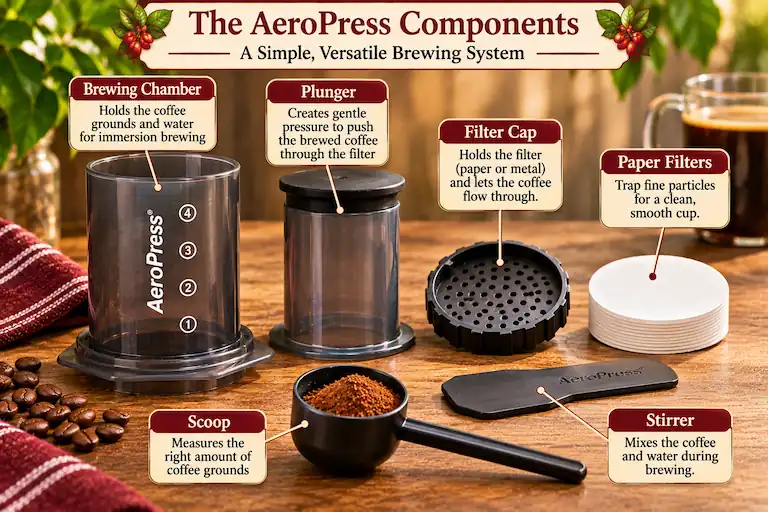
The enthusiasm eventually developed into a worldwide community of enthusiasts and competitors. The World AeroPress Championship began in 2008, bringing together coffee lovers who compete by developing their own recipes using the same basic brewing device.
For a closer look at the inventor and the development of the brewer, see the official AeroPress story.
How Does the AeroPress Work? The Science of Immersion and Pressure
The AeroPress combines two familiar brewing principles: immersion and pressure-assisted filtration.
Unlike a traditional pour-over brewer, where water passes continuously through a bed of coffee, the AeroPress initially holds the grounds and water together inside its chamber. This is known as immersion brewing.
The Immersion Phase
During immersion, the ground coffee remains surrounded by hot water. Soluble compounds gradually dissolve into the liquid, contributing the acids, sugars, aromatic compounds and other substances that shape the finished flavour.
The length of this contact period, together with grind size, water temperature and coffee-to-water ratio, influences the resulting extraction.
Because the coffee and water remain together rather than passing through the grounds immediately, the brewer offers considerable control over steeping time.
The Pressure-Assisted Filtration Phase
Once the coffee has steeped, the plunger is pressed downwards. The movement compresses the air trapped above the liquid, creating a modest pressure difference that helps push the brew through the filter.
This is not the same as espresso extraction. An espresso machine uses a pump or lever system to generate substantially higher brewing pressure, whereas the AeroPress relies on manual force and a much lower-pressure brewing process.
The filter plays an important role in the final cup. Paper filters retain much of the suspended coffee material and oils, producing a cleaner result. Reusable metal filters allow more oils and fine particles through, generally giving the coffee a fuller texture.
The combination of immersion and pressure-assisted filtration is what makes the AeroPress so distinctive. It offers the flexibility of an immersion brewer with the convenience of a compact manual press.
The Inverted AeroPress Method: An Eight-Step Brewing Guide
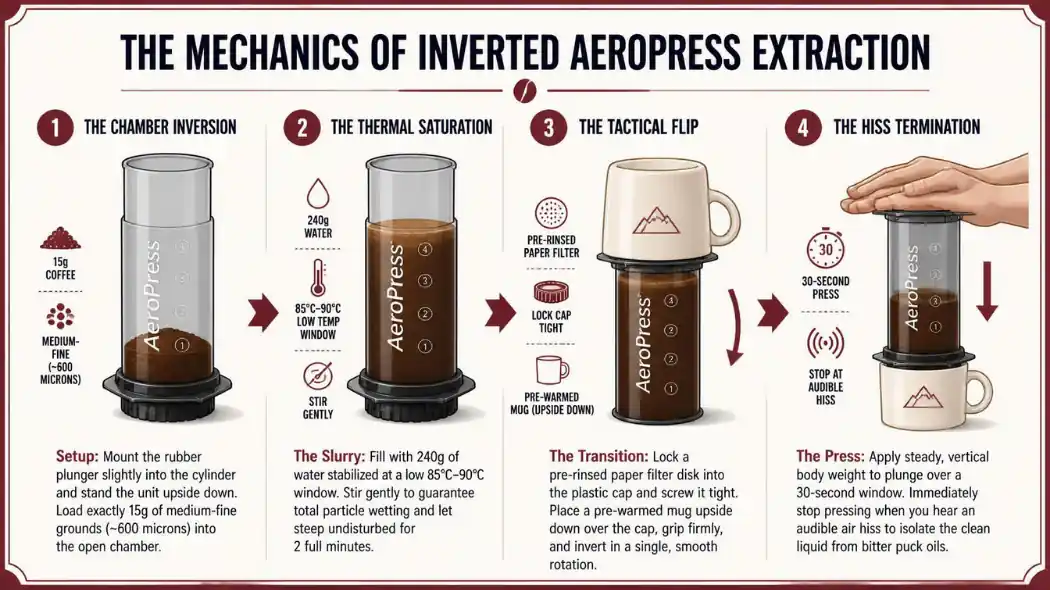
One of the best-known AeroPress techniques is the inverted method. Instead of standing the brewer upright with the filter cap at the bottom, the chamber is turned upside down and rested on the end of the plunger.
This arrangement prevents coffee from dripping through the filter before the steeping period is complete. It also allows the brewer to control the immersion time more easily.
However, there is an important safety consideration. AeroPress itself strongly discourages the inverted method because the brewer is less stable in this position and can tip over, potentially spilling hot water and causing burns. The standard upright method, with the plunger seal inserted slightly into the chamber, is the manufacturer’s recommended alternative for preventing premature dripping.
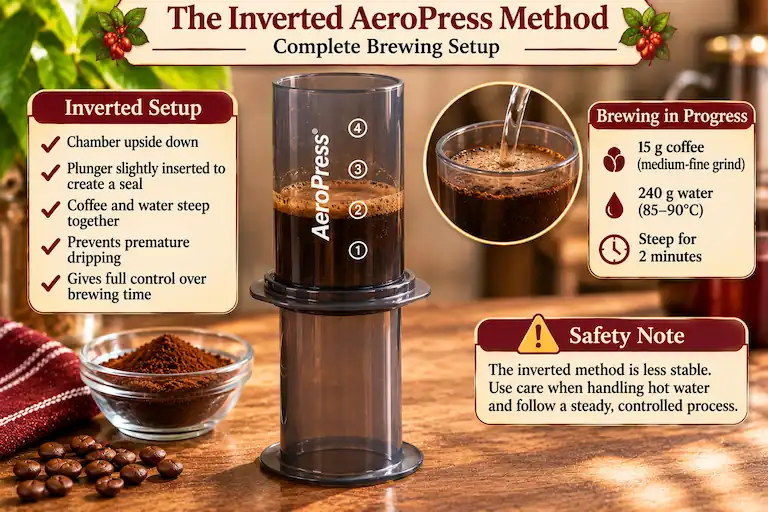
If you choose to try the inverted method, take particular care when handling the hot brewer and avoid using a slippery or unstable work surface.
An Example Inverted Recipe
The following is a practical starting recipe rather than an official AeroPress specification. You can adjust the quantities and timings to suit your coffee and taste.
1. Prepare the chamber
Insert the plunger a short distance into the main chamber and stand the brewer upside down on its plunger base. Make sure it is stable before adding anything.
2. Measure the coffee
Add 15g of medium-fine ground coffee to the chamber. A medium-fine grind is a useful starting point, although the ideal setting depends on the beans and your recipe.
3. Add the water
Pour in 240g of hot water, initially aiming for approximately 85–90°C. Stir gently to ensure all the grounds are saturated.
4. Allow the coffee to steep
Leave the mixture to steep for approximately two minutes. This gives the water time to extract soluble compounds from the coffee.
5. Prepare the filter cap
Place a paper filter into the perforated filter cap and rinse it with hot water. This helps it sit neatly in place and removes any paper taste. Secure the cap firmly.
6. Carefully invert the brewer
Place a suitable mug securely over the filter cap. Holding the chamber, cap and mug firmly together, turn the assembly over in one controlled movement. Keep your hands clear of the hot liquid and make sure the mug is stable.
7. Press gently
Apply steady, controlled pressure to the plunger. Avoid forcing it down aggressively. A gradual press should move the brewed coffee through the filter without unnecessary splashing.
8. Finish the brew
Continue until most of the liquid has passed through. You may hear a gentle hiss as air begins to escape at the end of the press. This is simply an indication that the liquid has largely passed through the filter; it is not a special stage that separates bitter crema from the finished coffee.
Remove the brewer carefully and enjoy your coffee.
A Safer Alternative: The Standard AeroPress Method
You can achieve a similar controlled immersion without turning the brewer upside down.
Place the filter into the cap, rinse it and attach the cap to the chamber. Stand the AeroPress on a stable mug, add the coffee and hot water, then insert the plunger seal approximately 1–2cm into the chamber. This helps prevent premature dripping while the coffee steeps.
After the desired steeping time, press down gently.
This is the approach recommended by the manufacturer for longer steeping recipes. You can also investigate the official AeroPress brewing guidance and FAQs for further advice.
Common AeroPress Brewing Mistakes and How to Avoid Them
The AeroPress is a forgiving brewer, but a few common mistakes can still produce disappointing results. Fortunately, most are easy to correct.
1. Using Water That Is Too Hot
Boiling water does not literally scorch coffee grounds, but water temperature influences how quickly different compounds dissolve.
Very hot water can produce a different flavour balance from cooler brewing water, particularly with darker roasts. If your coffee tastes harsh or overly bitter, try reducing the temperature slightly rather than assuming the water itself has damaged the grounds.
For many coffees, a starting range of around 85–95°C is worth experimenting with. The best temperature depends on the roast, grind size and personal preference.
If bitterness continues to be a problem, read our guide to why coffee tastes bitter.
2. Pressing the Plunger Too Quickly
There is no need to force the plunger down. Excessive pressure can make the brewer unstable, increase the risk of splashing and disturb the coffee bed.
Use a steady, controlled movement. If the plunger feels unusually difficult to press, check whether the grind is too fine or the filter is becoming obstructed.
3. Grinding the Coffee Too Fine
An extremely fine grind can increase resistance as the coffee passes through the filter. This can make pressing difficult and may contribute to an overly concentrated or unbalanced result.
Start with a medium-fine grind and make small adjustments. If the brew is too weak or watery, try a slightly finer setting or extend the steeping time. If it is too intense or difficult to press, move a little coarser.
4. Treating Every Recipe as a Fixed Formula
One of the AeroPress’s greatest strengths is its flexibility. There is no single recipe that suits every coffee.
A light-roasted coffee may benefit from a different temperature and steeping time from a darker roast. Likewise, changing the filter from paper to metal can alter the texture of the finished drink.
Experiment with one variable at a time. This makes it easier to understand what has improved the flavour and what has not.
Choosing Coffee Beans for Your AeroPress
The AeroPress works particularly well with a wide range of coffee origins and processing styles. Its flexibility allows you to explore different flavour characteristics without needing to change your brewing equipment.
Here are two origins worth exploring:
Costa Rica: Costa Rican coffees are often associated with clean sweetness and balanced acidity. Honey-processed examples can offer rounded sweetness and fruit characteristics that work particularly well in an AeroPress.
Honduras: Honduran coffees can offer a pleasing combination of chocolate, caramel, fruit and balanced acidity. Their versatility makes them an enjoyable choice for experimenting with different AeroPress recipes.
Remember that origin alone does not determine flavour. Variety, altitude, processing, roasting and freshness all influence what eventually reaches your cup.
The AeroPress: A Modern Brewer with Endless Possibilities

The AeroPress may have started as an unusual invention from an engineer better known for sporting toys, but it has become one of the most recognisable manual coffee brewers in the specialty coffee world.
Its appeal is easy to understand. It is compact, portable, straightforward to clean and capable of producing a wide variety of coffee styles. The combination of immersion and pressure-assisted filtration gives you considerable control over brewing time, grind size and flavour.
Whether you prefer the simplicity of the standard method or enjoy experimenting with different recipes, the AeroPress rewards curiosity. Once you understand how its brewing variables interact, you can move beyond following instructions and start developing a cup that suits your own taste.
That is the real attraction of this modern maverick: a small, uncomplicated device that leaves plenty of room for discovery.
“Courtesy of James Hoffmann. A deeper look at the ‘AeroPress’ technique mentioned above.”
Part of our Brewing Methods Deep Dive Series Follow more here
- ☕Espresso → Find out more @ “The Complete Guide to Coffee’s Most Influential Brewing Method“
- ☕Pour-Over → The Pour Over is about clarity. “Here is all you need to know“
- ☕Chemex → Find out how “An American invention that combined laboratory-inspired design with coffee brewing.“
- ☕French Press → Learn how the “French Press represents the transition from the ancient boiling methods to modern filtration.“
- ☕Moka Pot → The Moka Pot is all about “The Little Man with the moustache” find out why!
- ☕Cold Brew → Find out why this brewing method is so popular
- ☕Drip Filter → The Drip Filter isn’t called the Reliable Worhorse for nothing Find out why here
- ☕Turkish Ibrik → One of the Oldest Brewing methods Learn its history here
- ☕Phin Filter → Learn more of The Anatomy of The Phin Brewer
- ☕Which Coffee Brewing Method is the best → We tell you here


