

Table of Contents

Guatemala: The Connoisseur’s Choice
Guatemala  The Volcanic Soul and the Diversity of Eight Coffee Regions
Guatemalan coffee is highly regarded in the speciality coffee world for its complexity, regional diversity and distinctive growing environments. Its volcanic highlands, cool mountain climates and rich agricultural heritage produce coffees celebrated for chocolate sweetness, lively acidity and delicate fruit and spice notes.
From the celebrated Antigua region to the high-altitude farms of Huehuetenango, Guatemala offers a distinctive coffee experience that continues to attract the attention of professional tasters, roasters and coffee enthusiasts.
The country’s recognised growing regions, traditional Arabica varieties and established quality classifications have helped make Guatemala one of Central America’s best-known speciality coffee origins.

Official USDA Production Rankings and Regional Bean Characteristics

Variety
Predominantly Arabica, including Caturra, Bourbon, Catuaí, Catimor, Typica and other cultivars. Robusta represents a small proportion of planted coffee area.

Growing Region
Antigua, Huehuetenango, Atitlán, Acatenango, Cobán, Fraijanes, New Oriente and San Marcos.

Processing Methods
Washed, Natural and Honey.

Flavour Profile
Cocoa, chocolate, caramel, citrus, fruit, floral notes and warm spice.

Harvest Season
November – April, with regional variations.

Acidity
Medium to bright, depending on region, variety and processing.
World Production Ranking
11th
– based on Marketing Year 2025/26 production estimates.

Production Per Year
Approximately 3.16 million 60 kg bags – MY 2025/26.

World Production Share
Approximately 1.8% – calculated against global production of 178.83 million 60 kg bags in MY 2025/26..

Altitude
Approximately 1,300–2,000 metres across the principal highland coffee-growing regions.

Climate
Tropical highland, with volcanic, mountainous, humid and varied regional microclimates.

Body
Medium to full, depending on the coffee and its preparation.

Production note: The USDA’s April 2026 Guatemala Coffee Annual forecast production of approximately 3.13 million 60 kg bags for MY 2026/27. This is a forecast, not a completed harvest figure.
Rankings and Production Source: USDA Foreign Agricultural Service – Coffee: World Markets and Trade, 2025/26.
Guatemala: Volcanic Landscapes and Exceptional Coffee Diversity
Guatemala has earned an international reputation for producing some of Central America’s most distinctive speciality coffees. Its mountainous terrain, varied microclimates and volcanic landscapes create a range of growing conditions that influence cherry development and the characteristics of the finished cup.
From the chocolate sweetness often associated with Antigua to the bright fruit characteristics found in selected Huehuetenango coffees, Guatemalan coffee offers considerable regional diversity.
Much of the country’s Arabica is cultivated at high elevations, where cooler temperatures can encourage slower cherry maturation and contribute to denser coffee seeds.
The country’s recognised regional identities, traditional varieties and established quality classifications have helped make Guatemala an important speciality coffee origin.
What Is the Historical Origin of Commercial Coffee Cultivation in Guatemala?
Guatemala’s coffee industry developed during a period of significant economic change. During the first half of the nineteenth century, the country’s export economy relied heavily on indigo and cochineal, a valuable red dye produced from insects that feed on prickly pear cacti.
Coffee had already been introduced into Guatemala during the colonial period, although it initially remained a relatively minor agricultural crop. Its commercial development gathered momentum during the middle of the nineteenth century.
From cochineal to coffee
Cochineal was an important export commodity, supplying European textile manufacturers with a natural red dye. However, the development and increasing use of synthetic dyes during the nineteenth century began to undermine demand for natural colouring materials.
This created an opportunity for agricultural diversification. Coffee was increasingly promoted as an alternative export crop, and cultivation expanded during the second half of the nineteenth century.
The transition was not immediate. Early coffee production faced practical difficulties, including the need for suitable land, investment, labour and export infrastructure. Nevertheless, the industry grew steadily.
A major turning point came with the Liberal reforms of the 1870s, particularly under President Justo Rufino Barrios. Government policies encouraged coffee expansion and helped establish the crop as the foundation of Guatemala’s export economy.
This transformation also had a serious human cost. The expansion of plantation agriculture involved the appropriation of Indigenous communal lands and the development of labour systems that placed considerable pressure on Indigenous communities. Understanding this history is an important part of understanding how Guatemala’s coffee industry was built.
By the end of the nineteenth century, coffee had become the country’s dominant export crop, establishing a commercial foundation that continues to influence its agricultural economy today.
How Do Volcanoes Shape the Terroir and Bean Density of Guatemalan Coffee?
Guatemala is situated within the volcanically active landscape of Central America. Its mountain ranges, volcanic valleys and varied elevations provide some of the country’s most favourable environments for growing high-quality Arabica coffee.
Volcanic activity has contributed to the formation of soils across several important coffee-growing areas. These soils can contain mineral-rich volcanic materials and organic matter, although their composition varies considerably between locations.
Volcanic soils and growing conditions
One of the best-known examples is the Antigua coffee-growing area, situated in a valley surrounded by three prominent volcanoes:
- Agua: A prominent volcano overlooking the Antigua valley.
- Fuego: An active volcano known for its frequent eruptions.
- Acatenango: A neighbouring volcanic peak forming part of the region’s dramatic mountainous landscape.
The combination of volcanic geology, relatively dry conditions, sunny days and cool nights contributes to Antigua’s distinctive growing environment.
However, volcanic soil should not be viewed as a simple natural fertiliser that automatically produces superior coffee. Soil fertility depends on its mineral composition, organic matter, drainage and agricultural management.
It is also important to recognise that Guatemala’s coffee-growing regions are not all volcanic. For example, Cobán has a different soil and climatic environment, while Huehuetenango’s coffee-growing landscape is strongly influenced by its mountainous geography.
Altitude and Strictly Hard Bean grading
Many Guatemalan speciality coffees are cultivated at elevations where cooler temperatures encourage slower cherry development.
This can contribute to the formation of denser coffee seeds, which is one reason altitude-based grading is important in Guatemala.
A particularly recognised classification is Strictly Hard Bean (SHB).
Strictly Hard Bean (SHB) – Coffee Guide Glossary
SHB generally refers to coffee grown at elevations above approximately 1,370 metres (4,500 feet) within Guatemala’s grading system.
The cooler conditions associated with these elevations can encourage slower maturation and denser bean development. However, SHB is an altitude-related commercial classification rather than a guarantee of exceptional flavour or cup quality.
Other factors, including variety, harvesting, processing, storage and roasting, remain essential to the final result.
What Are the Distinct Coffee Varieties and Regional Microclimates of Guatemala?
Whether enjoyed as a carefully brewed single origin or incorporated into an espresso blend, Guatemalan coffee offers a fascinating combination of regional identity, sweetness and complexity.
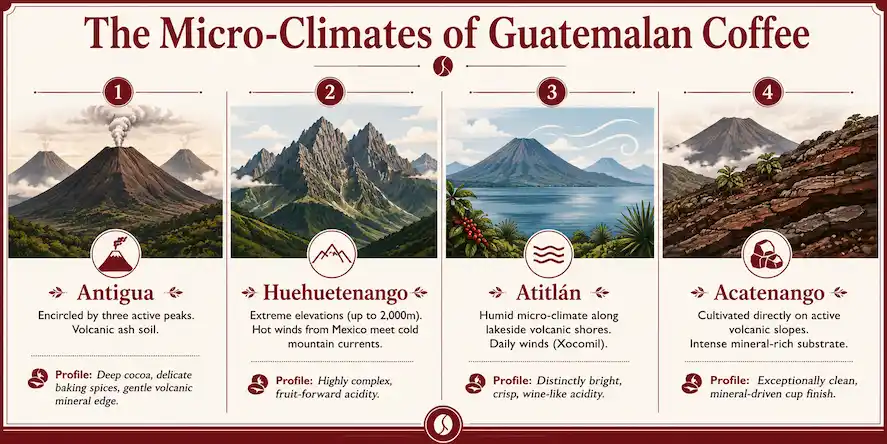
Guatemala grows a wide range of Arabica varieties, including traditional cultivars such as Bourbon and Typica, alongside Caturra, Catuaí, Catimor and other selections.
These varieties contribute different agronomic and sensory characteristics, although their final cup profiles are strongly influenced by growing conditions and processing.
Important Guatemalan coffee varieties
Bourbon
Bourbon is a traditional Arabica variety valued for its cup quality and sweetness. Depending on the growing environment and processing method, it can produce a rounded body with chocolate, caramel and fruit characteristics.
Caturra
Caturra is a natural mutation of Bourbon, recognised for its shorter growth habit and suitability for relatively high-density planting. It became an important variety in Central America and can produce coffees with bright acidity and good sweetness.
Catuaí
Catuaí is a hybrid of Mundo Novo and Caturra. It was developed to combine productive growth characteristics with a compact plant structure. Its cup quality varies according to the environment and agricultural management.
Catimor
Catimor varieties are derived from crosses involving Timor Hybrid and Caturra. They were developed partly to improve resistance to coffee leaf rust, an important consideration for growers managing disease pressure. Their cup characteristics vary according to the particular selection and growing conditions.
Guatemala’s eight recognised coffee-growing regions
Guatemala’s national coffee association, Anacafé, established eight recognised regional identities under its Guatemalan Coffees programme during the 1990s.
These regional identities help buyers and consumers understand the different growing environments and flavour characteristics found across the country.
The eight recognised regions are:
- Acatenango Valley
- Traditional Atitlán
- Antigua Coffee
- Rainforest Cobán
- Fraijanes Plateau
- Highland Huehuetenango
- New Oriente
- Volcanic San Marcos
For an overview of the official regional identities, see Anacafé’s Guatemalan Coffees regional programme.
1. Antigua
Antigua is perhaps Guatemala’s best-known coffee-growing region. Surrounded by Agua, Fuego and Acatenango volcanoes, it benefits from a distinctive valley environment.
Its coffees are often described as sweet and balanced, with chocolate, caramel and gentle spice characteristics. They can display a rounded body and pleasant acidity.
2. Huehuetenango
Located in the western highlands, Huehuetenango is one of Guatemala’s highest and most remote coffee-growing areas.
Its geography allows coffee to be cultivated at considerable elevations, sometimes approaching 2,000 metres. The region’s combination of mountain air and warmer winds from lower elevations helps create favourable conditions for coffee cultivation.
Coffees from Huehuetenango are often associated with pronounced acidity, fruit notes and a complex cup profile.
3. Atitlán
The Atitlán region surrounds the famous Lake Atitlán, where volcanic landscapes and lake-influenced microclimates contribute to its growing conditions.
Coffees are often described as aromatic, with bright citrus acidity, a fuller body and a range of fruit characteristics.
4. Acatenango
Acatenango is a mountainous coffee-growing region influenced by the surrounding volcanic landscape.
Its coffees are frequently associated with fragrant aromas, marked acidity, balanced body and a clean finish.
5. Cobán
Cobán is situated in the northern highlands and has a particularly humid growing environment, with frequent rainfall and cloud cover.
Its coffees can display fresh fruit characteristics, gentle acidity and a balanced body. The region’s wetter conditions make it quite different from the relatively dry Antigua valley.
6. Fraijanes Plateau
Fraijanes is located in the south-eastern highlands, where volcanic geology and varied elevations influence coffee cultivation.
Its coffees are often described as having bright, persistent acidity, a defined body and an aromatic character.
7. New Oriente
New Oriente lies in the eastern part of Guatemala. Its growing environment differs from some of the country’s better-known western volcanic regions.
Coffees from this area are often associated with a balanced body, sweetness and chocolate characteristics.
8. Volcanic San Marcos
Situated in western Guatemala, San Marcos is influenced by the region’s volcanic landscape and relatively warm, humid conditions.
Its coffees can display floral aromas, pronounced acidity and a good body.
Together, these eight recognised regions demonstrate why Guatemalan coffee cannot be reduced to one national flavour profile. Each has its own combination of elevation, rainfall, temperature, soil and agricultural traditions.
What Does Guatemalan Coffee Taste Like and Why Is It Valued by Professional Tasters?
Guatemalan Arabica is particularly valued for its regional diversity and the balance often found between sweetness, acidity and body.
Many coffees offer a chocolate or cocoa foundation, complemented by fruit, floral and spice characteristics. However, the precise flavour profile depends on the growing region, variety, processing method and roast.
Common tasting descriptions include:
- Chocolate and cocoa: A rounded, familiar sweetness often associated with Antigua and New Oriente coffees.
- Brown sugar and caramel: Sweet characteristics that can provide depth and balance.
- Citrus and stone fruit: Brighter notes that may appear in coffees from higher-altitude growing areas.
- Floral aromatics: Delicate fragrance found in some carefully produced speciality lots.
- Berry and wine-like notes: Fruit characteristics that can be particularly expressive in certain Huehuetenango coffees.
- Warm spices: Subtle spice-like impressions that can complement the chocolate and sweetness.
Understanding the smoky character sometimes associated with Guatemala
Some drinkers associate Guatemalan coffee with a subtle smoky character, particularly when describing coffees from volcanic growing areas.
It is important, however, not to confuse this with a direct smoky flavour produced by volcanic minerals. Volcanic soil does not automatically create a smoky cup.
What is sometimes described as smoky, earthy or mineral-like may reflect a combination of soil conditions, processing, roasting and individual sensory perception.
The country’s most distinctive coffees are better understood through their overall balance of sweetness, acidity, aroma and body rather than one supposedly universal volcanic flavour.
What Are the Best Brewing and Blending Methods for Guatemalan Coffee?
Guatemalan coffee is versatile and works well across several brewing methods. Its combination of sweetness, body and acidity makes it particularly suitable for paper-filtered brewing, while fuller-bodied lots can also work beautifully in espresso.
Two useful approaches are worth exploring.
1. Paper-filtered pour-over brewing
A Hario V60 or Chemex is an excellent starting point for exploring the more delicate characteristics of a Guatemalan single-origin coffee.
Paper filtration removes much of the fine sediment and coffee oils, allowing the acidity, sweetness and aromatic characteristics to come through more clearly.
Suggested starting recipe:
- Coffee: 15g
- Water: 225g
- Coffee-to-water ratio: 1:15
- Water temperature: 93–94°C
- Grind: Medium, adjusted to suit the brewer
- Bloom: 30–45 seconds
- Total brewing time: Approximately 2½–3½ minutes
This is a starting recipe rather than a fixed rule. A slightly different ratio or grind size may produce a more balanced cup depending on the coffee.
2. Guatemalan coffee in espresso blends
Guatemalan Arabica can also make an excellent contribution to espresso blends.
Its sweetness, body and balanced acidity can complement coffees with different characteristics, helping create a more rounded and layered espresso.
Rather than prescribing one universal blend percentage, it is worth experimenting with different proportions according to the coffee’s flavour profile.
A Guatemalan coffee with pronounced chocolate sweetness may provide a satisfying foundation, while a brighter lot could add fruit and acidity to a blend.
For drinkers who enjoy exploring single-origin espresso, a medium roast can be a useful starting point, allowing the coffee’s natural sweetness and regional characteristics to remain noticeable.
Guatemalan Coffee: A Distinctive Expression of Volcanic Terroir
Guatemala’s reputation as a speciality coffee origin is built on much more than its volcanic landscape. Its history, traditional Arabica varieties, high-altitude farms and eight recognised growing regions all contribute to a remarkably varied coffee industry.
From the balanced chocolate sweetness of Antigua to the fruit-forward complexity of Huehuetenango, each region offers a different expression of the country’s growing conditions.
The Strictly Hard Bean classification provides another useful indication of the high-altitude environments in which many of these coffees develop.
Together, these characteristics make Guatemalan coffee a fascinating origin to explore, whether enjoyed as a single-origin brew or used to bring sweetness, balance and complexity to an espresso blend.
The volcanic complexity of Guatemalan beans provides a spicy, floral finish unlike any other. To see how altitude and volcanic soil shape other regions, visit our overview of The Coffee Belt.“


