

Table of Contents
India  – The Monsooned Maverick and Shade-Grown Legacy
The story of Indian coffee begins with a remarkable journey from Arabia, a legendary Sufi pilgrim and seven coffee seeds said to have helped establish coffee cultivation in southern India.
Today, Indian coffee is recognised for its distinctive shade-grown plantations, traditional agricultural practices and unusual post-harvest processing techniques. From the celebrated Monsooned Malabar to premium Robusta grades such as Kaapi Royale, India produces coffees with a character that is quite different from many other major coffee origins.
But India’s contribution to coffee goes beyond its distinctive beans.
Its history encompasses centuries of cultivation, the development of commercial plantations, diverse growing regions and agricultural systems that combine coffee with other crops and native shade trees.
In this guide, we’ll explore the history of Indian coffee, its growing regions, production figures, botanical varieties, traditional cultivation methods and the processing techniques responsible for some of its most recognisable flavour characteristics.

Indian Coffee Production at a Glance
Official USDA Production Rankings and Regional Bean Characteristics

Variety
Arabica – Robusta

Growing Region
Karnataka, Kerala, Tamil Nadu, Andhra Pradesh and Odisha.

Processing Methods
Washed, Natural and Monsooned.

Flavour Profile
Chocolate, nuts, caramel and spice, with regional variations.

Harvest Season
Generally November – February, with regional variations.

Acidity
Generally low to medium, depending on variety and processing.
World Production Ranking
7th,
largest coffee-producing country (2025/26).

Production Per Year
6.43 million 60kg bags (2025/26 estimate).

World Production Share
Approximately 3.6%.

Altitude
Approximately 900–1,500 metres, varying by growing region.

Climate
Tropical and subtropical highland conditions, with seasonal monsoon rainfall.

Body
Medium to full, depending on variety and processing.

Production figures and international ranking are based on USDA Foreign Agricultural Service 2025/26 estimates. Regional production information is available from the Coffee Board of India.
What Is the Historical Origin of Commercial Coffee Cultivation in India?

The beginnings of Indian coffee cultivation are traditionally associated with a 17th-century Sufi pilgrim named Baba Budan.
According to the celebrated account, Baba Budan encountered coffee during a pilgrimage to Mecca. At a time when viable coffee seeds were closely controlled within the Arabian coffee trade, he is said to have brought seven fertile seeds back to India, concealing them during his return journey.
The seeds were reportedly planted in the Chandragiri Hills of Karnataka, an area subsequently associated with his name as Baba Budan Giri.

From these early plantings, coffee gradually spread through the surrounding highlands.
Although the precise details of the seven-seed story belong to historical tradition rather than firmly established contemporary documentation, Baba Budan remains an important figure in India’s coffee heritage.
Commercial coffee plantations developed later, particularly during the 18th century, when European entrepreneurs began establishing larger estates in southern India.
The Western Ghats provided favourable conditions for cultivation, with suitable elevations, seasonal rainfall and established forest environments.
Coffee gradually became an important agricultural crop, particularly in Karnataka, Kerala and Tamil Nadu.
The Coffee Board of India recognises the seven-seed tradition as the beginning of the country’s coffee-growing history.
Why Is India Recognised for Its Shade-Grown Coffee Plantations?
India has a distinctive approach to coffee cultivation. Unlike many producing regions where coffee is grown in relatively open plantations, Indian coffee has traditionally been cultivated beneath a managed canopy of shade trees.
The Coffee Board of India describes the country’s cultivation system as a two-tier mixed shade canopy, incorporating evergreen and leguminous trees.
The Board also identifies India as the only country where all coffee is traditionally grown under shade.
This system provides several agricultural and environmental benefits.

The upper canopy helps moderate temperatures and protects coffee bushes from excessive direct sunlight. The lower canopy contributes to a more controlled growing environment, while fallen leaves and other organic material help maintain soil structure and recycle nutrients.
Shade trees can also help reduce soil erosion, particularly on the sloping terrain associated with many southern Indian plantations.
By moderating sunlight and temperature, shade can influence the rate at which coffee cherries mature. The precise effect depends on the plantation’s elevation, canopy density and local growing conditions.
Indian coffee estates frequently incorporate additional crops into their agricultural systems.
Black pepper is particularly associated with these plantations, with vines often climbing the shade trees. Cardamom, fruit crops and other spices may also be cultivated alongside coffee.
This mixed-cropping approach provides agricultural diversity and additional income opportunities while helping maintain the ecological character of many traditional coffee-growing landscapes.
For further information, explore the Coffee Board of India’s guide to Indian coffee-growing regions.
What Are the Main Coffee-Producing Regions of India?
Indian coffee production is concentrated predominantly in the southern part of the country, particularly across the Western Ghats.
Karnataka is the largest producing state, followed by Kerala and Tamil Nadu.
Karnataka
Karnataka is the centre of Indian coffee production and accounts for the largest share of the national crop.
Important growing districts include:
- Chikkamagaluru
- Kodagu (Coorg)
- Hassan
The region produces both Arabica and Robusta, with growing conditions varying according to elevation and location.
Chikkamagaluru is particularly associated with India’s historic coffee-growing heritage, while Kodagu has developed a strong reputation for its extensive coffee plantations.
Kerala
Kerala is another important coffee-producing state, with production concentrated particularly in Wayanad.
Robusta represents a significant proportion of the state’s coffee production.
The region’s tropical conditions, rainfall patterns and plantation systems make it particularly suitable for Robusta cultivation.
Tamil Nadu
Tamil Nadu produces both Arabica and Robusta, with coffee cultivation concentrated in several elevated areas.
Important growing regions include:
- Nilgiris
- Pulney Hills
- Shevaroy Hills
- Anamalai Hills
These areas offer a variety of growing conditions, producing coffees with different characteristics.
Emerging Coffee-Producing Regions
Coffee cultivation has also expanded beyond India’s traditional southern growing areas.
Andhra Pradesh, particularly the Araku Valley region, has developed a growing reputation for coffee production. Odisha and parts of North-Eastern India also contribute to the country’s wider coffee industry.
These emerging regions demonstrate that Indian coffee production is not confined exclusively to the traditional Western Ghats plantations.
What Is Monsooned Malabar and How Does the Processing Method Work?
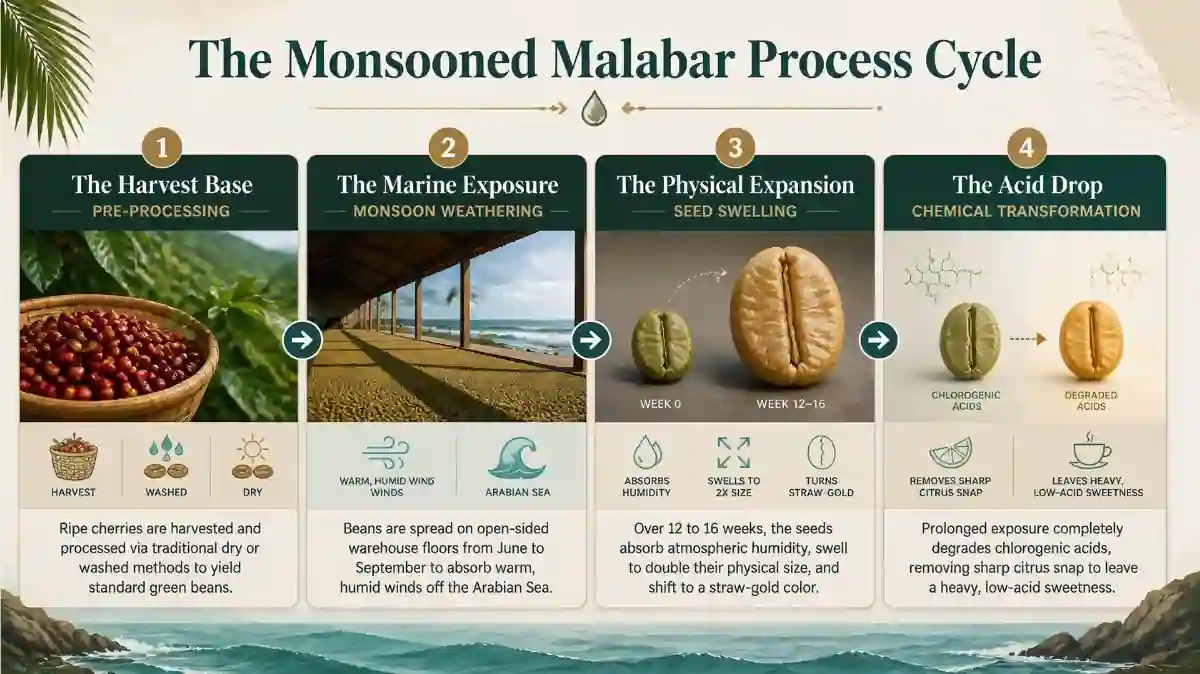
One of India’s most extraordinary contributions to the speciality coffee market is Monsooned Malabar , a distinctive post-harvest treatment that transforms the physical appearance and sensory characteristics of green coffee.
Its origins are associated with the historic sailing routes between India and Europe.
During long sea voyages around the Cape of Good Hope, coffee transported in wooden sailing ships was exposed to humid maritime conditions. The beans absorbed moisture, swelled, changed colour and developed a noticeably different flavour.
European consumers reportedly developed a preference for this mellowed style of coffee.
When faster shipping routes reduced the time beans spent at sea, the traditional characteristics became less common.
Indian coffee producers subsequently developed a controlled method of recreating the effect using the moisture-laden winds of the southwest monsoon.
The Four Stages of Monsooned Malabar
1. Preparation and Selection
Suitable dried coffee is selected for monsooning. Both Arabica and Robusta can be used, depending on the grade and intended product.
The beans are prepared and stored in suitable conditions before exposure to the monsoon atmosphere.
2. Exposure to Monsoon Conditions
During the southwest monsoon, generally between June and September, the coffee is spread in ventilated, open-sided warehouses along India’s western coast.
The humid air circulates around the beans, allowing them to absorb moisture gradually.
3. Physical Transformation
Over approximately 12–16 weeks, the beans undergo repeated exposure to humid air.
They are regularly raked, turned and transferred between bags to encourage even moisture absorption and reduce the risk of mould development.
As moisture enters the beans, they swell considerably, sometimes approaching twice their original size.
Their colour gradually changes from green to a pale yellow or straw-like appearance.
4. Final Conditioning and Grading
Once monsooning is complete, the coffee is polished, sorted and graded according to the relevant physical standards.
The finished beans are then prepared for storage and export.
What Happens to the Coffee’s Chemistry?
Monsooning changes more than the physical appearance of the bean.
Research into the process has identified changes in its chemical composition and volatile aromatic compounds.
Some studies have observed changes in chlorogenic acids and aromatic compounds associated with the distinctive spicy characteristics of Monsooned Malabar.
These changes help explain why the finished coffee develops a flavour profile quite different from conventional unmonsooned coffee.
The resulting cup is generally characterised by:
- Subdued perceived acidity.
- A mellow, rounded character.
- Substantial body.
- Earthy and woody characteristics.
- Spice-like and occasionally musty notes.
It is important to understand that monsooning does not simply remove all acidity. Rather, it changes the overall balance of flavour and aroma, creating the distinctive character for which this Indian speciality is recognised.
The Coffee Board of India’s specialist coffee information provides further details about the process and its 12–16-week duration.
What Are the Distinct Sensory Profiles of Indian Arabica and Kaapi Royale Robusta?
India has developed a respected dual identity within the international coffee market, producing both speciality Arabica and premium Robusta.
Although individual characteristics depend on growing region, variety, processing and roasting, Indian coffees are frequently associated with rounded body, chocolate-like sweetness and spice-related notes.
Indian Arabica
Indian Arabica is grown predominantly in the higher elevations of the southern coffee-producing regions.
Depending on its origin and processing method, it can offer a varied sensory experience, including:
- Milk and dark chocolate.
- Caramel and brown sugar.
- Toasted nuts.
- Citrus and gentle fruit acidity.
- Floral and spice-like characteristics.
Shade-grown cultivation and regional differences contribute to the diversity of Indian Arabica, making it suitable for a range of brewing applications.
Robusta Kaapi Royale
One of India’s recognised premium Robusta grades is Kaapi Royale, a carefully selected washed Robusta coffee.
According to the Coffee Board of India, Kaapi Royale is prepared from selected Robusta Parchment AB coffees sourced from regions including Coorg, Wayanad, Chikkamagaluru and Travancore.
Its physical characteristics include bold, rounded beans with a grey to bluish-grey appearance.
In the cup, it is recognised for its full body and soft, smooth, mellow character.
Its combination of strength and rounded mouthfeel makes it particularly useful in espresso blends.
Robusta should not automatically be associated with harshness or unpleasant bitterness. Careful cultivation, processing, grading and roasting can produce a much more balanced and approachable coffee.
If your extractions at home are becoming unpleasantly harsh or dry, take a look at our guide to Why Does My Coffee Taste Bitter?. It explains the common causes of bitterness and how adjustments to brewing technique can improve the result.
What Are the Best Brewing and Blending Applications for Indian Coffee?
Indian coffees offer considerable flexibility when it comes to brewing.
Although Monsooned Malabar and Kaapi Royale are particularly well suited to espresso applications, Indian Arabica can also produce enjoyable results through filter and immersion brewing.
The Single-Origin Espresso Method
Monsooned Malabar is frequently used as a single-origin espresso because its naturally mellow character, substantial body and subdued perceived acidity create a distinctive shot.
When prepared using a commercial espresso machine, it can produce a dense, rounded espresso with earthy, woody and spice-like characteristics.
Its distinctive flavour can also work particularly well with milk.
Rather than being overwhelmed by the sweetness and texture of steamed milk, the coffee’s heavier body helps maintain its presence in a latte or cappuccino.
The Espresso Blending Framework
Indian Robusta and Monsooned Malabar have long been valued by coffee roasters for their contribution to espresso blends.
Depending on the intended flavour profile, a proportion of Indian coffee can help increase body, introduce chocolate and spice characteristics, and create a more substantial mouthfeel.
A starting point of approximately 20–30% Indian coffee in an espresso blend can be explored, although the ideal proportion depends on the beans being combined, their roast development and the desired final cup.
Indian Arabica can provide sweetness and complexity, while carefully selected Robusta can contribute additional body and crema.
Exploring Filter Brewing
Although Indian coffee is often associated with espresso, there is no reason to restrict it to pressure-based brewing.
A medium-roasted Indian Arabica can work particularly well in a pour-over brewer, while a fuller-bodied Robusta or Monsooned Malabar may be more suited to immersion methods.
The important consideration is to adjust the grind, water temperature and brewing time to suit the particular coffee rather than assuming that every Indian bean requires the same extraction approach.
India’s Distinctive Contribution to the World of Coffee
Indian coffee has developed an identity shaped by centuries of cultivation, traditional shade-growing systems and an unusual approach to post-harvest processing.
From the legendary journey of Baba Budan to the distinctive transformation of Monsooned Malabar, India’s coffee story demonstrates how agricultural traditions and environmental conditions can influence the character of the finished bean.
Its Arabica and Robusta coffees offer a broad range of possibilities, from mellow, spice-led profiles to fuller-bodied espresso components.
Whether enjoyed as a single-origin espresso, incorporated into a carefully balanced blend or explored through filter brewing, Indian coffee deserves recognition as one of the world’s distinctive coffee-producing traditions.
Its contribution goes far beyond the familiar story of seven seeds. It is a story of adaptation, agricultural knowledge and craftsmanship, with a coffee industry that continues to evolve.
To explore how Indian coffee fits into the wider geography of production, continue with our guide to The Coffee Belt.


