

Table of Contents
If you’ve ever looked at a bag of speciality coffee and wondered what makes it different from an ordinary supermarket blend, the words single origin are a good place to start.
But what is single origin coffee, and why has it become such an important part of the speciality coffee world?
At its simplest, single origin means that the coffee comes from one defined geographical source rather than being combined with coffees from different origins. That source might be an entire country, a particular growing region, a cooperative, an individual farm or even a carefully separated harvest lot.
The attraction is the opportunity to explore the relationship between coffee and the place where it grows. Climate, altitude, botanical variety, farming practices and processing can all influence the character of the finished beans.
For coffee lovers, this opens up a fascinating journey through different producing countries, each offering its own range of growing conditions, traditions and potential flavour profiles.
Let’s explore what single origin really means, how traceability works and why the idea of terroir is so important when understanding the coffee in your cup.

What Does Single Origin Coffee Mean in Specialty Coffee?
Single origin coffee is sourced from one defined geographical origin rather than being blended with coffees from different origins.
However, the term can cover several different levels of sourcing, and this is where things become interesting.
A coffee labelled as single origin Colombia, for example, may contain beans gathered from several farms within the country. A more specific label might identify a particular growing region, cooperative, washing station or individual estate.
At the most detailed end of the scale, a coffee may come from a single micro-lot, representing a separately identified harvest from a particular farm or section of land.
This distinction is important because single origin does not automatically mean single farm.
It is also worth separating single origin from single variety. A coffee can come from one geographical source while containing several botanical varieties grown in that area.
Understanding the levels of coffee traceability
| Origin description | What it tells you |
|---|---|
| Single country | All the coffee comes from one producing country |
| Single region | The beans come from a defined growing area within that country |
| Cooperative or washing station | The coffee is associated with a particular producer organisation or processing facility |
| Single estate or farm | The coffee comes from one named agricultural property |
| Micro-lot | A separately identified, relatively small batch of coffee, often distinguished by farm location, variety, processing or harvest |
The more detailed the information on the packaging, the more clearly you can understand where the coffee originated.
Traceability is particularly valuable in speciality coffee because it provides a connection between the finished product and the people and places involved in producing it.
It can also help roasters communicate information about the harvest, processing method and botanical variety, giving the customer a much clearer picture of what they’re buying.
For an industry perspective on how origin and traceability are used in speciality coffee sourcing, the International Coffee Organization’s work on coffee standards and definitions provides useful background.
What Is the Difference Between Single Origin Coffee and a Blend?
The main difference between single origin coffee and a blend is how the beans are sourced and combined.
Neither is automatically better. They simply offer different possibilities for the roaster and the coffee drinker.
Single Origin Coffee
Single origin coffees allow roasters to highlight the characteristics of a particular place or harvest.
Depending on the beans, you might encounter floral aromas, citrus-like brightness, ripe berry flavours, chocolate notes or a combination of several characteristics.
One of the attractions is that the flavour can change between harvests. Weather, crop conditions, processing and other seasonal influences mean that the same farm may produce a slightly different coffee from one year to the next.
For people who enjoy discovering new coffees, this variation is part of the appeal.
Coffee Blends
Coffee blends combine beans from two or more sources to create a particular flavour profile.
A roaster might use one coffee to contribute sweetness, another to add body and a third to introduce brightness or complexity.
Blending also allows roasters to maintain a more recognisable house style when individual coffees change seasonally.
Blends are particularly common in espresso, where consistency and balance are often important considerations. However, single origin coffees can make excellent espresso too.
Which should you choose?
Try single origin coffee if you enjoy exploring different flavour profiles and learning about where your beans come from.
Choose a blend if you prefer a familiar, balanced cup designed to maintain a consistent character.
There is room for both in a good coffee collection.
How Do Terroir and Growing Conditions Influence Single Origin Coffee?
The French word terroir is often associated with wine, but it has an equally interesting place in the world of coffee.
It describes the combination of environmental and geographical influences that contribute to the character of an agricultural product.
In coffee, this includes altitude, temperature, rainfall, soil, shade, local climate and the conditions in which the cherries develop.
These influences can affect how coffee plants grow, how quickly their cherries mature and the chemical composition of the beans.
However, terroir is not determined by geography alone. Botanical variety, farming practices, harvesting, processing, roasting and brewing all contribute to the flavour we eventually experience.
A useful scientific review, Does Coffee Have Terroir and How Should It Be Assessed?, explores these relationships and explains why coffee terroir is more complicated than simply identifying where a bean was grown.
Several factors help explain why coffees from different locations can develop distinctive characteristics.
1. Altitude and Temperature
Altitude is one of the most frequently discussed factors in coffee production.
Coffee grown at higher elevations often experiences cooler temperatures, which can slow the development of the cherries.
This extended maturation period can influence bean density and the formation of compounds associated with aroma and flavour.
High-grown coffees are frequently associated with lively acidity and complex flavour profiles, although altitude alone does not guarantee quality.
The variety, climate, farming practices and overall growing environment all play their part.
2. Climate and Rainfall
Rainfall, temperature fluctuations, sunlight and seasonal weather influence flowering, cherry development and ripening.
Coffee plants require suitable conditions throughout the growing cycle, and changes in rainfall can affect both the health of the crop and the consistency of the harvest.
Differences between growing seasons can therefore contribute to changes in a coffee’s flavour from one year to the next.
This is one reason why a particular farm or region may produce slightly different tasting coffees in different harvests.
3. Soil and Local Growing Conditions
Soil influences water availability, root development and the nutrients accessible to a coffee plant.
Its effects depend on the wider growing environment, including drainage, rainfall, shade and farming practices.
It is tempting to assume that volcanic or mineral-rich soil automatically produces better-tasting coffee, but the relationship is more complicated.
Soil is one part of a much larger growing system, and its influence cannot be separated from all the other conditions surrounding the plant.
4. Botanical Variety
Different coffee varieties have their own genetic characteristics and flavour potential.
Even within the same growing region, two varieties can produce noticeably different cups when grown and processed under comparable conditions.
For example, Ethiopian coffees include a remarkable diversity of locally adapted varieties, while Colombian producers cultivate well-known varieties such as Caturra, Castillo and Colombia.
Knowing the botanical variety, as well as the geographical origin, can therefore make a coffee’s story considerably more informative.
5. Processing Method
Once the cherries have been harvested, they need to be processed to remove the fruit and prepare the beans for drying.
The three widely recognised approaches are washed, natural and honey processing.
Washed processing removes the fruit pulp before the beans are dried. These coffees are often associated with a cleaner, more defined flavour, allowing acidity and origin characteristics to stand out.
Natural processing dries the whole coffee cherry before the outer fruit layers are removed. Depending on the conditions, this can contribute fruit-forward notes and a fuller impression of sweetness and body.
Honey processing removes the skin while leaving some of the sticky mucilage attached during drying. It can produce a range of characteristics between the broad tendencies of washed and natural coffees.
These are general patterns rather than guaranteed results. The outcome depends on the coffee itself and how carefully each processing stage is managed.
What Do Single Origin Coffees from Different Countries Taste Like?
Different coffee-producing countries have developed their own growing traditions, botanical varieties and processing practices.
These differences can create recognisable flavour tendencies, although it is important to remember that no country produces just one type of coffee.
Growing regions within the same country can have very different climates, altitudes and agricultural conditions. Even neighbouring farms may produce beans with noticeably different characteristics.
Here are four well-known origins to help you begin exploring.
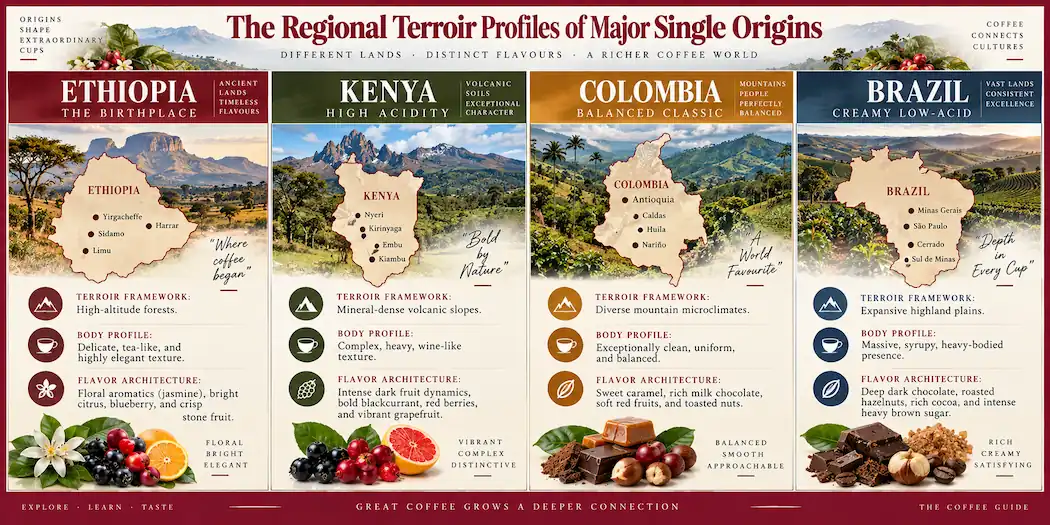
Ethiopia: Floral, Fruity and Expressive
Ethiopia is renowned for its diverse Arabica coffees and is often regarded as one of the most exciting origins for people who enjoy distinctive, aromatic flavours.
Depending on the region, variety and processing method, an Ethiopian coffee may offer floral aromas, citrus, delicate tea-like qualities or ripe berry and stone-fruit notes.
Washed coffees from areas such as Yirgacheffe are often associated with floral character and bright acidity, while naturally processed lots may display more pronounced berry-like fruit and a fuller impression of sweetness.
There is enormous diversity within the country, so exploring different Ethiopian regions can be a rewarding experience in itself.
Kenya: Bright Acidity and Blackcurrant Notes
Kenyan coffees are frequently recognised for their lively acidity, pronounced fruit character and distinctive depth of flavour.
Blackcurrant, berry, citrus and grapefruit-like notes are common descriptors for some lots.
The country’s growing conditions, varieties and carefully managed processing traditions all contribute to its reputation for producing expressive coffees.
The result can be particularly appealing if you enjoy bright, fruit-led flavours with plenty of character.
Colombia: Balance, Sweetness and Variety
Colombia produces coffee across a wide range of landscapes and elevations, making it difficult to describe its entire crop using a single flavour profile.
Many Colombian coffees offer a balanced combination of sweetness, acidity and body.
Depending on the region and lot, you may encounter caramel, chocolate, red fruit, citrus or nut-like notes.
Its geographical diversity makes Colombia an excellent starting point for exploring single origin coffee. You can move between different producing regions and discover how their individual growing conditions influence the cup.
Brazil: Chocolate, Nuts and Rounded Sweetness
Brazilian coffees are often associated with chocolate, nuts, caramel and a rounded body, with relatively gentle perceived acidity in many lots.
These characteristics can make some Brazilian coffees particularly well suited to espresso and milk-based drinks.
However, Brazil produces a much wider range of coffee than these familiar descriptions suggest. Different growing regions, botanical varieties and processing methods can produce coffees with more pronounced fruit characteristics and varying levels of acidity.
The country is a good reminder that tasting notes are guides rather than fixed rules.
Remember that tasting notes describe aromas and flavours perceived by the drinker. They do not mean that flavourings such as blueberries, jasmine or hazelnuts have been added to the beans.
Which Brewing Methods Work Best for Single Origin Coffee?
There is no single brewing method that works best for every single origin coffee.
The ideal approach depends on the beans, their roast profile and the characteristics you want to bring forward.
Paper-filter methods are popular because they can produce a clear cup in which differences in aroma, acidity and flavour are relatively easy to appreciate.
However, immersion brewing and espresso can reveal different aspects of the same coffee.
Pour-Over and Paper Filter
The Hario V60, pour-over method and Chemex give you considerable control over water flow and brewing time.
Paper filters retain much of the suspended material and some of the oils from the coffee, often producing a lighter-bodied, clean-tasting cup.
These methods can be particularly enjoyable with floral Ethiopian coffees or bright Kenyan lots, although they work equally well with coffees from other origins.
Automatic Drip Filter
An automatic drip filter offers a convenient way to explore single origin coffee without having to control every pour.
A well-designed machine, a suitable grind and freshly roasted beans can produce a balanced cup that reveals plenty of origin character.
It is also a useful choice when preparing several cups at once.
French Press
The French press uses immersion brewing and a metal filter, allowing more oils and fine particles into the cup than most paper-filter methods.
This generally creates a fuller texture and heavier body.
That doesn’t mean it hides a coffee’s origin. It simply presents the coffee differently, and you may find that naturally processed or chocolate-forward coffees work particularly well this way.
Espresso
Single origin coffee can also make excellent espresso.
A suitable roast and carefully adjusted grind, dose and extraction time can bring out concentrated sweetness, acidity and distinctive flavours.
Some coffees may require more experimentation than others to achieve a balanced shot, but the results can be very rewarding.
If you want to explore how brewing variables influence the finished cup, our guide to the science of coffee extraction explains the relationship between grind size, water, contact time and flavour.
There is no need to restrict yourself to one brewing method. Try the same single origin coffee using two different approaches and compare how its aroma, sweetness, acidity and body change.
If your coffee tastes unpleasantly sharp, hollow or sour, the cause may be under-extraction rather than the origin itself. Our guide to why coffee tastes sour and how to fix it explains the adjustments worth trying.
Is Single Origin Coffee Worth Trying?
Single origin coffee offers a way to explore the diversity of coffee rather than treating every bag as interchangeable.
It can help you discover which flavour profiles you enjoy, learn more about producing regions and appreciate how farming, variety, processing and roasting influence the finished cup.
You don’t need specialist equipment or an expert palate to get started.
Choose a coffee with a clearly stated origin, read the roaster’s tasting notes and brew it using a method you already enjoy. Pay attention to its aroma, sweetness, acidity and body, then compare it with a coffee from another region.
Over time, you may discover that you prefer the floral character of one Ethiopian coffee, the bright fruit of a Kenyan lot or the chocolate and nut notes often found in Brazilian coffees.
You may also find that your preferences change as you explore different varieties and processing methods.
The most useful lesson is that single origin tells you where a coffee comes from, not exactly how it must taste.
Its origin provides a starting point for exploration, while the individual coffee and the way it is grown, processed, roasted and brewed complete the story.
And that is part of what makes coffee so fascinating: every origin has something different to offer, and there is always another cup waiting to be discovered.
Further Reading
- Arabica vs Robusta → Arabica vs Robusta: The Ultimate Guide for Coffee Lovers
- Ethiopia: The Birthplace of Coffee → Kaldi the Goat-Herder
- Kenya Coffee Guide → Full details of the Kenyan Coffee production
- Colombia Coffee Guide → Full Details of The Colombian Coffee Production
- Brazil Coffee Guide → Full Details of The Brazilian Coffee Production
- Pour-Over Brewing Method → The Pour Over
- Chemex Brewing Method → The Chemex: A Full Guide to Clarity


