

Table of Contents
The Flat White: Strength, Smoothness and Simplicity

A flat white is an espresso-based coffee drink made with steamed milk and a thin layer of finely textured microfoam. Usually served in a smaller cup than a latte, it combines the smoothness of milk with a more pronounced espresso flavour.
Often associated with the coffee cultures of Australia and New Zealand, the flat white became popular during the 1980s. Its appeal lies in its simplicity: a well-prepared espresso, carefully textured milk and a smooth, velvety finish.
Unlike a traditional cappuccino, which has a more noticeable foam layer, the flat white is designed to have a close, integrated texture. The milk blends with the espresso rather than sitting on top as a thick, airy cap.

What Is a Flat White and How Did It Originate in the Southern Hemisphere?
The flat white has one of the more disputed histories in the coffee world. Both Australia and New Zealand have strong claims to its creation, and the debate has become part of the drink’s identity.
The exact origin is difficult to establish, but the flat white became associated with cafés in both countries during the 1980s.
One Australian account centres on Sydney café owner Alan Preston, who says he introduced the name to his menu at Moors Espresso Bar in 1985. He recalled customers asking for a “white coffee – flat”, which inspired him to use the name flat white.
New Zealand has its own well-known story. Former barista Fraser McInnes has described preparing a cappuccino in Wellington in 1989 when the milk failed to produce the expected foam. He reportedly apologised to the customer by describing it as a “flat white”.
Neither story has settled the argument. What is clearer is that the drink developed within the growing espresso cultures of Australia and New Zealand before travelling to cafés around the world.
Its popularity grew as customers looked for a milk-based coffee that retained more of the espresso’s character without the thick, airy foam traditionally associated with some cappuccinos.
For a fascinating look at the competing origin stories, Perfect Daily Grind explores where the flat white came from. A historical perspective is also available from the University of Newcastle’s investigation into the Australian origins of the flat white.
What Are the Technical Guidelines for Texturing and Pouring a Flat White?
Making a good flat white is all about balance. The espresso needs enough presence to remain noticeable, while the milk must be smooth enough to create a velvety texture without overwhelming the coffee.
There are three important stages.
1. Prepare the Espresso Base
A flat white is commonly made with a double shot of espresso, although recipes vary between cafés and countries.
Use freshly ground coffee and adjust the grind, dose and extraction to produce a balanced shot. An extraction time of approximately 25–30 seconds is a familiar starting point, but it is not a fixed rule. The coffee and recipe will determine the most suitable result.
The espresso provides the foundation of the drink, so its flavour should be clean and well balanced before the milk is added.
2. Steam and Texture the Milk
Fresh whole milk is traditionally used, although oat milk and other alternatives are increasingly popular.
Begin with cold milk in a clean stainless-steel jug. Introduce a small amount of air at the beginning of steaming, then create a gentle whirlpool to distribute the bubbles evenly.
The aim is to produce fine, glossy micro-foam rather than stiff, dry froth. Properly textured milk should look smooth and shiny, with a consistency often compared to wet paint.
A practical temperature range is around 60–65°C. This helps produce warm, sweet-tasting milk while avoiding excessive heating that can spoil its texture.
3. Pour and Integrate the Milk
Pour the textured milk steadily into the espresso, allowing it to blend naturally with the coffee.
A well-made flat white should have a smooth, integrated appearance rather than distinct layers of coffee, liquid milk and thick foam.
The surface should finish with a thin layer of microfoam. This provides the ideal texture for latte art, with patterns such as hearts, tulips and rosettas commonly appearing in cafés.
There is no universal requirement for a precise 0.5 cm foam layer. Cup size, milk quantity and café style all influence the final appearance.
The important thing is that the milk remains silky and the espresso flavour is not lost.
What Are the Differences Between a Flat White, a Caffè Latte and a Cappuccino?
All three drinks combine espresso and milk, but their proportions, serving sizes and milk textures create noticeably different experiences.
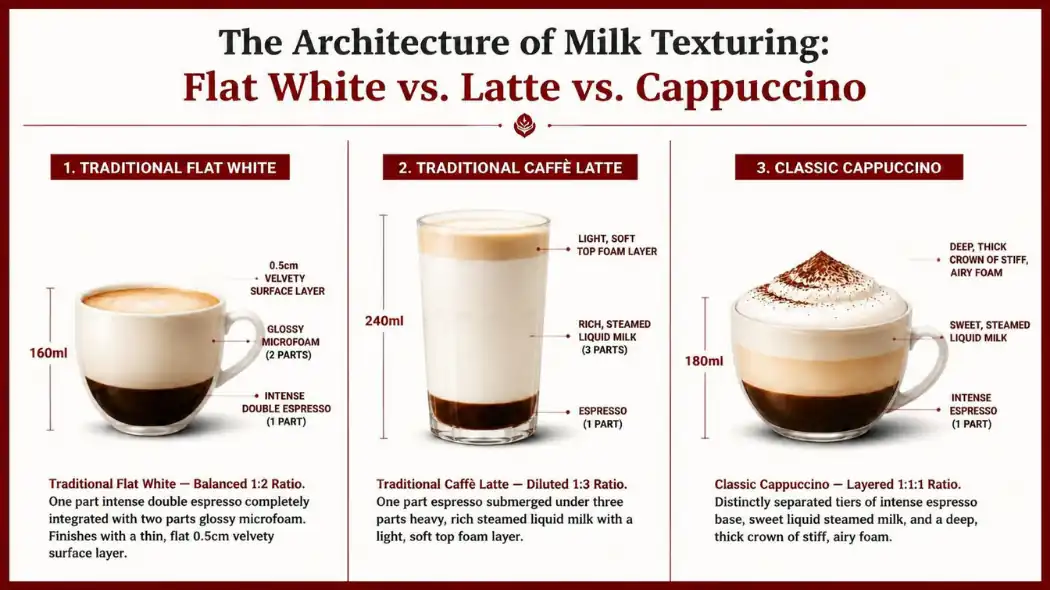
| Beverage | Typical milk balance | Milk texture | Overall character |
|---|---|---|---|
| Flat White | Less milk relative to espresso | Thin, finely integrated microfoam | Velvety, smooth and coffee-forward |
| Caffè Latte | Generous quantity of milk | Creamy steamed milk with a light foam layer | Mellow, smooth and milk-forward |
| Cappuccino | More balanced espresso, milk and foam | More substantial foam layer | Airier, more textured and pronounced |
These are general comparisons rather than fixed recipes. The exact proportions differ between countries, cafés and individual baristas.
A flat white is usually served in a smaller vessel than a latte, which helps maintain a more pronounced coffee flavour. A cappuccino, meanwhile, traditionally has a more substantial foam layer, giving it a lighter and airier mouthfeel.
Is a Flat White Stronger Than a Standard Caffè Latte?
In terms of flavour, a flat white is generally more coffee-forward than a traditional latte.
The difference is largely down to the balance between espresso and milk. A flat white is usually served in a smaller cup, often with a double espresso, while a latte contains a greater volume of steamed milk.
This means the espresso flavour is less diluted in a flat white, giving it a richer and more pronounced coffee character.
However, stronger flavour does not automatically mean more caffeine.
If a flat white and a latte contain the same espresso dose, they will contain broadly similar amounts of caffeine. The larger quantity of milk in a latte softens the flavour, but it does not remove the caffeine.
It is also worth remembering that café recipes vary. Some flat whites use a double shot, while others may use a different espresso dose depending on the serving size and local tradition.
Why Is the Flat White So Popular?
The flat white occupies an appealing middle ground between a concentrated espresso and a larger, milkier latte.
It offers the smoothness of steamed milk without losing the distinctive flavour of the coffee underneath. Its fine micro-foam creates a silky mouthfeel, while the smaller serving size gives the espresso a more noticeable presence.
It has also become a favourite among baristas because its smooth surface is ideal for latte art. A carefully poured heart or rosetta adds a little creativity to what is otherwise a remarkably simple drink.
From its disputed beginnings in Australia and New Zealand to its place on coffee-shop menus around the world, the flat white has become a modern classic.
Its appeal is easy to understand: good espresso, beautifully textured milk and nothing unnecessary.
That is the flat white – smooth, balanced and full of coffee character.
Visit the history and origins of the world’s most popular coffees, and explore how each much-loved drink found its place in coffee culture.


