

The Honduras Coffee Production at a Glance
Honduras  The High-Altitude Rising Star of Central American Coffee
Honduras Coffee has risen to become the powerhouse of Central American coffee production, establishing itself as the region’s leading producer and exporter while earning growing recognition in the international speciality coffee market.

Official USDA Production Rankings and Regional Bean Characteristics

Variety
Arabica

Growing Region
Copán, Montecillos, Opalaca, Comayagua, El Paraíso, Agalta

Processing Methods
Washed, Natural and Honey.

Flavour Profile
Citrus, Chocolate

Harvest Season
October – March

Acidity
Medium
World Production Ranking
8th,

Production Per Year
5.53 million 60 kg bags (MY 2025/26)

World Production Share
3.1% (MY 2025/26)

Altitude
1,000 – 1,600 metres

Climate
Tropical – Highland

Body
Medium

Rankings and Production Source: USDA Foreign Agricultural Service – Coffee: World Markets and Trade, Marketing Year 2025/26.
Honduras has become one of Central America’s most important coffee-producing countries. Once better known for commercial-grade Arabica, it now has an established reputation for producing distinctive speciality coffees, supported by a diverse range of growing regions, improved processing facilities and a strong network of smallholder farmers.
Its mountainous landscape, varied microclimates and commitment to improving coffee quality have helped transform the country’s position in the international market. From the cooler highlands of Montecillos to the tropical growing environments of Agalta, Honduras offers a wide range of coffee characteristics worth exploring.

How did Honduras emerge as a leading speciality coffee origin?
For much of the twentieth century, Honduran coffee received less international recognition than coffee from neighbouring countries such as Guatemala.
This was not necessarily a reflection of poor growing conditions or a lack of quality. Honduras faced practical challenges, including difficult transport routes, limited processing infrastructure in some producing areas and fewer opportunities for individual farmers to market their coffee under a recognised regional identity.
Historically, some Honduran coffee was also traded through neighbouring countries. However, it is difficult to establish how widespread this practice was, so it is better not to suggest that cross-border smuggling was the principal reason Honduran coffee remained less visible internationally.
The role of IHCAFÉ
A major part of Honduras’s development has been the work of the Instituto Hondureño del Café (IHCAFÉ), the country’s national coffee institute.
Established to support the coffee sector, IHCAFÉ has contributed to agricultural research, farmer training, technical assistance, quality improvement and the development of Honduras’s international coffee identity.
The institute also helped establish a framework for recognising the country’s different growing regions and promoting their individual characteristics. Alongside investment by producers, cooperatives and exporters, this has helped Honduras move beyond its earlier reputation as primarily a source of commercial coffee.
Honduras is now the leading coffee producer in Central America and a major producer on the world stage. Its coffee sector supports more than 100,000 farming families and provides employment throughout the growing, harvesting, processing and export chain.
How does the cloud-forest environment influence Honduras coffee terroir?

Honduras has a varied mountainous landscape, with coffee cultivated across numerous elevations and microclimates. Some of its most distinctive speciality coffees come from high-altitude farms where cooler temperatures, cloud cover and seasonal rainfall influence the development of the coffee cherries.
Cloud forests are particularly associated with humid mountain environments, where mist and low cloud can be a regular feature. These conditions can moderate temperatures and reduce direct sunlight, contributing to a growing environment quite different from warmer lowland areas.
Altitude, temperature and cherry development
Many Honduran coffee farms are situated at elevations where cooler conditions can encourage a slower maturation of the coffee cherry. This can influence bean development and contribute to the sweetness, acidity and complexity found in some high-grown coffees.
However, it is important to recognise that not every Honduran coffee is grown between 1,400 and 1,800 metres. The country’s coffee-producing areas cover a much wider range of elevations, and the character of each harvest is influenced by several factors, including:
- Altitude: Higher elevations generally bring cooler temperatures and can extend the maturation period.
- Rainfall: Seasonal rainfall affects flowering, cherry development and harvesting conditions.
- Cloud cover: Mist and cloud can moderate exposure to direct sunlight and influence local temperatures.
- Soil composition: Soil characteristics vary between growing areas and contribute to the conditions in which coffee plants develop.
- Processing and drying: The way cherries are processed and dried has a major influence on the final cup.
The result is a country with considerable variation in coffee character rather than one single, uniform flavour profile.
What are the six recognised coffee-growing regions of Honduras?
IHCAFÉ identifies six principal coffee-growing regions, each with its own geographical and climatic characteristics. These regional identities help explain why Honduran coffees can vary considerably from one area to another.
1. Copán
Located in western Honduras, Copán is known for coffees that can display chocolate, caramel and citrus characteristics. Cups are often described as sweet and rounded, with a balanced acidity and a satisfying body.
2. Opalaca
Opalaca is a mountainous growing area where varied landscapes and local growing conditions contribute to distinctive coffees. Its regional identity is closely connected to the traditions and experience of its coffee-growing communities.
3. Montecillos
Situated in the south-western part of the country, Montecillos is home to the recognised coffee-growing area of Marcala. The region has earned particular recognition for its speciality production and geographical identity.
Coffees from this area can offer a combination of sweetness, balanced acidity and fruit characteristics.
4. Comayagua
Comayagua is an important coffee-producing region with a range of growing environments. Its coffees vary according to altitude, farm conditions and processing, making it difficult to assign one flavour profile to every lot.
5. Agalta
Located in the eastern part of Honduras, Agalta is associated with coffees displaying tropical fruit, caramel and chocolate characteristics. Its varied growing conditions contribute to a broad range of cup profiles.
6. El Paraíso
El Paraíso, in the south-east of the country, produces coffees often associated with sweetness, citrus notes and a smooth body. As with the other regions, individual results depend on the farm, variety, harvest and processing method.
Together, these six regions demonstrate the geographical diversity behind Honduras coffee production. Their names are useful starting points when exploring Honduran origins, although individual farms and lots can differ considerably.
What are the differences between the Lempira and Parainema coffee varieties?
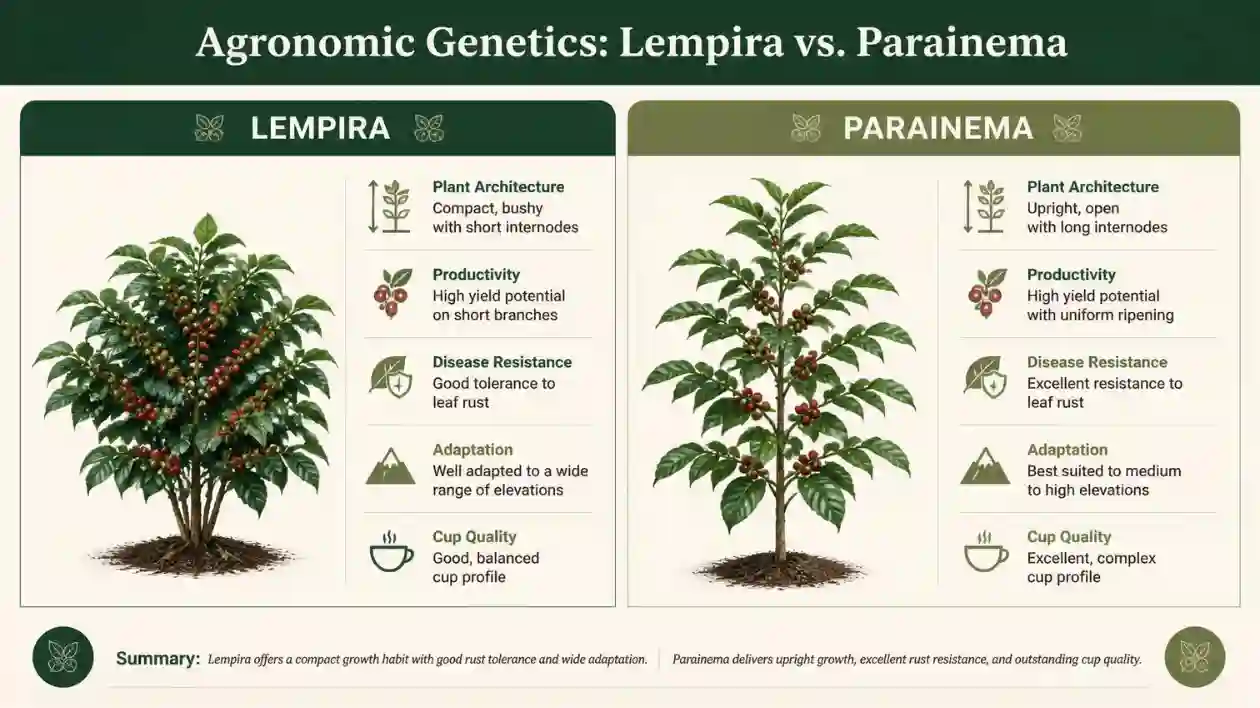
Honduras grows a mixture of traditional Arabica varieties and improved cultivars developed to help farmers manage disease pressure and improve productivity.
Two important examples are Lempira and Parainema. Both have played a role in the development of the country’s coffee industry, but they have different genetic backgrounds and agronomic characteristics.
The Lempira variety
Lempira is a cultivar developed through coffee-breeding work involving IHCAFÉ. It was released in Honduras in 1998 and is derived from a cross between Timor Hybrid 832/1 and Caturra.
Its genetic background includes Timor Hybrid ancestry, which introduced Robusta-related genetic material associated with resistance to certain coffee diseases. This does not make Lempira a Robusta coffee: it remains an Arabica cultivar.
Lempira was widely adopted because of its productivity and its initial resistance to coffee leaf rust, also known as roya. However, that resistance proved less durable than originally hoped.
Rust populations evolved, and outbreaks affecting Lempira were reported in Honduras. More recent scientific evaluations have confirmed that the variety can be susceptible to coffee leaf rust under local conditions.
This is an important lesson in coffee agriculture: disease resistance is not necessarily permanent, as fungal populations can evolve and overcome previously effective plant defences.
The Parainema variety
Parainema is another important Honduran Arabica cultivar, developed through breeding work involving IHCAFÉ and related regional research programmes.
It belongs to the Sarchimor genetic group and has been selected for its resistance to coffee leaf rust and certain nematodes. Its agronomic characteristics have made it an important option for farmers looking to manage disease pressure while maintaining productive coffee plants.
Parainema has also attracted international attention for its potential cup quality. Well-produced lots have achieved impressive results in speciality coffee competitions, including Honduras’s Cup of Excellence.
Its cup profile can be particularly expressive, with examples displaying tropical fruit, citrus, floral notes and pronounced sweetness. These characteristics are not guaranteed in every harvest, however, as processing, growing conditions and roasting all influence the final result.
The success of Parainema demonstrates that disease-resistant cultivars do not necessarily have to be associated with ordinary commercial coffee. Under the right conditions, they can produce coffees of considerable speciality quality.
What does Honduras coffee taste like?
Honduras coffee is often appreciated for its approachable balance of sweetness, body and acidity. Many washed Arabica coffees display familiar Central American characteristics, including chocolate, caramel, nuts and gentle fruit notes.
However, there is no single flavour profile that represents the whole country. The six growing regions, individual farm conditions, coffee varieties and processing methods all contribute to the final cup.
Common tasting descriptions include:
- Chocolate and cocoa: Often associated with rounded sweetness and a familiar Central American character.
- Caramel and brown sugar: Sweetness that can bring balance and depth to the cup.
- Citrus: A brighter acidity that may resemble orange or other citrus fruits.
- Stone fruit: Notes such as peach and apricot can appear in some higher-quality lots.
- Tropical fruit: Particularly expressive coffees may display mango and other ripe fruit characteristics.
These are tasting descriptors rather than fixed characteristics of every Honduran coffee. A washed coffee from one region may taste quite different from a naturally processed lot grown elsewhere.
How should you brew Honduran coffee?
The versatility of Honduran Arabica makes it suitable for several brewing methods. A paper-filtered method is a particularly useful starting point if you want to explore sweetness, acidity and individual flavour notes without too much sediment or heavier coffee oils in the cup.
For a balanced starting recipe, try a Drip Filter or Hario V60.
Suggested V60 starting recipe
- Coffee: 15g
- Water: 240g
- Coffee-to-water ratio: 1:16
- Water temperature: 93°C
- Grind: Medium, adjusted to suit your brewer and coffee
- Bloom: 30–45 seconds
- Total brewing time: Approximately 2½–3½ minutes
This recipe provides a useful starting point rather than a fixed rule. If the coffee tastes sharp or underdeveloped, try a slightly finer grind or a longer extraction. If it tastes dry or excessively bitter, a coarser grind or shorter brewing time may help.
For a fuller-bodied cup, try a French Press. Its metal mesh filter allows more coffee oils and fine particles into the cup, producing a different texture from a paper-filtered brew.
If your coffee tastes unexpectedly sharp or sour, our guide to why coffee tastes sour explains how grind size, water temperature and extraction time can affect the final result.
Honduras: A coffee origin continuing to evolve
Honduras has developed from a relatively overlooked coffee origin into one of the most important producers in Central America. Its progress reflects more than favourable growing conditions. Investment in research, improved agricultural practices, regional recognition and the work of smallholder farmers have all helped strengthen its international reputation.
The six recognised growing regions offer a useful way to explore the country’s geographical diversity, while varieties such as Lempira and Parainema demonstrate the importance of agricultural research in responding to disease and changing production challenges.
Whether you prefer the chocolate sweetness of a traditional washed Arabica or the more expressive fruit characteristics of a carefully produced speciality lot, Honduras offers plenty to discover.
Its coffee industry continues to evolve, and its growing reputation suggests that this Central American origin has much more to offer the speciality coffee world.
Compare Honduras’ rise in popularity to other nations that make up The Coffee Belt


