

Table of Contents
There’s something rather fascinating about the story of European coffee houses. What started as an unfamiliar drink arriving from the East eventually became the centre of social life in some of Europe’s most famous cities. During the seventeenth and eighteenth centuries, coffee houses offered somewhere to exchange news, discuss business, debate politics and catch up with friends over a freshly prepared cup of coffee.
The development of European coffee houses was about much more than introducing a new beverage. These establishments helped change the way people communicated, conducted business and shared ideas. From the trading streets of Venice to the elegant cafés of Paris and Vienna, each city developed its own distinctive coffee house tradition.
Let’s follow the journey through four European cities and discover how coffee became such an important part of everyday life.
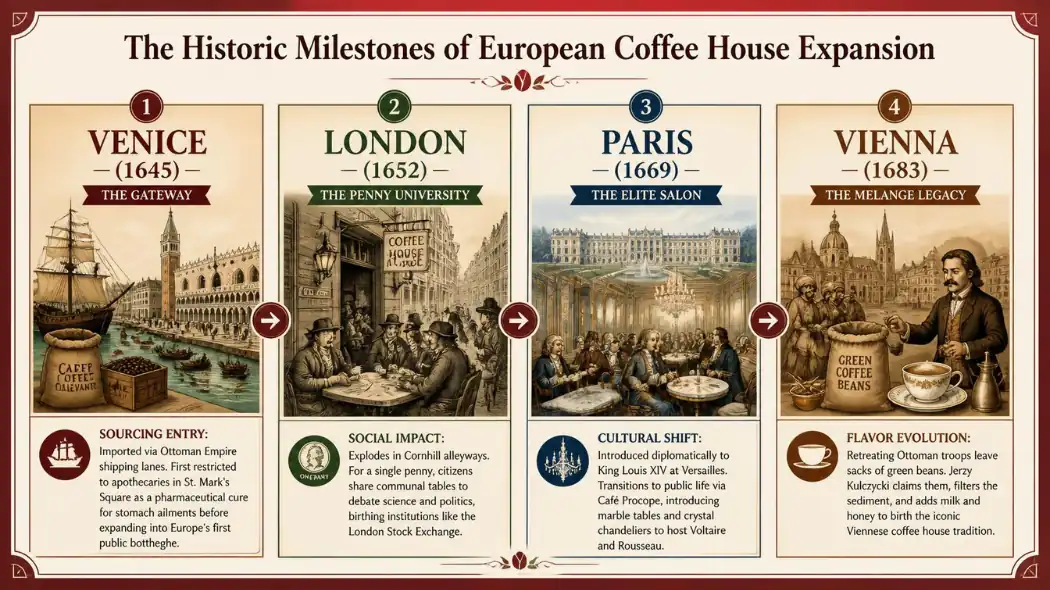

How Did European Coffee Houses First Become Popular?
Coffee was already well established in parts of the Ottoman Empire and the wider Islamic world before it became fashionable in Europe.
European travellers, merchants and diplomats encountered the drink through their trading connections with cities such as Constantinople, Cairo and Aleppo. As commercial routes developed, coffee gradually made its way into European ports, particularly those with established Mediterranean trading connections.
At first, it was an expensive curiosity, enjoyed mainly by wealthy households and people interested in its medicinal properties. Some welcomed its stimulating qualities, while others were suspicious of a drink associated with the Islamic world.
However, curiosity soon turned into enthusiasm. By the middle of the seventeenth century, the first European coffee houses were appearing, giving people somewhere to enjoy this unfamiliar beverage and spend time in company.
Venice was among the earliest European cities to embrace the new drink, followed by the growing coffee house scenes in England, France and Austria.
Venice: The Beginning of European Coffee House Culture
Venice was ideally positioned to introduce coffee to European society. Its merchants had long-established trading connections with the eastern Mediterranean, bringing spices, textiles and other unfamiliar goods into the city.
Coffee gradually found its way into Venetian households and trading circles, initially attracting wealthy customers and those interested in its medicinal properties.
One particularly interesting figure from this period was Prospero Alpini, an Italian physician and botanist who travelled to Egypt during the late sixteenth century.
Alpini studied the coffee plant and included a description of it in his botanical work De Medicina Aegyptiorum, published in 1591. His observations helped introduce European readers to a plant that was still relatively unfamiliar.
By 1647, Venice had established one of Europe’s earliest recognised public coffee houses. Coffee was no longer simply an exotic curiosity; it was becoming a fashionable social drink.

CLICK IMAGE TO EXPLORE ↗
Caffè Florian, opened in 1720, is one of Europe’s oldest and most celebrated coffee houses.One of the city’s most famous establishments, Caffè Florian, opened much later, in 1720, beneath the arcades of St Mark’s Square. It became a favourite meeting place for locals and visitors alike, developing a reputation for its elegant surroundings and welcoming atmosphere.
What I particularly like about Venice’s coffee history is how the city helped turn an unfamiliar imported drink into something people wanted to enjoy as part of their everyday social lives.
Explore further:
London: The Rise of the Famous Penny Universities
Coffee arrived in England during the middle of the seventeenth century. Oxford had an early coffee house by 1650, while one of London’s first and best-known establishments opened around 1652 in St Michael’s Alley, Cornhill.
Its proprietor was Pasqua Rosée, who had previously worked for an English merchant with experience of coffee drinking in the Ottoman trading world.
Londoners quickly took to the new drink. Coffee houses began appearing throughout the city, attracting merchants, writers, professionals and curious customers who wanted to find out what all the excitement was about.
One of the most interesting features was the relatively inexpensive entrance. For around a penny, customers could purchase coffee and spend time listening to conversations, exchanging information and discussing current events.
This gave rise to the familiar expression Penny Universities.
They weren’t universities in the traditional sense, of course, but customers could listen to informed discussions and exchange ideas without needing a formal education or an expensive membership.
How London’s Coffee Houses Helped Shape Modern Business
Perhaps the most surprising part of London’s coffee house history is its connection with the development of modern financial institutions.
Different establishments developed their own specialities, attracting customers involved in particular trades and professions.
Jonathan’s Coffee House in Exchange Alley became an important meeting place for stockbrokers and merchants. It was closely associated with the early development of organised stock trading, eventually contributing to the establishment of the London Stock Exchange.

CLICK IMAGE TO EXPLORE ↗
Lloyd’s Coffee House became an important meeting place for London’s merchants and shipowners, helping lay the foundations for today’s Lloyd’s insurance market.Another famous establishment was Edward Lloyd’s Coffee House, which became a meeting place for shipowners, merchants and people involved in maritime trade.
Customers exchanged information about shipping movements, cargoes and overseas trading opportunities. This eventually helped establish the foundations of Lloyd’s insurance market.
It’s quite remarkable to think that places where people gathered to enjoy a cup of coffee played such an important role in the development of international business.
Explore further:
Paris: From Royal Curiosity to the Famous Coffee Salon

CLICK IMAGE TO EXPLORE ↗Parisian coffee salons became fashionable meeting places during the late seventeenth century, bringing coffee, conversation and European high society together.
Coffee arrived in Paris during the seventeenth century, initially attracting attention among the aristocracy and fashionable society.
A particularly important moment came in 1669, when the Ottoman ambassador Suleiman Aga arrived at the court of King Louis XIV.
He introduced coffee to French high society, presenting the drink as an exotic and fashionable part of Ottoman culture. His gatherings attracted considerable attention, and coffee soon became something of a talking point among the Parisian elite.
However, it wasn’t long before coffee moved beyond royal circles.
In 1686, a Sicilian entrepreneur named Francesco Procopio dei Coltelli opened Café Procope in Paris. The establishment became famous for its elegant surroundings and soon attracted writers, philosophers and intellectuals.
Among the celebrated figures associated with Café Procope were Voltaire, Rousseau and Denis Diderot.
How Parisian Coffee Houses Encouraged New Ideas
During the eighteenth century, Parisian cafés became important meeting places for people interested in literature, philosophy, politics and the sciences.
This was the period of the Enlightenment, when writers and thinkers were questioning traditional beliefs and exploring new ideas about society, government and individual freedom.
Coffee houses provided somewhere for these conversations to take place. Customers could exchange opinions, discuss new publications and hear different points of view.
They were not the only places where Enlightenment ideas developed, but they formed part of a wider network of intellectual meeting places that helped ideas circulate throughout European society.
Café Procope remains one of the best-known reminders of this fascinating period.
Explore further:
Vienna: The Origins of Its Famous Coffee House Tradition
Vienna developed one of Europe’s most recognisable coffee house cultures, although its origins are surrounded by a particularly entertaining historical story.
The traditional account takes us back to 1683, when Vienna was under siege by Ottoman forces.
Following the retreat of the Ottoman army, sacks of coffee were reportedly left behind. According to the popular legend, these unfamiliar beans were initially mistaken for camel feed.
A Polish military figure named Jerzy Franciszek Kulczycki is often credited with recognising their value and using them to establish Vienna’s first coffee house.
It’s a wonderful story, but the historical evidence tells us something rather different.
The first documented Viennese coffee house was established by Johannes Diodato, an Armenian merchant who received permission to serve coffee in 1685.
Kulczycki remains an important character in Viennese coffee folklore, but he should not be credited as the founder of the city’s first documented coffee house
How Vienna Created Its Own Coffee House Culture

CLICK IMAGE TO EXPLORE ↗
An artistic reconstruction of early Viennese coffee house culture, inspired by the famous Blue Bottle legend and the traditions that helped shape Vienna’s coffee heritage.Vienna’s coffee houses gradually developed a character quite different from those found elsewhere in Europe.
They became places where customers could spend hours reading newspapers, meeting friends, discussing current affairs or simply enjoying a leisurely cup of coffee.
By the eighteenth century, newspapers had become an increasingly familiar feature of these establishments. Coffee houses were turning into informal information centres where customers could catch up with events at home and abroad.
The traditional Viennese coffee house also developed its own distinctive atmosphere, with marble-topped tables, comfortable seating and attentive service.
One of Vienna’s best-known coffee specialities is the Wiener Melange, generally prepared using espresso or strong coffee with steamed milk and a layer of milk foam.
Although sometimes compared with a cappuccino, it has its own traditional serving style and place within Viennese coffee culture.
In 2011, UNESCO recognised Viennese coffee house culture as part of Austria’s intangible cultural heritage.
It is easy to understand why. These establishments became much more than places to purchase a drink; they developed into an important part of Vienna’s cultural identity.
Explore further:
The Lasting Influence of European Coffee Houses
Looking back, it’s fascinating to see how differently coffee houses developed across Europe.
Venice helped introduce coffee to fashionable European society, London turned coffee houses into busy centres of commerce and discussion, Paris connected the drink with intellectual and artistic life, while Vienna developed a tradition that remains famous around the world.
Each city brought something different to the experience, but they all shared one important feature: coffee gave people a reason to come together.
Their influence can still be seen in the cafés we visit today. Whether people are meeting friends, reading the newspaper, working on a laptop or simply taking a break from a busy day, the idea of the coffee house as a place to spend time has never really disappeared.
And perhaps that’s what makes their history so interesting.
Coffee may have started its European journey as an unfamiliar imported drink, but it eventually became part of the social fabric of an entire continent.
The European coffee house was never just about the coffee. It was about the conversations that happened around it.


