

Table of Contents
Peru  The Andean High-Flyer
Peruvian coffee has earned an increasingly important place in the international speciality coffee market. Although it does not always receive the same attention as some of its South American neighbours, Peru has developed a strong reputation for Arabica production, smallholder farming and certified organic coffee.
Grown along the eastern slopes of the Andes, Peruvian coffee benefits from an extraordinary range of elevations, tropical climates and local growing conditions. Its coffee industry is built largely around family-run farms and producer cooperatives, many of which help farmers reach international markets and obtain specialist certifications.
From the chocolate sweetness often associated with Cajamarca to the more delicate fruit and floral characteristics found in selected highland lots, Peruvian coffee offers a diverse range of flavours. Its combination of traditional farming communities, distinctive mountain environments and growing speciality recognition makes it an origin worth exploring.


Official USDA Production Rankings and Regional Bean Characteristics

Variety
Arabica

Growing Region
Cajamarca, Amazonas, San Martín, Junín, Cusco

Processing Methods
Washed, Natural

Flavour Profile
Chocolate, Citrus, Caramel, Nuts

Harvest Season
April–September

Acidity
Medium
World Production Ranking
9th,
Approximately depending on the production year and statistical source.

Production Per Year
4.76 million 60 kg bags
(2025/26 estimate).

World Production Share
approx: 2.7%

Altitude
1,000–2,000 metres.

Climate
Tropical Highland

Body
Medium

Rankings and Production Source: USDA Foreign Agricultural Service – Coffee: World Markets and Trade, 2025/26.
What Is the Historical Story Behind Peru’s Emergence as a Coffee Origin?

Coffee was introduced to Peru during the eighteenth century, although commercial cultivation developed more gradually. By the nineteenth century, coffee farming had become established in several parts of the country, particularly along the eastern slopes of the Andes.
The mountainous landscape offered suitable growing environments, while the development of agricultural settlements and export routes helped coffee become an increasingly important crop.
From commercial production to speciality coffee
or much of the twentieth century, Peruvian coffee was primarily traded as a commercial export, with a substantial proportion entering international blending markets.
Over time, however, the industry began developing a stronger speciality identity. Smallholder farmers, cooperatives and exporters have played important roles in improving quality, traceability and access to international buyers.
This transformation has not been the result of one single initiative. It has involved producer organisation, agricultural support, investment in processing and quality control, and growing international demand for coffees with identifiable origins and production practices.
Today, Peru is recognised as an important source of Arabica, particularly in organic and Fair Trade markets. Its coffee sector also remains an important source of income for rural communities.
Which Are the Main Coffee-Growing Regions of Peru?
Peruvian coffee is cultivated along the eastern slopes of the Andes, where elevation, rainfall, temperature and local microclimates create a wide range of growing environments.
Coffee is produced in numerous regions, but several areas are particularly important to the country’s national output and speciality reputation.
Cajamarca
Situated in northern Peru, Cajamarca is one of the country’s major coffee-producing regions. Its mountainous terrain and highland farms provide conditions suited to Arabica cultivation.
Cajamarca coffees are frequently associated with balanced sweetness, chocolate, caramel and fruit characteristics. The region is also home to organised producer groups that have helped develop access to speciality markets.
Junín
Junín is an important central coffee-growing region, including the well-known areas of Chanchamayo and Satipo.
Its varied elevations and growing environments produce a broad range of coffee profiles. Traditional chocolate-led flavours can be found alongside more expressive speciality lots with fruit and floral characteristics.
San Martín
Located in north-eastern Peru, San Martín is one of the country’s major producing regions. Coffee cultivation is an important part of its agricultural economy, with a substantial network of smallholder farms.
The region’s varied growing conditions and production systems contribute to a wide range of cup profiles.
Other important producing areas
Coffee is also cultivated in Amazonas, Cusco, Huánuco and Pasco, among other regions. Each contributes to the diversity of Peruvian Arabica, with differences in altitude, climate, varieties and processing influencing the final cup.
Many Peruvian coffee farms are situated between approximately 1,000 and 2,000 metres above sea level, although elevations vary considerably between regions and individual farms.
These Andean environments help explain why Peruvian coffee cannot be reduced to one universal flavour profile. A coffee from one mountain area may be quite different from a lot grown elsewhere, even when both are produced within the same country.
Why Is Peru So Well Known for Certified Organic Coffee?
One of the most distinctive features of the Peruvian coffee industry is its strong connection with organic farming and smallholder producer organisations.
Peru’s Ministry of Agrarian Development and Irrigation (MIDAGRI) reports that the country has more than 85,000 hectares of certified organic coffee-growing land. This makes certified organic production an important part of Peru’s international coffee identity.
World Coffee Research also identifies Peru as a leading producer of certified Fair Trade and organic Arabica coffee.
The importance of smallholder farming
Much of Peru’s coffee is produced by family-run farms, many of which operate on relatively small plots of land.
World Coffee Research estimates that Peru has more than 202,000 mostly smallholder coffee farms, averaging just over one hectare each. It also reports that more than 70% of national production comes from smallholder farmers.
For many of these producers, working collectively is essential. Cooperatives and agricultural organisations can provide access to resources, technical support and international buyers that individual farms might struggle to reach independently.
Cooperative organisations can help farmers with:
- Access to organic and Fair Trade certification programmes.
- Training in agricultural management and sustainable production.
- Shared processing and quality-control facilities.
- Assistance with export requirements and traceability.
- Improved negotiating opportunities with international buyers.
What does organic certification actually mean?
Traditional farming practices, including shade cultivation and the use of organic soil amendments, are found in parts of Peru’s coffee-growing landscape. However, it is important to distinguish between traditional low-input farming and formally certified organic production.
A farm does not automatically qualify as organic simply because it uses few synthetic agricultural chemicals. Certification requires producers to meet recognised standards, maintain appropriate records and undergo inspection.
The growth of Peru’s organic coffee industry has therefore depended on more than geographical isolation or traditional farming methods. Producer organisation, certification support and access to international markets have all played important roles.
For many smallholder communities, organic production offers an opportunity to reach specialist buyers and differentiate their coffee from conventional commercial exports.
What Are the Distinctive Flavour Characteristics of Peruvian Arabica?
Peruvian Arabica is often appreciated for its balanced sweetness, approachable body and moderate acidity. Many coffees offer familiar chocolate, caramel and toasted-nut characteristics, while selected speciality lots display more delicate fruit and floral notes.
Common tasting descriptions include:
- Milk chocolate: A rounded sweetness that provides a familiar foundation.
- Caramel and brown sugar: Soft sweetness that adds depth and balance.
- Toasted almonds and hazelnuts: Nutty characteristics that complement chocolate notes.
- Apple and citrus: Gentle fruit acidity that can bring freshness to the cup.
- Herbal and floral notes: More delicate characteristics found in some speciality coffees.
- Stone fruit: Peach and similar fruit impressions that may appear in selected lots.
These are tasting descriptions rather than characteristics guaranteed in every Peruvian coffee. The final cup depends on the growing environment, coffee variety, ripeness at harvest, processing, storage and roasting.
If your home extractions are failing to reveal these sweet, balanced flavours and are instead tasting unpleasantly sharp or sour, our guide to why does my coffee taste sour explains how grind size, water temperature and extraction time can influence the final cup.
How do regional conditions influence flavour?
Peru’s geographical diversity means that its coffees do not all share the same flavour profile.
Cajamarca is frequently associated with sweet, balanced coffees displaying chocolate, caramel and fruit characteristics. Junín produces a broad range of profiles, from traditional chocolate-led coffees to more expressive speciality lots. San Martín also offers considerable variation, influenced by its different growing environments, varieties and processing methods.
Processing has an important influence too. Washed coffees often display a cleaner and more defined cup, while naturally processed coffees can develop more pronounced fruit characteristics.
This is why it is useful to consider the individual farm, region and processing method rather than assuming that every coffee from Peru will taste the same.
What Are the Best Brewing Methods for Peruvian Coffee?
Peruvian Arabica is versatile and works well across several brewing methods. Its often balanced sweetness and moderate acidity make it particularly suitable for paper-filtered brewing, while its chocolate and nut characteristics can also complement milk-based drinks.
Two approaches are especially worth exploring.
1. Paper-filtered brewing
A drip filter or Hario V60 is an excellent starting point for exploring the sweetness and acidity of a Peruvian single-origin coffee.
Paper filtration removes much of the fine sediment and coffee oils, producing a cleaner cup in which individual flavour characteristics are easier to distinguish.
Suggested starting recipe
| Brewing detail | Starting point |
|---|---|
| Coffee | 15 g |
| Water | 225 g |
| Coffee-to-water ratio | 1:15 |
| Water temperature | 93°C |
| Grind | Medium, adjusted to suit the brewer |
| Bloom | 30–45 seconds |
| Total brewing time | Approximately 2½–3½ minutes |
This recipe provides a useful starting point rather than a fixed rule. You can adjust the grind size and ratio to bring out more sweetness, acidity or body, depending on the particular coffee and your preferred taste.
2. Peruvian coffee with oat milk
Peruvian coffee’s chocolate, caramel and toasted-nut characteristics can make it an enjoyable pairing with steamed oat milk.
Oat milk has a naturally sweet, cereal-like character that can complement the roasted almond and chocolate notes often found in Peruvian Arabica.
When combined in a latte or flat white, the coffee’s sweetness and the creamy texture of the oat milk can create a flavour combination reminiscent of toasted hazelnuts and chocolate.
This is sometimes described informally as a ‘Nutella effect’ — a comforting combination of roasted-nut and chocolate impressions.
The result depends on the particular coffee, roast level and oat milk used. Barista-style oat milk is generally a useful choice because it is formulated to steam and texture more consistently.
For a simple pairing, try a medium-roasted Peruvian coffee prepared as a double espresso, topped with steamed oat milk. This allows the coffee’s sweetness to remain noticeable without being overwhelmed by the milk.
Peruvian Coffee: An Organic Success Story from the Andes
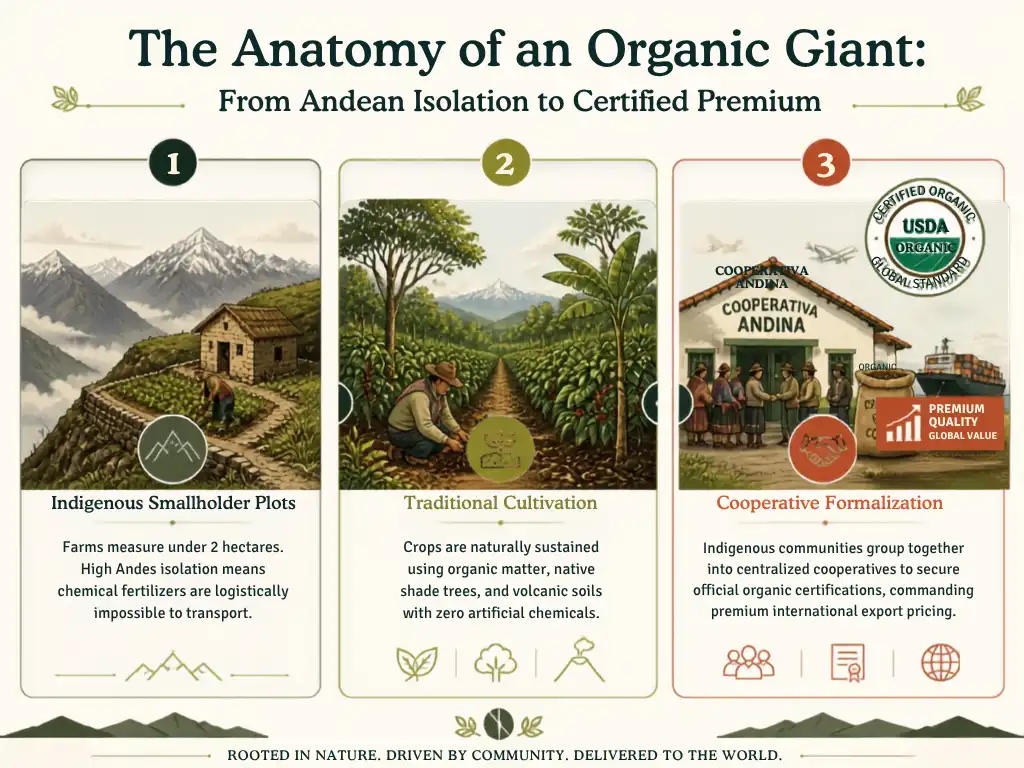
Peru’s coffee industry is built around a combination of smallholder farming, traditional agricultural knowledge and the remarkable geographical diversity of the Andes.
Its organic production sector has helped establish the country as an important supplier to international speciality and ethically focused markets, while cooperatives continue to create opportunities for small-scale farmers.
From the chocolate sweetness often associated with Cajamarca to the more delicate fruit characteristics found in selected coffees from Junín and San Martín, Peru offers a wide range of Arabica profiles worth exploring.
Its reputation is no longer simply that of a commercial coffee exporter. Peru has developed a distinctive speciality identity, with its farming communities, organic production and Andean growing environments at the heart of its success.
The Coffee Guide Note
The Andean Advantage
Peru’s mountainous geography creates a remarkable range of growing environments. As temperatures and rainfall patterns change, elevation becomes an increasingly important consideration for coffee farmers.
Higher-altitude cultivation can offer cooler growing conditions and a slower cherry development period, although altitude alone does not guarantee quality. Variety, farm management, harvesting, processing and careful preparation all contribute to the final cup.
For coffee drinkers, this means that Peruvian coffee is well worth exploring beyond its organic credentials. Its regional diversity offers opportunities to discover everything from familiar chocolate sweetness to more delicate fruit and floral characteristics.
Explore the different origins of the Coffee Belt and discover how geography, farming and processing shape the coffee in your cup.


