

Table of Contents
From an unfamiliar Eastern drink to one of Europe’s most celebrated coffee traditions.
Venice coffee history is closely connected to the arrival of coffee in Europe, the city’s powerful maritime trading networks and the curiosity of its physicians and merchants. During the late sixteenth century, reports of this unfamiliar dark drink began reaching European scholars, while Venice’s connections with the Ottoman world helped introduce coffee to an increasingly interested public. What began as an exotic curiosity would eventually become part of the city’s social identity, paving the way for the elegant coffee houses that still attract visitors today.

How did coffee first reach Venice and the European market?
During the sixteenth century, Venice was one of Europe’s most important trading centres. Its merchants maintained extensive commercial relationships with ports throughout the eastern Mediterranean, including territories within the Ottoman Empire. Along these established routes travelled spices, textiles, medicines and other unfamiliar goods, and coffee would eventually join them.
Coffee was already well established in parts of the Islamic world, particularly Yemen, Egypt and the Ottoman territories. Travellers and merchants returning from these regions brought stories of a dark beverage prepared from roasted seeds. To Europeans unfamiliar with coffee, it was an unusual and intriguing discovery.
The year 1570 is sometimes given as the date coffee first reached Italy, although the precise circumstances and earliest commercial imports are not firmly established. What is clearer is that knowledge of coffee began entering European writing during the late sixteenth century, with Venice playing an important part in this early exchange.
At first, coffee was an expensive curiosity rather than an everyday drink. Its unfamiliar appearance and association with the eastern Mediterranean gave it an exotic reputation, while its perceived medicinal properties helped introduce it to European circles of physicians and apothecaries.
Who was Prospero Alpini and how did he introduce coffee to European scholars?

One of the most important figures in the early European understanding of coffee was Prospero Alpini, a Venetian physician and botanist whose travels took him to Egypt during the 1580s.
Alpini spent several years studying Egyptian plants, local customs and traditional remedies. His observations eventually appeared in two important works: De Medicina Aegyptiorum, published in 1591, and De Plantis Aegypti, published in 1592.
In his botanical writing, Alpini described a plant whose seeds were used to prepare a drink known locally as caova. He also provided an early European illustration of the coffee plant, referring to the seeds as Bon.
His account is particularly interesting because it introduced European readers to both the plant and the way coffee was prepared and consumed in Egypt. At this stage, coffee was still largely unfamiliar in Europe, and descriptions such as Alpini’s helped bring it to the attention of the scientific and medical communities.
Rather than immediately becoming a fashionable social drink, coffee was initially viewed through the lens of medicine and botanical curiosity. Its stimulating qualities were noted, and it was discussed alongside other plants and substances used in traditional remedies.
For anyone interested in seeing the original historical work, the MUMAC account of Prospero Alpini’s De Plantis Aegypti provides an interesting introduction to its significance.
Did Pope Clement VIII really give coffee his blessing?
One of the best-known stories in the history of European coffee concerns Pope Clement VIII, who was head of the Catholic Church from 1592 until 1605.

According to the popular account, coffee initially attracted suspicion among some Christian authorities because of its association with the Muslim world. It was sometimes described in the story as the drink of the infidel, or even the work of Satan.
Concerned about its growing popularity, priests supposedly asked the Pope to condemn the beverage. Clement VIII is then said to have requested a taste before making his decision.
The story goes that he enjoyed the drink so much that he declared it a shame to leave something so delicious exclusively to non-Christians. He supposedly gave coffee his blessing, allowing Christians to enjoy it without religious objection.
It is a wonderful story, and one that has become firmly attached to coffee folklore. However, there is no known papal decree or contemporary documentation confirming that this tasting or blessing actually took place.
The anecdote is best understood as a legend reflecting the religious and cultural suspicions that sometimes surrounded unfamiliar products arriving from the Islamic world. Whether or not the Pope ever tasted coffee, the drink gradually gained acceptance across Christian Europe.
How did Venice develop its early coffeehouse culture?
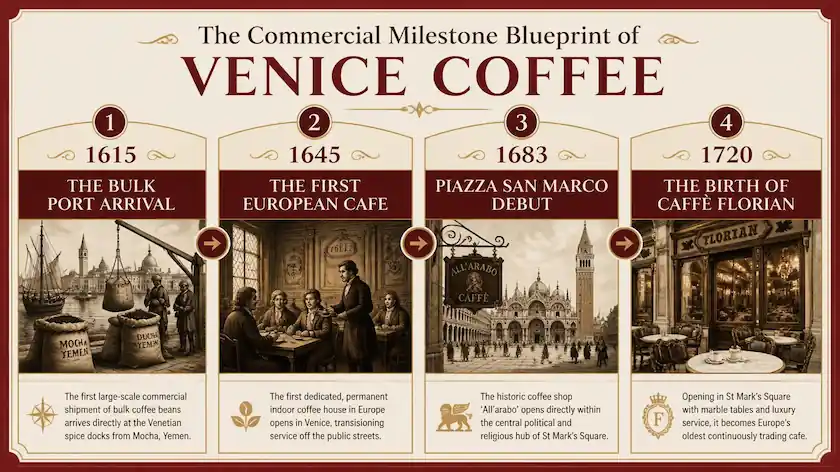
Coffee’s journey from an unfamiliar eastern beverage to a fashionable European drink took place over several generations. Venice was among the early centres of this transformation, although some of the dates traditionally associated with its first coffeehouses remain uncertain.
Here are some of the important milestones:
Late sixteenth century – Coffee enters European accounts
Reports of coffee begin appearing in European writing. Prospero Alpini’s observations in Egypt help introduce the coffee plant and drink to European scholars.
1615 – Coffee attracts growing European interest
The early seventeenth century saw increasing European curiosity about coffee. In 1615, the Italian traveller Pietro Della Valle wrote from Constantinople about the drink and his intention to bring some back. This is an important indication of coffee’s growing awareness in Europe, rather than proof of a first large commercial shipment into Venice.
Around 1640–1645 – Early Venetian coffeehouses
Several historical accounts place the appearance of early coffeehouses in Venice around this period. However, the precise date of the first establishment is uncertain, and the commonly repeated 1645 date should be treated with caution.
1683 – All’arabo opens in St Mark’s Square

A coffeehouse known as All’arabo is traditionally associated with the opening of a coffee shop in Piazza San Marco in 1683. This marked an important stage in the development of public coffee drinking in Venice.
1720 – Caffè Florian opens its doors

On 29 December 1720, Floriano Francesconi opened a coffee house in St Mark’s Square under the name Alla Venezia Trionfante. Venetians soon began referring to it as Florian’s, and the name Caffè Florian has remained ever since.
The establishment became famous for its elegant surroundings, refined service and distinguished clientele. Its rooms welcomed writers, artists, merchants and travellers, helping establish coffee drinking as an important part of Venetian social life. You can explore its story through the official history of Caffè Florian.
Why did Venice become so important to European coffee culture?
Venice’s importance was not simply that coffee arrived there early. Its position as a major trading port connected European consumers with goods and ideas from the eastern Mediterranean and beyond.
The city’s merchants helped create the commercial networks through which unfamiliar products could reach European markets. Its physicians and scholars, including Prospero Alpini, helped introduce coffee to European intellectual circles. Later, its coffeehouses provided places where people could meet, exchange news and enjoy a drink that had once seemed remarkably foreign.
By the eighteenth century, coffee had become an established part of Venetian life. The success of establishments such as Caffè Florian demonstrated how far the drink had travelled from its earlier reputation as an exotic medicinal curiosity.
Today, Venice remains one of the most evocative places in which to experience Europe’s historic coffeehouse tradition. Sitting beneath the arcades of St Mark’s Square, it is easy to appreciate how a drink that travelled through centuries of trade, curiosity and cultural exchange became such an enduring part of European life.

How to spot a Venetian legacy today:
if you see a cafe with marble tables, gold-leaf mirrors, and waiters in formal attire, you are sitting in a descendant of Caffè Florian.
Opened in 1720 (and still open today!), it proved that European coffee wasn’t just a drink—it was an atmosphere.
The European Coffee Journey
The beans have arrived in the Mediterranean, but where did they go next?
Up Next: [The Penny Universities: London’s Caffeine Revolution (1650) →]


