

From Turkish Cezve to Vietnamese Phin: How Different Brewing Methods Work
Every cup of coffee begins with the same basic principle: water extracts soluble compounds from ground coffee. But the way that water meets the grounds, how long they remain in contact and how the finished drink is filtered can make a remarkable difference.
Over the centuries, coffee preparation has developed into a fascinating collection of techniques. Some methods immerse the grounds in water, others rely on gravity, while espresso and related methods use pressure to move water through a compact bed of coffee.
In this guide, we’ll explore eight popular coffee extraction methods, looking at how each works, its distinctive characteristics and the kind of cup you can expect.

Turkish Coffee – The Traditional Cezve or Ibrik
How does traditional Turkish coffee brewing work?

Turkish coffee is one of the oldest coffee preparation traditions still widely practised today, with its history closely associated with the Ottoman Empire and the coffee culture that developed in Istanbul during the 16th century.
The method uses an exceptionally fine, powder-like grind. Coffee and water are combined in a small long-handled pot called a cezve in Turkish, also widely known internationally as an ibrik. The mixture is heated gently, allowing the coffee to develop its characteristic surface foam.
Unlike filtered brewing methods, Turkish coffee is served without removing the grounds. They settle naturally at the bottom of the small cup, leaving a concentrated, aromatic drink with a rich texture and distinctive mouthfeel.
The preparation is as much a cultural ritual as a brewing technique. Turkish coffee is traditionally served in small cups, often accompanied by a glass of water and something sweet.
“Turkish coffee has a long history within Ottoman society, and its preparation remains an important part of everyday hospitality and social life, as explained in this account of Turkish coffee culture and tradition.”
Explore our complete guide to Turkish coffee brewing
French Press – Full Immersion Brewing
How does a French Press extract coffee flavour?

The French Press, also known as a cafetière, is one of the best-known examples of full-immersion brewing. Coarsely ground coffee is steeped directly in hot water, allowing soluble compounds to dissolve throughout the brewing period.
When the coffee has steeped, a plunger fitted with a metal mesh filter is pressed down to separate most of the grounds from the liquid.
Unlike a paper filter, the metal mesh allows more of the coffee’s natural oils and fine particles to pass into the finished drink. This produces a fuller-bodied cup with a heavier mouthfeel and a little more sediment than paper-filtered coffee.
The French Press is particularly popular with people who enjoy a rounded, substantial cup. It also gives the brewer straightforward control over the coffee dose, water temperature and steeping time.
The metal mesh allows more coffee oils and fine particles into the cup, contributing to the French Press’s characteristic full body.
Explore our complete French Press guide
Moka Pot – Stovetop Pressure Brewing
How does a Moka Pot brew coffee?

Invented by Alfonso Bialetti and introduced in 1933, the Moka Pot brought concentrated stovetop coffee into homes around the world.
Its familiar three-part design consists of a lower water chamber, a funnel-shaped coffee basket and an upper collection chamber. As the water heats, rising steam pressure pushes hot water up through the coffee grounds and into the upper chamber.
A Moka Pot operates at considerably lower pressure than a commercial espresso machine. It does not produce true espresso, but it does create a concentrated, robust drink with a distinctive flavour and fuller mouthfeel than many filter coffees.
The result depends on several variables, including grind size, heat, coffee dose and how the brewing process is managed. Using moderate heat and removing the pot from the stove as brewing finishes can help avoid an excessively harsh result.
The Moka Pot is a classic stovetop brewer, producing concentrated coffee through heat-generated pressure rather than the high-pressure extraction used by espresso machines.
Explore our complete Moka Pot brewing guide
Espresso – High-Pressure Extraction
What are the technical requirements for espresso extraction?

Espresso is a pressure-driven brewing method in which hot water is forced through a compacted puck of finely ground coffee. Modern espresso machines commonly operate at around 9 bars of brewing pressure, producing a small, highly concentrated beverage in a relatively short time.
A typical espresso recipe may take around 25–30 seconds to run, although the ideal time depends on the coffee, dose, grind size, machine and desired result. There is no single timing rule that suits every espresso.
One of espresso’s most recognisable features is crema: the golden-brown foam that forms on the surface of a freshly extracted shot. It develops as gases and coffee oils disperse into the liquid under pressure.
Espresso offers an intense concentration of flavour and provides the foundation for drinks such as cappuccino, flat white, latte and Americano. Its small serving size and concentrated character distinguish it from larger filter coffees.
Espresso combines finely ground coffee, controlled water temperature and pressure to produce a concentrated drink with its characteristic crema.
Explore our complete espresso guide
Chemex – Pour-Over Brewing with Thick Paper Filtration
Why does a Chemex produce such a clean cup of coffee?

The Chemex is a manual pour-over brewer designed by chemist Peter Schlumbohm in 1941. Its distinctive hourglass shape and thick bonded paper filters give it a recognisable appearance and a particular brewing character.
Hot water is poured over coffee grounds held in the paper filter. Gravity draws the brewed coffee through the filter and into the glass vessel below.
Chemex filters are thicker and more densely structured than many conventional paper coffee filters. They retain a greater proportion of fine particles and coffee oils, helping produce a particularly clean cup with a lighter mouthfeel.
The brewer gives the user control over pouring speed, water distribution, grind size and brewing time. These variables all influence the finished flavour.
Chemex is especially well suited to coffees where you want to appreciate delicate aromas, clean acidity and clearly defined flavour characteristics.
Explore our complete Chemex brewing guide
Hario V60 – Precision Pour-Over Extraction
How does the Hario V60 compare with the Chemex?

The Hario V60 is another popular gravity-fed pour-over method. Its name comes from its cone shape and 60-degree angle. The design features spiral ribs along the inside of the dripper and a large opening at the base.
These features allow air to escape around the filter and give the brewer considerable control over water flow. By changing the pouring technique, grind size and water quantity, you can influence the contact time and character of the finished coffee.
Unlike the Chemex, the V60 normally uses a thinner paper filter. This allows a different balance of oils and fine particles through, often producing a cup with a little more body while retaining excellent clarity.
The V60 is particularly popular with home brewers and speciality coffee enthusiasts who enjoy experimenting with individual brewing variables and exploring the flavour differences between origins and roast profiles.
Explore our complete V60 brewing guide
AeroPress – Immersion Combined with Manual Pressure
Who invented the AeroPress and how does it work?

The AeroPress was invented by engineer Alan Adler and introduced in 2005. Its clever design combines immersion brewing with gentle manual pressure to produce coffee quickly and conveniently.
Alan Adler developed the AeroPress after experimenting with ways to make a better single cup of coffee, and the invention and development of the AeroPress provides an interesting insight into its engineering.
Ground coffee and hot water are combined inside the brewing chamber and allowed to steep. A rubber plunger is then pushed down, forcing the brewed coffee through a small filter at the base.
The standard paper filter removes most fine particles and much of the coffee’s oils, producing a relatively clean cup. The brewing time, grind size, water temperature and coffee-to-water ratio can all be adjusted to suit different recipes.
The AeroPress is particularly versatile. It can produce a concentrated brew or a lighter cup, depending on the recipe, and is popular with travellers because it is compact, portable and straightforward to clean.
It is not an espresso machine: the pressure produced by the hand-operated plunger is considerably lower than commercial espresso pressure.
Explore our complete AeroPress brewing guide
Drip Filter – Automated Gravity Brewing
How did the electric drip filter machine evolve?

Drip filter coffee is one of the most familiar brewing methods in homes and workplaces. Rather than requiring the brewer to pour water manually, an electric machine heats and distributes water over a bed of ground coffee.
The water passes through the grounds under gravity, then travels through a filter into a collection jug or carafe. Most household machines use paper filters, although some models use reusable metal or mesh filters.
The development of the electric drip brewer helped make filter coffee more convenient and consistent. The Wigomat, associated with German inventor Gottlob Widmann and commonly dated to 1954, was an important early machine in this development.
A good drip brewer should distribute water evenly and maintain a suitable brewing temperature. Grind size, coffee dose, water quality and machine performance all influence the result.
When these variables are properly controlled, drip filter coffee can produce a clean, balanced cup with good flavour clarity and consistency.
Automated drip brewing offers convenience, but the quality of the result still depends on water temperature, grind size and even distribution across the coffee bed.
Explore our complete drip filter coffee guide
Vietnamese Phin – Slow Gravity-Drip Brewing
What is a Phin Filter and how does it brew coffee?

The Phin is a traditional Vietnamese coffee brewer made from metal. It usually consists of a brewing chamber, a perforated base, an internal filter plate or press and a lid.
Ground coffee is placed inside the chamber, hot water is added, and the coffee slowly drips through the perforated base into a cup below.
Unlike a French Press, the Phin is not a full-immersion brewer. It relies on gravity, with the internal press helping to hold the coffee grounds in place. The flow rate is influenced by grind size, the amount of coffee, how firmly the grounds are settled and the quantity of water used.
Because the Phin uses a metal filter rather than paper, more oils and fine particles can pass into the cup. The result is often a concentrated, full-bodied coffee with a distinctive texture.
Vietnamese coffee is frequently served with sweetened condensed milk, creating the familiar combination of strong coffee and creamy sweetness.
Explore our complete Vietnamese Phin brewing guide
Comparing Different Coffee Extraction Methods
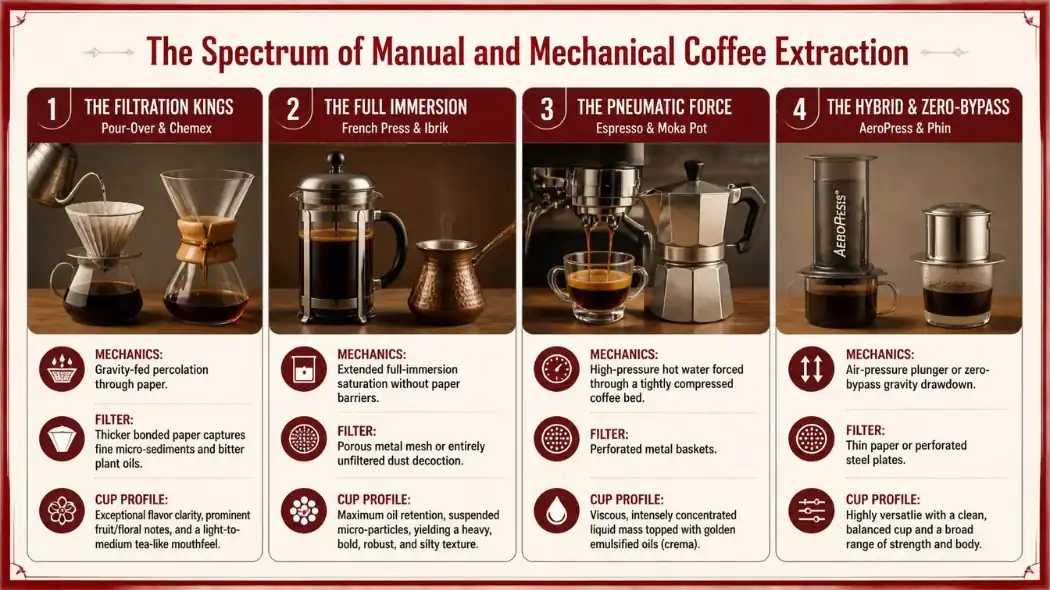
Alt text: Comparison of coffee extraction methods, showing immersion, gravity filtration, pressure brewing and unfiltered preparation.
Every brewing method has its own strengths. The choice depends on the type of coffee you enjoy, how much control you want over the process and the equipment available.
| Brewing method | Extraction style | Typical body | Filtration | Character |
|---|---|---|---|---|
| Turkish coffee | Heated immersion | Very full, with sediment | Unfiltered | Concentrated and aromatic |
| French Press | Full immersion | Full | Metal mesh | Rich, rounded and textured |
| Moka Pot | Steam-pressure driven | Full and concentrated | Metal filter | Strong and robust |
| Espresso | High-pressure | Concentrated and full | Metal basket | Intense, syrupy and aromatic |
| Chemex | Gravity pour-over | Light | Thick paper | Very clean and clear |
| Hario V60 | Gravity pour-over | Light to medium | Paper | Clean, expressive and adjustable |
| AeroPress | Immersion and manual pressure | Variable | Paper or metal | Versatile and adaptable |
| Drip Filter | Automated gravity filtration | Light to medium | Paper or reusable filter | Consistent and clean |
| Vietnamese Phin | Slow gravity drip | Full and concentrated | Metal filter | Strong and textured |
The descriptions are typical tendencies, not fixed results. Coffee variety, roast level, grind size, water quality and recipe can all change the final cup.
Which Coffee Extraction Method Should You Choose?
There is no single best brewing method. Each one offers a different combination of flavour, texture, convenience and control.
For tradition and a concentrated cup: Turkish coffee offers a distinctive preparation ritual and an unfiltered, aromatic drink.
For a fuller-bodied coffee: French Press and Moka Pot are excellent choices when you enjoy a richer mouthfeel.
For concentrated intensity: Espresso provides a powerful, short drink and forms the basis of many popular milk-based coffees.
For clarity and delicate flavours: Chemex and V60 are excellent pour-over options, particularly when exploring speciality single-origin beans.
For versatility and convenience: AeroPress is easy to adapt to different recipes and is ideal for smaller servings.
For everyday brewing: A good automatic drip filter machine offers consistency and convenience without requiring constant attention.
For Vietnamese-style coffee: The Phin produces a strong, slow-brewed cup that pairs particularly well with sweetened condensed milk.
Whichever method you choose, understanding the relationship between water, grind size, temperature and contact time will help you get more from your coffee.


