

Table of Contents
What Is a Ristretto Shot and How Did It Get Its Name?

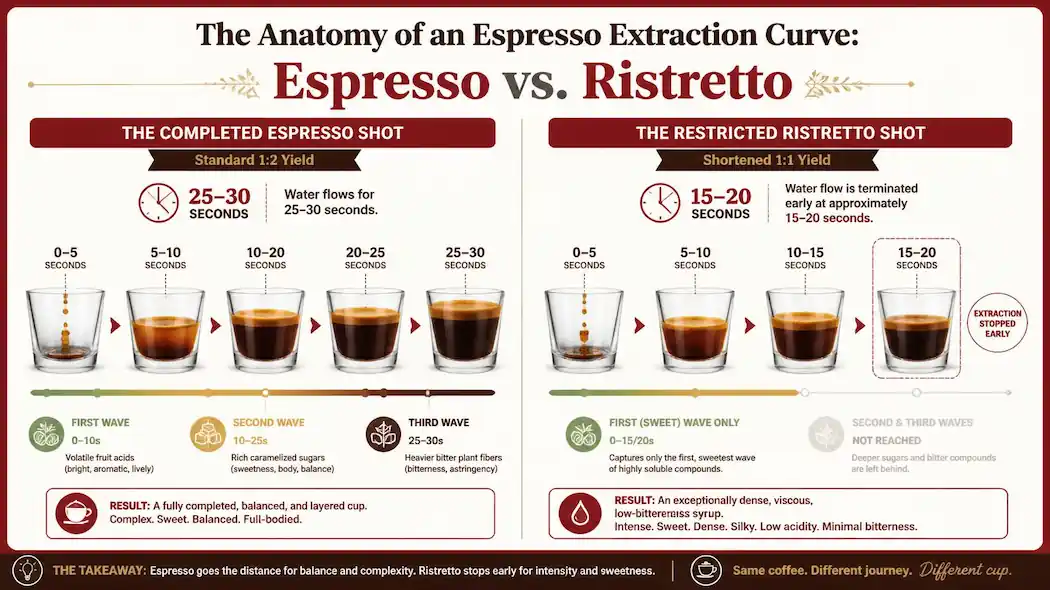
A traditional Ristretto is a short, concentrated espresso beverage prepared by restricting the amount of water that passes through the coffee grounds. The result is a smaller shot with a more concentrated flavour and a distinctive, often syrupy mouthfeel.
The word Ristretto comes from Italian and means restricted, shortened or limited. It describes the reduced volume of the finished coffee rather than a different type of coffee bean or a special espresso machine.
A Ristretto generally uses the same dry coffee dose as a conventional espresso but produces a smaller quantity of liquid. This is achieved by stopping the extraction at a lower beverage yield.
For example, a modern double-shot recipe might use 18g of ground coffee to produce:
- Ristretto: Approximately 18–27g of extracted coffee.
- Espresso: Approximately 36g of extracted coffee.
- Lungo: Approximately 54g of extracted coffee.
These are illustrative brew ratios rather than fixed international standards. The coffee, equipment and desired flavour profile all influence the recipe.
The shorter extraction changes the balance of dissolved compounds and produces a more concentrated drink. It can emphasise sweetness and body, although an excessively short or poorly adjusted shot may taste sharp, sour or underdeveloped.
For a useful introduction to the drink’s traditional preparation and modern interpretations, Perfect Daily Grind’s guide to Ristretto coffee explores how baristas approach the shorter extraction.

What Are the Mechanical and Technical Requirements to Pull a Perfect Ristretto?
Preparing a good Ristretto involves controlling the amount of coffee used, the grind size and the final liquid yield. The objective is to achieve a balanced, concentrated shot rather than simply stopping the machine as quickly as possible.
1. Maintain the coffee dose
Start with the same dry coffee dose you would normally use for your espresso recipe.
For example, an 18g dose in a double basket provides a useful starting point. Keeping the dose consistent makes it easier to compare the Ristretto with a conventional espresso.
2. Adjust the grind where necessary
A Ristretto often requires a slightly finer grind than the corresponding espresso recipe, although this depends on the coffee and machine.
A finer grind increases resistance to water flow and can help achieve the desired extraction within a shorter beverage yield.
However, grind size should be adjusted through tasting rather than automatically made finer for every coffee. Excessive resistance can produce an uneven or poorly balanced extraction.
Tamping should remain level and consistent. Increasing tamping pressure is not a reliable substitute for adjusting grind size.
3. Control the final beverage yield
The defining feature of a Ristretto is its reduced output.
A useful starting point is a brew ratio of approximately 1:1 to 1:1.5, meaning one part dry coffee to one to one-and-a-half parts extracted beverage by weight.
For an 18g dose, this would produce approximately 18–27g of coffee.
This is considerably less than a conventional 1:2 espresso recipe, which would produce approximately 36g.
4. Taste and refine the extraction
Do not assume that a shorter extraction is automatically a better one.
If the finished Ristretto tastes excessively sour, sharp or salty, it may be under-extracted. Small adjustments to grind size, temperature or yield can help produce a more balanced result.
The aim is to create a concentrated shot that retains clarity and sweetness without becoming harsh or excessively acidic.
The Specialty Coffee Association’s research into changing espresso preparation practices illustrates how widely espresso recipes and extraction preferences can vary among professional baristas.
How Does the Flavour and Texture Profile of a Ristretto Differ from an Espresso?
The principal difference between a Ristretto and a conventional espresso is the quantity of liquid collected from the same amount of ground coffee.
Because less water passes through the coffee, the resulting beverage is generally more concentrated. Its flavour and texture can therefore feel more intense, although concentration should not be confused with extraction yield.
The Espresso Profile
A conventional espresso uses a larger beverage yield, allowing more water to pass through the coffee bed.
A well-prepared espresso can offer a balanced combination of sweetness, acidity, bitterness and aromatic complexity. Its texture varies according to the coffee, roast and preparation method.
The Ristretto Profile
A Ristretto produces a smaller, more concentrated serving, often with a thicker and more syrupy mouthfeel.
Depending on the coffee and recipe, it may emphasise chocolate, caramel, fruit sweetness and heavier body.
However, it is important not to assume that a Ristretto simply captures the sweet compounds while leaving all the bitter compounds behind. Coffee extraction is not divided into perfectly separated stages, and the compounds responsible for sweetness, acidity and bitterness overlap throughout the brewing process.
A shorter yield can reduce the overall amount of dissolved material extracted, but the final flavour depends on how effectively the coffee has been extracted within that shorter volume.
If your shortened espresso extractions are finishing with an unpleasantly sharp, thin or bracingly sour taste rather than a balanced sweetness, take a look at our guide to why coffee tastes sour and how to fix it. It explains how grind size, water temperature and extraction time influence the finished cup.
When Should a Barista Choose a Ristretto Shot Over Standard Espresso?
A Ristretto is particularly useful when a barista wants a concentrated coffee with a distinctive texture and flavour profile.
Its smaller serving size makes it well suited to drinking straight, allowing the customer to experience the coffee without the additional water used in a conventional espresso.
It can also be used as the foundation for certain milk-based drinks.
Drinking Ristretto on its own
When served straight, a well-prepared Ristretto offers a compact, concentrated coffee experience.
Its smaller volume makes it ideal for customers who enjoy espresso but prefer a different balance of intensity, body and sweetness.
The quality of the beans is particularly important because there is little additional water to soften or dilute the finished flavour.
Using Ristretto in milk-based drinks
Some speciality cafés use Ristretto shots in milk-based beverages to create a concentrated coffee foundation.
The reduced beverage yield can provide a pronounced coffee presence beneath the milk, while a well-balanced extraction may contribute a smooth, rounded flavour.
This can work particularly well with drinks such as Flat Whites and Cappuccinos, where the espresso remains an important part of the finished flavour.
However, a Ristretto is not automatically sweeter or better suited to milk than conventional espresso. The result depends on the coffee, extraction recipe and amount of milk added.
Ristretto, Espresso and Lungo: Understanding the Differences
These three drinks belong to the same espresso family, but their different beverage yields produce distinct results.
| Feature | Ristretto | Espresso | Lungo |
|---|---|---|---|
| Meaning | Restricted or short | Expressed or pressed out | Long |
| Brew ratio guide | Approximately 1:1–1:1.5 | Approximately 1:2 | Approximately 1:3 |
| Water passing through grounds | Less | Standard quantity | More |
| Finished volume | Smallest | Medium | Largest |
| Typical texture | Concentrated and often syrupy | Balanced and full-bodied | More diluted and potentially lighter |
| Flavour tendency | Intense and concentrated | Balanced and layered | Can become more bitter or dry depending on extraction |
These ratios are useful starting points rather than rigid definitions. Individual cafés and baristas may use different recipes to suit their coffee and equipment.
The important distinction is that Ristretto, Espresso and Lungo are variations of espresso extraction, not three different types of coffee bean.
A Ristretto demonstrates how a relatively small adjustment to beverage yield can change the character of a familiar espresso, creating another way to appreciate the flavour and texture of carefully prepared coffee.
Visit the history and origins of the world’s most popular coffees, and explore how each much-loved drink found its place in coffee culture.


