

Table of Contents
The Mexican Coffee Production at a Glance
Mexico  The Organic Giant and Community Power
Mexican coffee plays an important role in the global coffee landscape. Situated between the established coffee-producing regions of Central America and the vast North American consumer market, Mexico offers a distinctive combination of chocolate sweetness, gentle nuttiness and balanced acidity.
Its rich agricultural heritage, organic smallholder communities and diverse mountain-growing regions have helped establish its place among the world’s recognised coffee origins.
Coffee is grown across several southern and eastern states, particularly Chiapas, Veracruz, Oaxaca and Puebla. Many farms operate on a relatively small scale, with coffee cultivation closely connected to indigenous communities, traditional agricultural practices and cooperative organisations.
Mexico is also an important international supplier of certified organic coffee. Its production combines conventional commercial cultivation with speciality lots that offer distinctive regional characteristics.
From the chocolate-led profiles of traditional washed coffees to the more delicate characteristics associated with Pluma Hidalgo in Oaxaca, Mexican coffee offers a fascinating range of origins worth exploring.


Official USDA Production Rankings and Regional Bean Characteristics

Variety
Arabica / Robusta

Growing Region
Chiapas, Veracruz, Oaxaca, Puebla

Processing Methods
Washed – Natural

Flavour Profile
Nutty, Chocolate

Harvest Season
November – April

Acidity
Medium
World Production Ranking
10th,

Production Per Year
4.08 Million 60 kg Bags

World Production Share
approx: 2.3%

Altitude
900–1,800 metres

Climate
Tropical – Highland

Body
Medium

Rankings and Production Source: USDA Foreign Agricultural Service – Coffee: World Markets and Trade, 2025/26.
Mexico: Organic Coffee, Smallholder Communities and Mountain Terroir
Mexico has a long and distinctive coffee-growing history, shaped by its mountainous landscapes, traditional farming communities and growing reputation for organic production.
From the southern highlands of Chiapas and Oaxaca to the coffee-growing slopes of Veracruz and Puebla, the country produces a diverse range of Arabica coffees.
Much of Mexico’s coffee industry is built around smallholder farmers, many of whom cultivate coffee within traditional shade-grown agricultural systems. These farms play an important role in maintaining local livelihoods and preserving the landscapes in which coffee is grown.
Mexico is also one of the world’s significant producers of certified organic coffee, with a strong network of smallholder organisations supplying international speciality and ethically focused coffee markets.
What is the historical origin and industry structure of Mexican coffee cultivation?
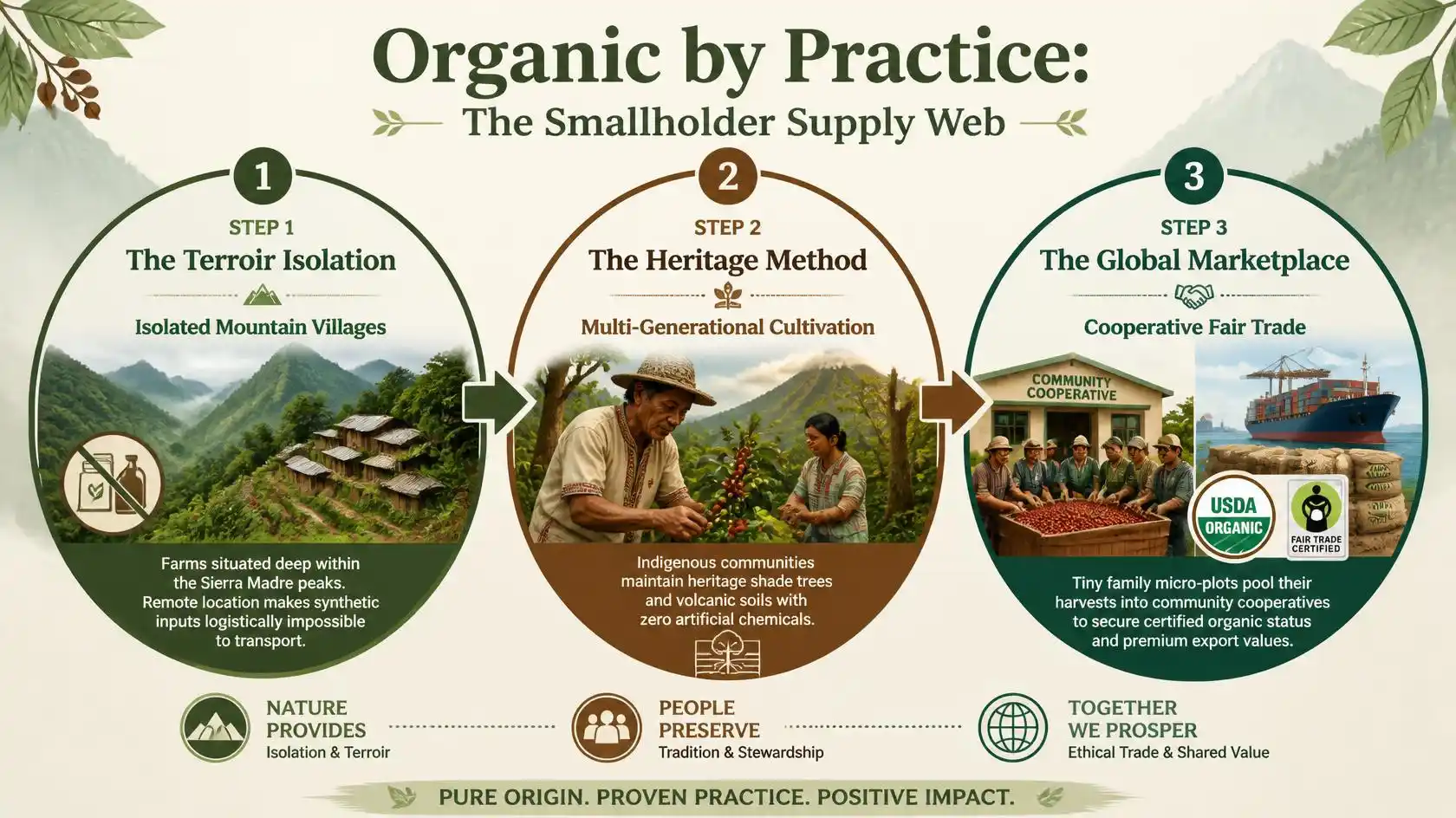
Coffee was introduced to Mexico towards the end of the eighteenth century, arriving during the period of Spanish colonial rule. It gradually spread through the country’s southern and eastern agricultural regions, where the warm, humid climate and mountainous terrain provided suitable conditions for cultivation.
Today, the principal coffee-producing states include Chiapas, Veracruz, Oaxaca and Puebla, although coffee is grown in several other parts of the country.
The importance of smallholder farming
Unlike some major coffee origins where production is dominated by large estates, Mexico’s coffee sector relies heavily on smallholder farmers. Many cultivate relatively small plots of land, often within indigenous communities that have maintained coffee-growing traditions across generations.
These farms are frequently situated in remote mountainous areas, where coffee is grown beneath a canopy of native shade trees. This traditional approach can help protect soil, support biodiversity and provide a more varied agricultural environment.
Smallholder farming is also closely connected to Mexico’s organic coffee movement. Many farmers and community organisations have developed certified organic production systems, particularly in Chiapas and Oaxaca.
However, it is important to distinguish between traditional low-input farming and formally certified organic production. A farm cannot automatically be described as organic simply because it uses few synthetic agricultural chemicals. Certification requires compliance with recognised production standards and inspection procedures.
Mexico’s organic coffee industry
Mexico has established itself as an important international supplier of certified organic coffee.
According to the USDA Foreign Agricultural Service report Mexico’s Organic Production and Trade, the country had approximately 88,173 hectares of organically cultivated coffee in 2023, supported by 41,911 organic coffee producers.
The report identifies coffee as Mexico’s most important organic crop by cultivated area and number of producers. It also highlights the significance of indigenous community organisations, particularly in Chiapas, Oaxaca and Puebla.
Read the USDA Foreign Agricultural Service report on Mexico’s organic production and trade.
These organisations help small-scale farmers access certification, processing facilities and international markets. Cooperatives can also improve their negotiating position by bringing together the production of many individual farms.
Mexico’s organic coffee sector therefore represents more than a production method. It is closely connected to rural livelihoods, community organisation and the ability of small producers to participate in international trade.
The country shares this important position in organic coffee production with other Latin American origins, including Peru.
What is Pluma Hidalgo coffee and how does it define Mexican coffee terroir?

Mexico’s speciality coffee reputation is closely associated with its southern mountain regions, particularly the Sierra Madre ranges. These landscapes provide a combination of altitude, rainfall, shade and varied soils that influence the development of the coffee crop.
Among the country’s best-known regional coffee identities is Pluma Hidalgo, associated with the mountainous region of Oaxaca.
Pluma Hidalgo: A distinctive Oaxacan coffee
Pluma Hidalgo takes its name from a town in Oaxaca that has become closely associated with the area’s coffee-growing heritage.
The name is used in connection with both a recognised coffee variety and a regional coffee identity. The Mexican government formally recognised the Denomination of Origin Pluma in 2020, defining a production area across 30 municipalities in Oaxaca.
The official designation identifies Typica as the original variety and also recognises Pluma Hidalgo, alongside several other Arabica varieties cultivated within the region.
This is an important distinction: Pluma Hidalgo should not simply be described as a confirmed natural mutation of Typica. Its history and relationship with Typica are part of a more complex regional coffee heritage.
Coffee from the Pluma area is associated with a pleasant bouquet, pronounced acidity, excellent aroma and relatively light body. These characteristics are recognised in the official denomination description, although the final cup will also depend on the farm, harvest, processing and roasting.
Understanding Mexican coffee terroir
The Sierra Madre mountain system extends across several parts of Mexico, but its different ranges and slopes create distinct growing environments.
The Sierra Madre del Sur is particularly important to Oaxaca’s coffee-growing landscape, while Chiapas has extensive coffee cultivation along the southern highlands and Sierra Madre de Chiapas. Veracruz, meanwhile, has its own coffee-growing areas along the eastern mountain slopes.
These environments provide different combinations of elevation, temperature, rainfall and soil composition.
The result is considerable variation between Mexican coffees, even when they come from neighbouring growing areas.
Understanding Mexican coffee altitude classifications
When buying Mexican coffee, you may encounter descriptions such as Strictly High Grown (SHG) and Height Grown Mexican (HGM).
These terms relate to growing elevation and coffee grading, but they should not be treated as identical classifications.
- SHG – Strictly High Grown: A designation used for coffee cultivated at higher elevations. In some Mexican grading references, SHG is associated with farms above approximately 1,200 metres.
- HGM – Height Grown Mexican: A Mexican origin-related grading description used to identify high-grown coffee. Its precise application should be checked against the relevant grading or exporter specification rather than assumed to have one universal altitude threshold.
Higher elevations can encourage slower cherry maturation because of cooler temperatures. However, altitude alone does not guarantee superior cup quality. Variety, agricultural management, harvesting, processing and storage all play important roles.
What does Mexican coffee taste like and what are its core sensory markers?
Mexican Arabica is often appreciated for its balanced and approachable character. Many washed coffees display a combination of chocolate sweetness, gentle acidity and nutty flavours, making them popular both as single-origin coffees and as components of blends.
Typical tasting descriptions include:
- Milk chocolate and cocoa: A rounded sweetness that provides a familiar foundation.
- Brown sugar and caramel: Soft sweetness that can add depth and balance.
- Toasted nuts: Often described as almond or hazelnut characteristics.
- Citrus: A brighter acidity that can bring freshness to the cup.
- Pear and stone fruit: Some speciality lots offer delicate fruit characteristics that lift the overall profile.
These are common tasting descriptions rather than a fixed national flavour signature. A coffee from Chiapas may taste quite different from one grown in Oaxaca or Veracruz.
How do growing conditions influence flavour?
Several factors contribute to the sensory character of Mexican coffee.
Altitude and temperature can influence cherry maturation and the development of the coffee seed. Cooler growing conditions may encourage a longer maturation period.
Shade cultivation can moderate exposure to direct sunlight and create a more varied growing environment. Many traditional Mexican farms use shade trees as part of their agricultural system.
Processing methods also make a significant difference. Washed coffees often display a cleaner, more defined cup, while naturally processed coffees can develop more pronounced fruit characteristics.
For readers interested in troubleshooting their own brewing results, our guide to why coffee tastes bitter explains how grind size, water temperature and extraction time can influence bitterness and dryness.
What are the optimal brewing techniques and roasting approaches for Mexican coffee?
Mexican coffee is versatile and can work well across a variety of brewing methods. Its often balanced sweetness and moderate acidity make it a useful origin to explore with both paper-filtered brewing and immersion techniques.
Two approaches are particularly worth considering.
1. Paper-filtered pour-over brewing
A Hario V60 or Drip Filter is a good starting point for exploring the more delicate characteristics of a Mexican single-origin coffee.
Paper filtration removes much of the fine sediment and coffee oils, producing a cleaner cup in which individual flavour notes can be easier to distinguish.
Suggested starting recipe:
- Coffee: 15g
- Water: 225g
- Coffee-to-water ratio: 1:15
- Water temperature: 93°C
- Grind: Medium, adjusted to suit the brewer
- Bloom: 30–45 seconds
- Total brewing time: Approximately 2½–3½ minutes
This recipe provides a starting point rather than a strict rule. You can adjust the grind and ratio to bring out more sweetness, acidity or body, depending on the coffee.
2. Roasting Mexican coffee
Mexican Arabica can be roasted across a range of profiles, depending on the characteristics of the green coffee and the intended brewing method.
Light to medium roasts are useful when the aim is to preserve delicate acidity, sweetness and regional characteristics. These profiles can work particularly well with high-quality speciality lots from Oaxaca and Chiapas.
Medium roasts can bring chocolate, caramel and nutty flavours into greater prominence while retaining some of the coffee’s original character.
Medium-dark roasts can produce a deeper cocoa profile and a fuller roasted flavour, making them suitable for drinkers who prefer a more traditional cup or want a coffee for espresso blends.
As with any origin, roasting too darkly can mask the more delicate characteristics of the green coffee. The best approach is to match the roast to the quality and intended flavour profile of the particular lot rather than assume that all Mexican beans respond in the same way.
Mexican coffee: Small farms, distinctive origins and a growing international reputation
Mexico’s coffee industry is built on a combination of traditional agricultural knowledge, smallholder farming and increasingly recognised regional identities.
Its organic coffee movement has helped many farming communities access international markets, while regions such as Chiapas, Veracruz and Oaxaca continue to develop their own reputations within the speciality coffee world.
Pluma Hidalgo provides a particularly interesting example of how a local coffee-growing heritage can become recognised through geographical identity and denomination of origin protection.
From the chocolate sweetness of traditional washed coffees to the more expressive characteristics of high-grown speciality lots, Mexican coffee offers plenty of variety to explore.
Its importance lies not simply in the volume it produces, but in the farming communities, regional traditions and distinctive landscapes that shape every harvest.

The Shade-Grown Sanctuary
“Mexico is a champion of ‘Shade-Grown’ coffee.
The coffee trees are planted under the canopy of native forests, which protects the local bird populations.
For the reader of The Coffee Guide, this means that choosing a Mexican single-origin is often an environmental choice as much as a flavour choice.”
From the organic highlands of Chiapas to the smooth, light-bodied cups of Oaxaca, Mexico offers a unique profile in the Americas.
See where Mexico sits on the global map in our guide to The Coffee Belt.


