

Table of Contents
Ever wonder how the drinks on your favorite cafe menu actually came to be? This deep-dive guide into the origins of the worlds most popular coffees is designed as a quiet space to explore the rich history, recipes, and craftsmanship behind the beverages that shape our everyday coffee culture. Every single drink is broken down with care—no noise, no robotic jargon, just clear explanations and a pure focus on the craft.
In my years running a brick-and-mortar coffee shop and managing event catering, navigating the subtle differences between a short, long, strong, or velvety milk brew was the very first thing I taught our team. Whether you are completely new to the basics or looking to refine your home barista technique, this guide brings the global menu together to show you exactly how these classic styles developed from their traditional roots straight into your morning cup.
A Masterclass in Drink Origins
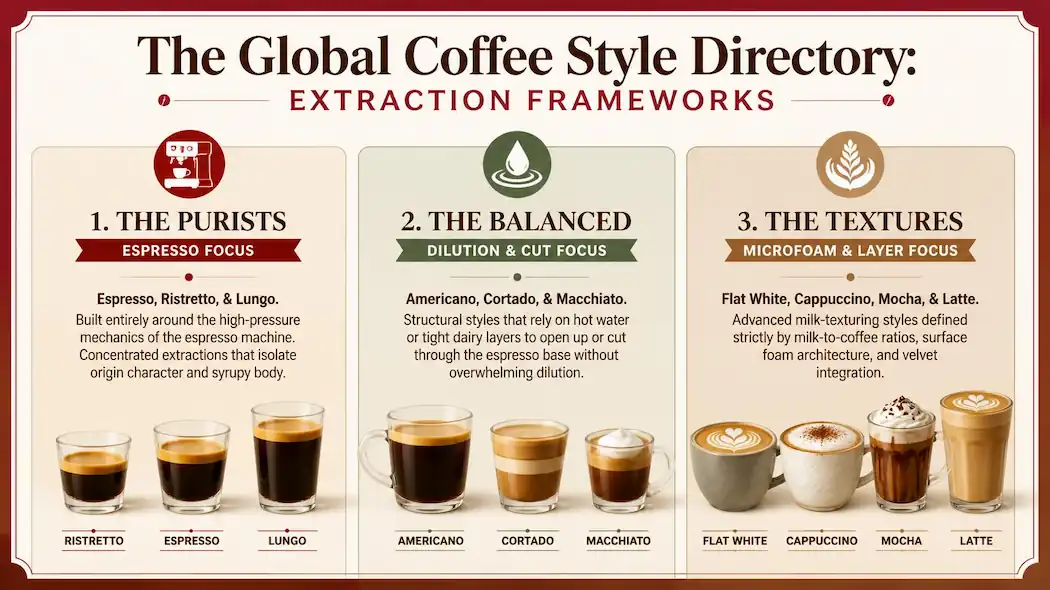
| Row | Left | Centre | Right |
| Row 1: The Purists | Espresso | Ristretto | Lungo |
| Row 2: The Balanced | Americano | Cortado | Macchiato |
| Row 3: The Textures | Flat White | Cappuccino/Mocha | Latte |

Espresso: Expressly For You
The story of espresso isn’t just about a drink; it’s about the Industrial Revolution meeting the classic Italian coffeehouse. It represents the exact moment in history when coffee became “fast.”
The Etymology: What “Espresso” Actually Means

There is a common misconception that the word simply means “express” (like a fast train), but its Italian root goes much deeper. Literally, espresso translates to “pressed out” or “expressed.” Historically, it carried an intentional meaning: “expressly for you.” Before the invention of the espresso machine, coffee was almost always brewed in massive batches and left to sit. An espresso was a luxury—a single cup made specifically for the individual customer who ordered it, at that exact moment.
It’s all in the Machine
Today, when we think of espresso, we think of the heavy commercial machines that shape the drink into its modern form. Because the word itself rings with the culture of Italy, it is no surprise that the very first espresso machine was invented and patented by an Italian innovator looking to speed up the morning rush. In my years running a coffee shop, I always loved sharing this history with our staff; it reminds you that every single shot you pull is still a customized, personal craft made expressly for the person standing across the counter.
To find out who he was and how the Espresso machine evolved Read all about it Here →
Cappuccino: The Monk’s Masterpiece

If the espresso is a product of the machine, the Cappuccino is a product of the cloth. Named for the humble, wood-toned robes of the 16th-century Capuchin Friars, this iconic drink transformed coffee from a dark, industrial shot into a balanced work of art. It serves as the ultimate historical bridge between the austere monasteries of old Europe and the vibrant, steam-filled bars of modern Italy.
To truly master the traditional Cappuccino is to master the ‘Monk’s Head’—a precise, symmetrical architecture of velvety milk foam encircled by a rich ring of espresso crema that has remained the global gold standard for milk-based coffee for over a century.
In my coffee shop and catering days, teaching a new barista how to consistently pour a flawless Monk’s Head was always a milestone moment. It requires a perfect balance of micro-foam density and pouring angles, proving that a monastic dress code from centuries ago can still be a living, breathing masterpiece of flavor behind a modern espresso bar. Read The Cappuccino Story →
Caffè Latte: The Canvas of Modern Café Culture

The Latte—or Caffè Latte—is arguably the most widely recognized espresso-based drink in the world. At its core, the latte is defined entirely by its specific proportions: typically combining one or two shots of rich espresso with a generous volume of steamed, textured milk, all finished with a thin, silky layer of microfoam. Compared to a traditional cappuccino, the latte contains a much higher volume of milk and a much thinner layer of foam. This precise ratio softens the espresso’s raw intensity, beautifully emphasizing its natural sweetness and reducing any perceived bitterness while still preserving the coffee’s underlying origin characteristics.
Because of this incredible balance and approachability, the latte has naturally become the absolute cornerstone of the modern café menu. In my coffee shop and catering days, it was always our highest-volume seller, serving as the ultimate versatile base for everything from vanilla syrups to seasonal specialty creations.
Our ongoing brewing trials here at The Coffee Guide constantly show that pulling a flawless latte requires meticulous milk steaming; when prepared with a perfectly extracted espresso shot and velvet microfoam, a true latte should taste luxuriously creamy and balanced rather than weak or diluted—delivering a gentle sweetness, a light-to-medium body, and a clean, satisfying finish that home baristas can easily master with a little practice. Delve Deeper Here →
Latte Macchiato: The Layered Masterpiece
The Latte Macchiato has a particularly interesting story because, unlike almost every other espresso-based drink on the menu, milk is the absolute starting point rather than the coffee.

The name itself translates roughly as “stained” or “marked milk”—a direct reference to a hot shot of espresso being poured slowly over the top of pre-steamed milk, effectively marking its pristine white surface with coffee.
In my coffee shop and catering days, serving a latte macchiato was always a great way to showcase a barista’s pouring technique. Because espresso is lighter than the dense, hot milk below it but heavier than the light microfoam on top, pouring the shot slowly creates three beautiful, distinct visual layers inside a tall glass. That single difference in construction is responsible for the drink’s striking, decorative appearance, making it a highly popular choices for customers who want a visual treat alongside a creamy, gentle coffee profile.
Learn how a Latte Macchiato develops three layers
Back to the Top →
Flat White: The Modern Rebellion Against “Big Foam”

Born from a fierce 1980s rivalry between Australia and New Zealand, the Flat White represents the modern rebellion against the massive, airy foam caps of the past. It was created for the purist—those who demanded the true punch and strength of a short espresso, but with the liquid-silk texture of perfectly steamed milk. It is the exact drink that went on to define the “Third Wave” coffee movement, trading stiff peaks for sophisticated micro-foam.
Unlike its traditional cousins on the menu, the Flat White is a study in complete ingredient integration rather than visual layers. In my coffee shop and catering days, mastering the flat white was always the ultimate test for a new hire. It requires a barista’s highest level of technical skill to correctly “stretch” milk into a glossy, velvety sheen that amplifies, rather than hides, the delicate origin character of the bean.
Our hands-on testing behind the counter here at The Coffee Guide shows that when you hit this sweet spot, the micro-foam folds seamlessly into a double shot of espresso. This gritty, sun-drenched history is what allowed a simple Southern Hemisphere creation to conquer the modern specialty world, one silky pour at a time. It’s All Here→
Cappuccino vs Latte vs Flat White: The Direct Comparison Matrix
To help you quickly visualize how these three popular espresso-and-milk favorites stack up against each other, our brewing team here at The Coffee Guide has mapped out their traditional, classic proportions:
| Drink Style | Espresso Base | Steamed Milk Layer | Microfoam Layer | Final Cup Character |
|---|---|---|---|---|
| Cappuccino | 1 Shot (roughly 30ml) | Equal Part (roughly 30ml) | Deep & Bubbly (roughly 30ml) | Airy, light, and focused heavily on a rich foam texture. |
| Café Latte | 1-2 Shots (30-60ml) | Generous Volume (150-180ml) | Thin Layer (roughly 5-10mm) | Milky, smooth, creamy, and incredibly approachable. |
| Flat White | Double Ristretto/Espresso (60ml) | Moderate Volume (120ml) | Velvety Microfoam (roughly 5mm) | Strong, intensely coffee-forward, and liquid-silk texture. |
The Barista’s Quick Rule
When ordering at the counter or brewing at home, keep this simple rule in mind: Want deep, thick foam? Choose a Cappuccino. Want a creamy, mild beverage? Choose a Latte. Want a strong, coffee-forward drink with a velvety sheen? Go for a Flat White.
Mastering the Underlying Espresso Base
Our hands-on testing behind the counter here at The Coffee Guide constantly proves that mastering these specific milk volumes requires flawless underlying extraction mechanics. In my coffee shop days, I saw how easy it was to mask a bad espresso with too much milk—but for a truly spectacular cup, your base shot has to be perfect.
If your home machine pulls are tasting unpleasantly sharp, hollow, or under-extracted before you even begin texturing your milk, check out our master troubleshooting guide to understand why does my coffee taste sour. We break down exactly how to manage your grind variables and balance your brewing variables smoothly.
Ristretto: The Concentrated Sweet Spot

A short, intensely concentrated take on a traditional espresso shot, the Ristretto is the ultimate hidden gem of the coffee menu. It uses the exact same dry coffee dose as a standard shot, but it is pulled with roughly half the amount of water and a much tighter extraction window. Because it cuts off the water stream early, it captures only the highly soluble fruit acids and natural sugars, completely dodging the bitter compounds that dissolve at the end of a full pour.
In my coffee shop and catering days, using a short ristretto shot in some of the milky drinks was our secret weapon for cutting out bitterness, allowing us to craft incredibly smooth, rich milk drinks where the natural sweetness of the bean truly shined. The result is a syrupy, bold shot that is packed with dense origin character.
To fully master the unique extraction physics, grind parameters, and recipes behind this specialized pour, check out our complete master guide to the Ristretto brewing method. We’ll show you exactly how to calibrate your grinder and master the tighter pour window to unlock a luxuriously sweet shot every single morning.
Americano: The Wartime Bridge

The story of the Americano represents two completely different cultures meeting on the battlefields of World War II. When American soldiers arrived in Italy, they found the local, high-pressure espresso to be a startling shock to their systems. To recreate the familiar, comforting “Cup of Joe” from their homeland, they began diluting the intense Italian shots with mugs of hot water—a move the locals initially viewed as a complete sacrilege, but eventually embraced as a global menu staple.
Today, the Americano is the ultimate test of an espresso’s true character. Because there is zero milk to hide behind, the raw quality of the bean and the precision of your grind are laid bare for the drinker. In my coffee shop and catering days, I always looked at the Americano as the drink of the purist—someone who seeks the comforting volume of a long cup of coffee without sacrificing the complex soul of a true espresso base.
There’s more to the Story here →
Lungo: The Chemistry of Time

To the untrained eye, a Caffè Lungo might look like a small Americano, but to the palate, they are completely worlds apart. While an Americano relies on post-extraction dilution—adding hot water to a finished shot—the Lungo is a fascinating lesson in the chemistry of time.
By allowing the espresso machine to run for nearly twice the usual duration, the water interacts with the coffee grounds for much longer, pulling out high-tonality flavors and heavy plant compounds that a standard shot leaves behind. In my coffee shop days, pulling a proper Lungo was always a balancing act; it requires a slightly coarser grind and a sharp eye to ensure that the extended extraction delivers a uniquely bitter-sweet, robust profile rather than a flat, over-extracted mess. Get to Know a Lungo Here →
Caffè Mocha: The Indulgent Balance

The Mocha—or Caffè Mocha—is one of the most recognizable espresso-based drinks in modern café culture, combining the rich depth of coffee and chocolate into a smooth, indulgent balance. Built on a rich foundation of espresso, a proper mocha expertly blends quality chocolate syrup or cocoa powder with perfectly steamed milk. This precise combination creates a luxurious cup that softens the espresso’s raw intensity without causing the drink to lose its underlying structural character.
In my coffee shop and catering days, the mocha was always our ultimate crowd-pleaser, especially during the colder winter months. Through our ongoing recipe trials here at The Coffee Guide, we always remind home baristas that the secret to a world-class mocha lies in using a robust, low-acidity espresso base—like a classic Brazilian natural—to ensure the coffee flavor punches through the sweetness rather than getting completely drowned out by the cocoa. Learn the History of a Mocha here →
Espresso Macchiato: The Stained Shot

The traditional Macchiato—more precisely, the Espresso Macchiato—is a short, concentrated drink designed to slightly soften the raw intensity of a straight espresso without completely transforming its character. The word macchiato means “stained” or “marked” in Italian, which perfectly describes the mechanics of the beverage. In this traditional context, it refers to a bold shot of espresso that has been marked with a single small spoonful of lightly texturized milk foam placed right on top of the crema.
In my coffee shop and catering days, the macchiato was easily the most misunderstood drink on our menu. We frequently had to gently remind customers that a traditional macchiato is a strong, punchy three-ounce drink, not a massive, sweet milk beverage.
Our brewing team here at The Coffee Guide loves celebrating this classic style because it represents the perfect middle ground for purists; the microscopic splash of milk breaks the sharpest bitter edges of the extraction while allowing the true origin notes of the underlying coffee bean to stay fully on display. There’s more on the Macchiato over here →
Cortado: The Spanish Minimalist Favorite

The Cortado is a beautifully balanced, minimalist espresso drink built on equal proportions of rich espresso and warm, texturized milk. Originating in Spain, its name comes from the Spanish word cortar, meaning “to cut”—which perfectly describes how a splash of velvety milk gently cuts through the intense, raw acidity of the espresso base without drowning it out.
In my coffee shop and catering days, the cortado was always the ultimate staff favorite behind the counter. Because it sits right at a perfect 1:1 ratio, it delivers a smooth, mellow finish while preserving the true strength, body, and distinct origin characteristics of the bean. It is the absolute perfect choice for anyone who wants a bold, coffee-forward drink that is entirely free of the heavy, overwhelming volume of milk found in a standard latte. Discover More →
From the Port of Mokha to the Modern Cup
These twelve iconic drinks represent centuries of steady refinement, tracing a proud lineage from the ancient docks of Al-Mokha, through the first European cafes of Venice, straight to the revolutionary coffeehouses of 17th-century London, and finally to the precision of today’s specialty craft.
Whether you prefer the raw intensity of a short Ristretto or the perfectly balanced architecture of a Cortado, you are participating in an ancient global ritual that has fueled human conversation and massive commerce for over four hundred years.
Here at The Coffee Guide, we are incredibly proud to help you navigate this massive, delicious landscape. In my years running coffee shops and setting up catering menus, I learned that every single cup tells a unique story—and by mastering these recipes at your own kitchen counter, you are keeping that incredible global craft alive.
Ready to see where it all began? Explore the History of the London Coffee House


