

Table of Contents
How did the Viennese coffee house tradition originate following the Siege of 1683?

The historical foundations of the iconic Vienna coffeehouse were established in 1683, following the military defeat and retreat of the Ottoman Empire’s army from the city gates. The fleeing forces abandoned hundreds of heavy sacks containing mysterious green seeds, which local Viennese soldiers completely mistook for camel fodder and prepared to burn.
Our deep-dive historical research here at The Coffee Guide shows that a Polish spy named Jerzy Kulczycki, who had extensive experience living in the East, recognized the true value of the seeds and claimed the sacks as his official reward for military bravery. Kulczycki used this abandoned inventory to open one of Vienna’s legendary early coffeehouses, The Blue Bottle.
Behind the counter, Kulczycki was a true retail pioneer: realizing the locals found the dark, bitter brew unpalatable, he began filtering the grounds and adding milk and honey, essentially inventing the classic European coffee menu we still use today.
While folklore celebrates The Blue Bottle, imperial court archives indicate that Vienna’s very first official commercial privilege to brew coffee was actually granted in 1685 to an Armenian merchant and intelligence agent named Johannes Diodato—giving the city’s famous cafe culture a wonderfully rich, mysterious foundation.

What technical adjustments birthed the classic Viennese coffee beverage profile?
When coffee was first introduced to Vienna, the local population found the intensely bitter, unfiltered, and black traditional Turkish preparation method far too harsh for Western palates. To adapt the beverage for the local market, Jerzy Kulczycki introduced two pioneering processing steps that permanently altered European coffee service:
| Viennese Technical Phase | Traditional Turkish Method | Kulczycki’s Innovation | Impact on the Cup Profile |
|---|---|---|---|
| The Filtration Phase | Leaving heavy, muddy grounds settling in the cup. | Systematically straining the liquid to trap the sediment. | Produces a significantly smoother, cleaner beverage texture. |
| The Additive Layer | Serving the drink completely black and unsweetened. | Blending the filtered liquid with fresh cream and honey. | Softens the sharp extraction edges, creating a rich, velvety body. |
This classic combination created the famous Wiener Melange, which served as the global historical blueprint for all modern milk-based espresso drinks.
In my coffee shop and catering days, dialing in a bean profile to cut through milk without turning muddy was always a fine art. If your manual extractions of these classic milk-based profiles at home are turning out unpleasantly harsh, dry, or muddy before you even add your dairy, review our master troubleshooting guide over at The Coffee Guide to understand why does my coffee taste bitter. We’ll show you exactly how to tune your brewing variables and water parameters to find that perfect balance cleanly.
What architectural and cultural elements define the traditional Viennese Kaffeehaus?
Rather than operating as quick, grab-and-go beverage stalls, the Viennese Kaffeehaus network was thoughtfully designed to serve as a quiet, unhurried, and comfortable extension of everyday civic life.
Our deep-dive historical research here at The Coffee Guide shows that the classic layout introduced several standardized design fixtures that became iconic, including small marble-topped tables, elegant Thonet bentwood chairs, and cozy, private alcoves. This clever spatial design created the perfect intellectual hub for socializing, reading the daily papers, writing literature, and engaging in high-level political debate.
Additionally, the staff played a massive role in this culture; waiters were trained to provide incredibly polite, discreet table service. Having managed seating layouts and floor service in my own coffee business, I absolutely admire this model—it allowed a customer to sit completely undisturbed at a table for hours on end after ordering just a single drink.
Why is Viennese coffee house culture protected as a UNESCO Intangible Cultural Heritage?
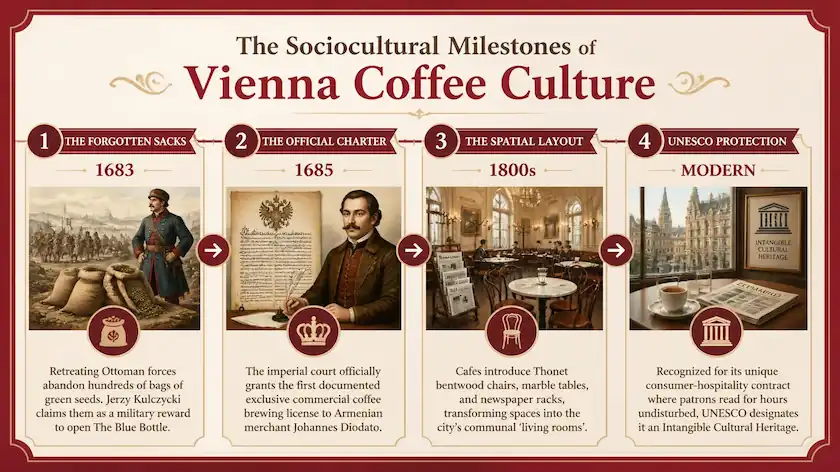
The Viennese coffeehouse earned the historic moniker of the “city’s living room” due to its highly unique hospitality model. Cafes traditionally provided an extensive library of daily newspapers mounted on specialized wooden racks, actively encouraging patrons to read global news for hours on end without any commercial pressure to purchase additional food.
Alongside premium coffee, which is always served with a mandatory, refreshing glass of pure water to cleanse the palate, these spaces integrated artisan pastries and cakes into the daily neighborhood routine. Because of this deeply embedded preservation of community life, local literature, and democratic debate, UNESCO officially protects Viennese Coffee House Culture as an Intangible Cultural Heritage.
Having spent years managing hospitality teams, I find this model inspiring—it proves that a great cafe isn’t just about selling a product; it’s about creating a safe, welcoming sanctuary for the community. Here at The Coffee Guide, that is exactly the spirit we aim to celebrate.

The “Kolschitzky” Legacy
Even today, in the streets of Vienna, you can find a statue of Kulczycki. If you enjoy a latte or a flat white, you are essentially drinking his 1683 recipe. The Viennese were the first to realize that coffee and dairy were a match made in heaven.
From the Sufi’s prayer to the Viennese cream, the coffee bean has spent 1,200 years evolving.
Today, as we step into a modern café, we aren’t just buying a drink—we are participating in the final chapter of a global revolution.”
The European Coffee Journey
← Previous: [Paris 1669: The Glamour of the Salon]
Explore the Full Series: [Back to The Coffee Guide European History Masterpage]


