

Table of Contents

Arabica coffee production is the most widely produced coffee species in the world, valued for its aromatic complexity, balanced sweetness and wide range of flavour profiles. From its origins in the highland forests of Ethiopia to coffee farms across Latin America, Africa and Asia, Coffea arabica has become central to the global coffee industry.
Its popularity is closely connected to its distinctive cup characteristics, but there is much more to Arabica than flavour alone. Its botanical history, genetic diversity, growing requirements and sensitivity to environmental conditions all contribute to the coffee we enjoy today.
In this guide, we explore where Arabica originated, how it spread around the world, what makes the plant distinctive and why it continues to dominate coffee production.
Where Did Arabica Coffee Originate?
Arabica coffee (Coffea arabica) is native to the highland forests of southwestern Ethiopia, where wild populations still provide an important source of genetic diversity.
Although the plant originated in Ethiopia, Yemen played a crucial role in the development of cultivated coffee. Coffee seeds were taken from Ethiopia across the Red Sea, and cultivation became established in Yemen. From there, coffee gradually spread through trade routes to other parts of the world.
By the seventeenth century, Arabica plants had reached India, and later introductions to Southeast Asia, the Caribbean and the Americas helped establish the foundations of modern commercial coffee production.
Much of today’s cultivated Arabica can trace its ancestry through two important genetic lineages: Typica and Bourbon. These lineages developed from early cultivated material associated with Yemen and subsequently spread to different coffee-growing regions.
The history is more varied than these two lineages alone, however. Ethiopia retains substantial genetic diversity, while later selections, mutations and breeding programmes have produced many additional varieties.
For a more detailed account of Arabica’s historical development and its major genetic groups, see the World Coffee Research Arabica varieties guide.
Why Does Arabica Coffee Production Dominate Globally?
Arabica accounts for approximately 60% of global coffee production, making it the leading coffee species cultivated and traded worldwide. Its importance reflects decades of agricultural development, consumer demand and the value placed on its diverse sensory characteristics.
Brazil, Colombia, Ethiopia, Honduras and Peru are among the important Arabica-producing countries, each offering different growing environments and regional flavour characteristics.
The species is particularly prominent in the roasted and ground coffee market, where its range of flavour profiles makes it suitable for single-origin coffees, speciality roasting and blends.
However, Arabica’s dominance does not mean it is the easiest coffee to cultivate. Compared with Robusta (Coffea canephora), Arabica is generally more sensitive to temperature, pests and diseases. This makes careful site selection and crop management particularly important.
The Food and Agriculture Organization (FAO) coffee overview provides further information about Arabica’s contribution to global coffee production and its importance to the agricultural economy.
What Are the Botanical Characteristics of Arabica Coffee?
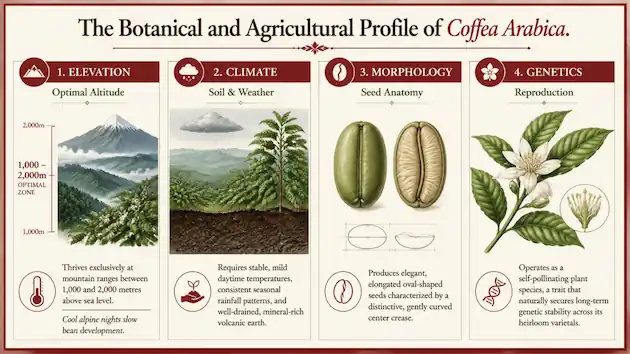
Arabica is an evergreen coffee species belonging to the Rubiaceae family. Under suitable conditions, the plant can develop into a sizeable shrub or small tree, although commercial farms commonly prune and manage its growth to make harvesting easier.
Several botanical characteristics distinguish Arabica from other commercially important coffee species.
1. Self-Fertile Flowers
Arabica is predominantly self-pollinating, meaning that its flowers can be fertilised using pollen from the same plant. This is an important reproductive characteristic and differs from Robusta, which is generally self-incompatible and relies more heavily on cross-pollination.
Self-fertility does not mean that all Arabica plants are genetically identical. The species contains different varieties and populations, each with its own inherited characteristics.
2. Chromosome Structure
Arabica has 44 chromosomes, making it an allotetraploid species. Its genetic history is unusual because it originated through a natural hybridisation event involving two ancestral coffee species, Coffea canephora and Coffea eugenioides.
This evolutionary history helps explain some of the distinctive characteristics of Arabica and its relatively narrow genetic diversity compared with several other coffee species.
3. Seed Shape and Appearance
Arabica coffee cherries generally contain two seeds, commonly called coffee beans. These seeds are typically oval or elongated, with a characteristic curved crease running along the flatter inner surface.
Their size, shape and appearance can vary according to variety, growing conditions and development.
4. Caffeine Content
Arabica generally contains less caffeine than Robusta. Typical values are often around 1–1.5% of the dry bean weight, although the actual concentration varies between varieties and growing conditions.
Caffeine is one of several natural compounds that contribute to coffee’s chemical composition and influences the plant’s defence against certain insects and other biological threats.
What Growing Conditions Does Arabica Coffee Need?
Arabica is particularly associated with highland coffee-growing regions, where moderate temperatures and suitable rainfall allow the cherries to develop under favourable conditions.
A commonly used guide is an elevation of approximately 1,000–2,000 metres above sea level, although Arabica can grow successfully outside this range depending on latitude, local climate, variety and agricultural management.
Elevation and Temperature
Arabica generally favours cooler growing environments than Robusta. Moderate temperatures can support steady plant development and a suitable cherry-ripening period.
Higher elevations often provide cooler conditions, but altitude alone does not guarantee better coffee. Soil, rainfall, shade, variety, farm management and harvesting practices all influence the final quality.
Rainfall and Soil
Consistent rainfall is important for healthy growth, flowering and cherry development. However, the timing and distribution of rainfall matter just as much as the total amount.
Arabica generally performs best in well-drained soils that provide sufficient nutrients and support healthy root development. Waterlogged conditions can damage roots and encourage disease.
Seasonal Conditions
A suitable balance of wet and dry periods can help regulate flowering and fruit development. The precise seasonal pattern differs between coffee-producing countries and even between individual growing regions.
Arabica is also vulnerable to excessive heat, frost and certain pests and diseases. As temperatures change, some traditional growing areas may become less suitable, placing greater importance on climate adaptation and resilient coffee varieties.
How Does High-Altitude Growing Influence Arabica’s Flavour?
One of the reasons Arabica is so highly regarded is the variety of flavours that can develop in its beans.
In many highland growing regions, cooler temperatures can slow the development and ripening of coffee cherries. This may allow more time for the seeds to develop, although the relationship between altitude, ripening speed and cup quality is influenced by several environmental and agricultural factors.
The resulting coffee can display a wide range of sensory characteristics, including:
- Acidity: Bright, lively or delicate acidity, sometimes reminiscent of citrus fruit.
- Sweetness: Natural sweetness that may suggest caramel, honey or ripe fruit.
- Aroma: Floral, fruity, nutty or chocolate-like aromatic characteristics.
- Body: A mouthfeel ranging from light and delicate to rounded and full.
The flavour of Arabica is not determined by altitude alone. Genetics, soil, climate, processing and roasting all play important roles.
For example, an Ethiopian coffee may display floral and citrus characteristics, while some Brazilian Arabicas are associated with chocolate, nuts and caramel. These are broad regional tendencies rather than fixed rules, and individual coffees can differ considerably.
This diversity is one of the reasons Arabica is so popular with speciality coffee roasters and people who enjoy exploring different origins.
Why Is Arabica Often Less Bitter Than Robusta?
Arabica is commonly described as smoother and less bitter than Robusta, partly because it generally contains less caffeine.
Caffeine has a naturally bitter taste, so differences in caffeine concentration can contribute to the way the two species are experienced in the cup.
However, caffeine is not the only compound responsible for bitterness. Other naturally occurring substances, together with roasting and brewing conditions, influence the final taste.
Arabica’s wider range of aromatic compounds and its potential for sweetness and acidity can help create a more balanced sensory experience. This is one reason it is often favoured for coffees where delicate flavours and aromatic complexity are important.
It is important to remember that Arabica is not automatically smooth or free from bitterness. A dark roast, unsuitable brewing recipe or excessive extraction can produce a bitter cup, regardless of the coffee species.
Equally, carefully cultivated and processed Robusta can produce a more balanced and enjoyable coffee than its traditional reputation might suggest.
What Are the Most Recognised Arabica Coffee Varieties?
Arabica contains numerous varieties, each with different characteristics relating to plant growth, productivity, disease resistance and potential cup quality.
Some of the best-known examples include:
Typica : One of the historically important Arabica lineages. Typica has played a major role in the spread of cultivated coffee around the world.
Bourbon : Another major lineage, recognised for its importance in the development of many cultivated Arabica varieties. Bourbon has contributed to numerous selections and regional coffee populations.
Geisha (Gesha): An Ethiopian-origin variety that became internationally celebrated through its outstanding performance in Panama. It is particularly associated with delicate floral aromas and complex fruit characteristics.
SL28: A Kenyan selection developed by Scott Agricultural Laboratories during the 1930s. It is valued for its potential cup quality and distinctive fruit characteristics, particularly in suitable Kenyan growing environments.
These examples demonstrate the genetic and sensory diversity within Arabica. They also show why it is important to distinguish between historical lineages, named varieties and modern selections.
There is more reading on Arabica coffee varieties
Is Arabica Always Better Than Robusta?
Arabica is often regarded as the more prestigious coffee species, particularly within the speciality coffee market. Its aromatic complexity, potential sweetness and range of flavour profiles have contributed to this reputation.
However, better is a matter of preference and intended use.
Arabica is frequently chosen for single-origin coffees and blends where sweetness, acidity and aromatic detail are important. Robusta, meanwhile, can contribute greater caffeine content, body and a different flavour character, making it useful in espresso blends and other coffee products.
The quality of either species depends on the variety, growing environment, harvesting, processing, storage and roasting.
Rather than assuming one species is always superior, it is more useful to understand what each can contribute to the cup.
Why Does Arabica Remain So Important to the Coffee World?
Arabica’s importance comes from a combination of history, genetics, agricultural development and consumer demand. From its origins in Ethiopia and cultivation in Yemen to its expansion across the world’s coffee-growing regions, it has become the foundation of much of the modern coffee industry.
Its distinctive flavour potential continues to attract growers, roasters and coffee drinkers, while its sensitivity to environmental conditions makes research, careful cultivation and genetic diversity increasingly important.
Whether enjoyed as a delicate single-origin filter coffee, a balanced espresso or part of a carefully developed blend, Arabica remains one of the most influential species in the world of coffee.
Understanding where it comes from, how it grows and what shapes its flavour makes every cup a little more interesting.
Further Reading
- Explore Robusta — Why is Robusta Popular in Espresso Blends
- Return to Coffee Species Overview
- Continue to Liberica or Excelsa


